Review
. 2023 Nov 22;23(1):288.
doi: 10.1186/s12935-023-03128-w.

Circular RNAs in renal cell carcinoma: from mechanistic to clinical perspective

Affiliations
Review

Circular RNAs in renal cell carcinoma: from mechanistic to clinical perspective

Chunjie Huang et al. Cancer Cell Int. .

Erratum in

Abstract

CircRNAs, a special type of noncoding RNAs characterized by their stable structure and unique abilities to form backsplicing loops, have recently attracted the interest of scientists. These RNAs are abundant throughout the body and play important roles such as microRNA sponges, templates for transcription, and regulation of protein translation and RNA-binding proteins. Renal cancer development is highly correlated with abnormal circRNA expression in vivo. CircRNAs are currently considered promising targets for novel therapeutic approaches as well as possible biomarkers for prognosis and diagnosis of various malignancies. Despite our growing understanding of circRNA, numerous questions remain unanswered. Here, we address the characteristics of circRNAs and their function, focusing in particular on their impact on drug resistance, metabolic processes, metastasis, cell growth, and programmed cell death in renal cancer. In addition, the application of circRNAs as prognostic and diagnostic biomarkers will be discussed.

Keywords: Biomarker; CircRNA; Renal cell carcinoma; Targeted therapy.


Conflict of interest statement

The authors have no potential conflicts of interest to declare.

Figures

Fig. 1
Fig. 1
Biogenesis of CircRNA. Pre-mRNA experience either back-splicing, which produces both a circRNA and an alternatively spliced linear RNA without an exon, or typical splicing, which produces a linear RNA with an exon. CircRNAs can form in one of three ways during biogenesis: EIciRNAs, ecircRNAs, and ciRNAs. The process of direct backsplicing, in which the upstream 3ʹ splice acceptor site is covalently connected to the downstream 5ʹ splice donor site of the exon, leads to looping of the precursor mRNA, often resulting in ecircRNAs. Direct backsplicing is also used by EIcircRNAs, although backsplicing leaves certain intron sequences in the circRNA instead of deleting them. Removal of introns during splicing of pre-mRNA is thought to be the cause of ciRNA formation. TricRNA is a type of circular RNA formed by the splicing process of precursor tRNA
Fig. 2
Fig. 2
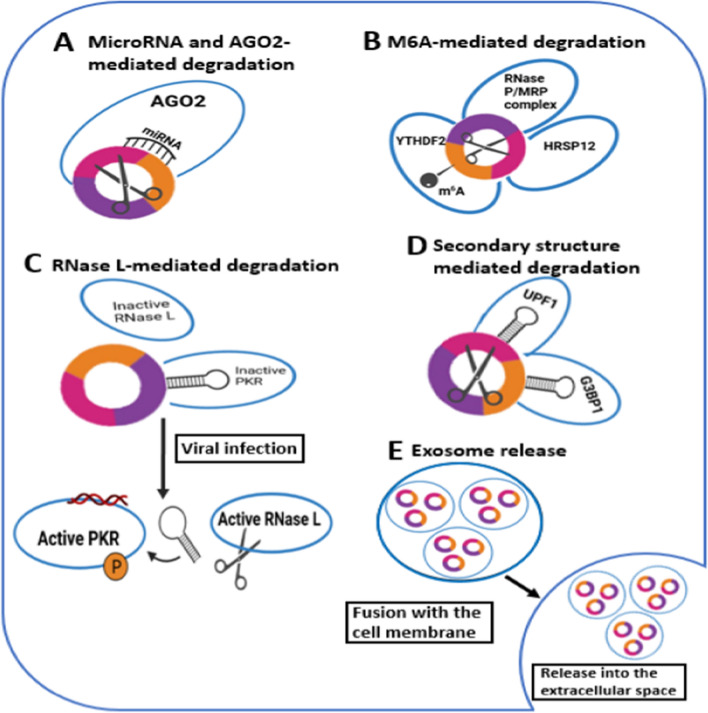
Disintegration of CircRNA and Extracellular Vesicle Discharge. A Certain circular RNAs (circRNAs) may be subject to degradation through targeted microRNA (miRNA) interaction, followed by argonaute-2 (AGO2)- facilitated RNA slicing. B CircRNAs carrying N6-methyladenosine (m6A) alterations may be detected and severed by the HRSP12-YTHDF2–RNase P/MRP complex. C RNA duplex structures (16–26 base pairs) of CircRNA may latch onto and hinder the functionality of double-stranded RNA-triggered protein kinase (PKR). In viral infection, RNase L is produced, breaking down the circRNAs, leading to PKR release and activation, crucial in the early stages of the innate immune response. D RNA binding proteins like Ras GTPase-activating protein-binding protein 1 (G3BP1) and regulator of nonsense transcripts 1 (UPF1) can bind via secondary structure mediation to unravel circRNAs, allowing UPF1's helicase activity to cleave them. E CircRNAs may be encapsulated in exosomes and expelled into the extracellular region following the fusion of multivesicular endosomes with the cellular membrane
Fig. 3
Fig. 3
CircRNAs have multiple functions, such as: A they sponge the molecular function of RNA-binding proteins through specific interactions; B they act as miRNA sponges in the cytoplasm by binding miRNAs and preventing them from repressing target messenger RNAs; C By serving as a scaffold for interactions between enzymes and substrates, they improve reaction kinetics; D They are translated using rolling circle amplification when they have internal ribosome entry sites or m6A RNA modification of the 5ʹ-untranslated regions; E In the nucleus, FECR1 enhance the activity of methylases and demethylases by attaching to the gene promoter-chromatin complex; F promote RNA polymerase II activity by cooperating with the small nuclear ribonucleoprotein U1 or promoting RNA Pol II elongation machinery, as observed with ci-ankrd52, sircEIF3J, and circPAIP2; G In the nucleus, cia-cGAS sponge cyclic GMP–AMP synthase (cGAS)
Fig. 4
Fig. 4
The role of CircRNAs in RCC through suppression of miRNAs and associated proteins. A Circ0054537, CircEGLN3, Circ001842 and CircNUP98, have an effect on apoptosis of renal cancer cells. B CircRNAs play a role in epithelial-mesenchymal transition (EMT) and metastasis of RCC including CircPSD3, CircUBAP2, CircRAPGEF5, and CircTLK1. C CircRNAs play a role in the cell cycle and growth of renal carcinoma cells; CircSCARB1, CircMTO1, CircEGLN3, CircCHT15 and CircMTO1 affect the proliferation of renal cancer cells. D CircRNAs affect the function of renal cancer cells. Circ0035483, Circ0000069, CircFOXP1 and Circ0054537 affect the metabolism of renal cancer cells

References

    1. Sung H, Ferlay J, Siegel RL, Laversanne M, Soerjomataram I, Jemal A, et al. Global cancer statistics 2020: GLOBOCAN estimates of incidence and mortality worldwide for 36 cancers in 185 countries. CA Cancer J Clin. 2021;71(3):209–249. doi: 10.3322/caac.21660. - DOI - PubMed
    1. Siegel RL, Miller KD, Fuchs HE, Jemal A. Cancer statistics, 2022. CA Cancer J Clin. 2022;72(1):7–33. doi: 10.3322/caac.21708. - DOI - PubMed
    1. Elbe N, Sauter G, Epstein J. Pathology and genetics of tumours of the urinary system and male genital organs: international agency for research on cancer (IARC) Oxford: Oxford University Press; 2004.
    1. Singh D. Current updates and future perspectives on the management of renal cell carcinoma. Life Sci. 2021;264:118632. doi: 10.1016/j.lfs.2020.118632. - DOI - PubMed
    1. Rini BI, Powles T, Atkins MB, Escudier B, McDermott DF, Suarez C, et al. Atezolizumab plus bevacizumab versus sunitinib in patients with previously untreated metastatic renal cell carcinoma (IMmotion151): a multicentre, open-label, phase 3, randomised controlled trial. Lancet. 2019;393(10189):2404–2415. doi: 10.1016/S0140-6736(19)30723-8. - DOI - PubMed

LinkOut - more resources