Review
. 2023 Nov 22;42(1):308.
doi: 10.1186/s13046-023-02901-z.

CRISPR/Cas9: a powerful tool in colorectal cancer research

Affiliations
Review

CRISPR/Cas9: a powerful tool in colorectal cancer research

Yang Hu et al. J Exp Clin Cancer Res. .

Abstract

Colorectal cancer (CRC) is one of the most common malignant cancers worldwide and seriously threatens human health. The clustered regulatory interspaced short palindromic repeat/CRISPR-associate nuclease 9 (CRISPR/Cas9) system is an adaptive immune system of bacteria or archaea. Since its introduction, research into various aspects of treatment approaches for CRC has been accelerated, including investigation of the oncogenes, tumor suppressor genes (TSGs), drug resistance genes, target genes, mouse model construction, and especially in genome-wide library screening. Furthermore, the CRISPR/Cas9 system can be utilized for gene therapy for CRC, specifically involving in the molecular targeted drug delivery or targeted knockout in vivo. In this review, we elucidate the mechanism of the CRISPR/Cas9 system and its comprehensive applications in CRC. Additionally, we discussed the issue of off-target effects associated with CRISPR/Cas9, which serves to restrict its practical application. Future research on CRC should in-depth and systematically utilize the CRISPR/Cas9 system thereby achieving clinical practice.

Keywords: CRC; CRISPR/Cas9; Gene editing tool; Off-target; Precise medicine; Target therapy.


Conflict of interest statement

Non-financial competing interests.

Figures
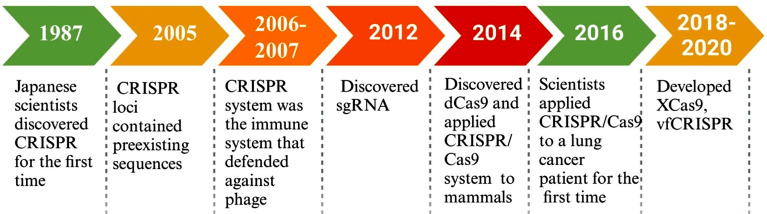
Fig. 1
Fig. 1
The brief development timeline of the CRISPR system. CRISPR array was firstly reported by Japanese scientists, and gradually developed into a versatile gene editing tool
Fig. 2
Fig. 2
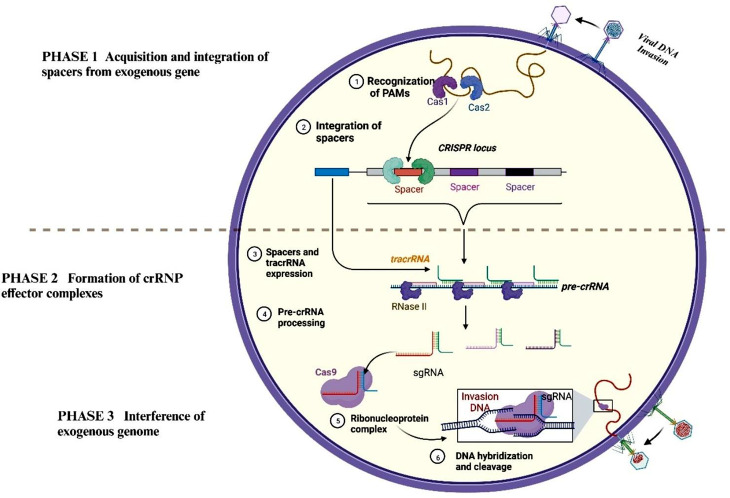
The mechanism of the CRISPR/Cas9: It is divided into three steps. First, when a viral DNA invades, CRISPR/Cas9 recognizes the PAMs of invaded DNA and cleaves them into suitable spacers, which are then selected and integrated into the CRISPR loci. Second, the CRISPR loci transcribe and form the effector complexes (crRNP) with the help of RNase III, Cas1/Cas2 complex, and other Cas proteins, tracRNA:crRNA structure in the type II system can be a single-guided RNA (sgRNA). Third, the Cas9 nuclease domain (including HNH and Ruvc) cleaves DNA through its nucleolytic activity, the HNH-like domain cleaves the DNA chain paired with crRNA, and the Ruvc-like nuclease domain cleaves another one
Fig. 3
Fig. 3
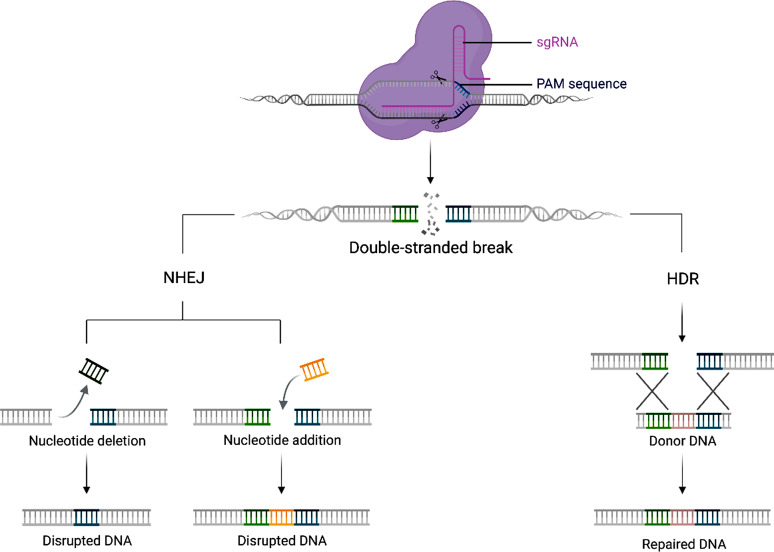
DNA damage repair system begins when viral DNA is cleaved. HDR harnesses the sister chromatid to repair the damage, achieving precise gene editing. On the contrary, the NHEJ pathway randomly repairs the DNA, causing disrupted DNA products. Both repair pathways can lead to gene mutations
Fig. 4
Fig. 4
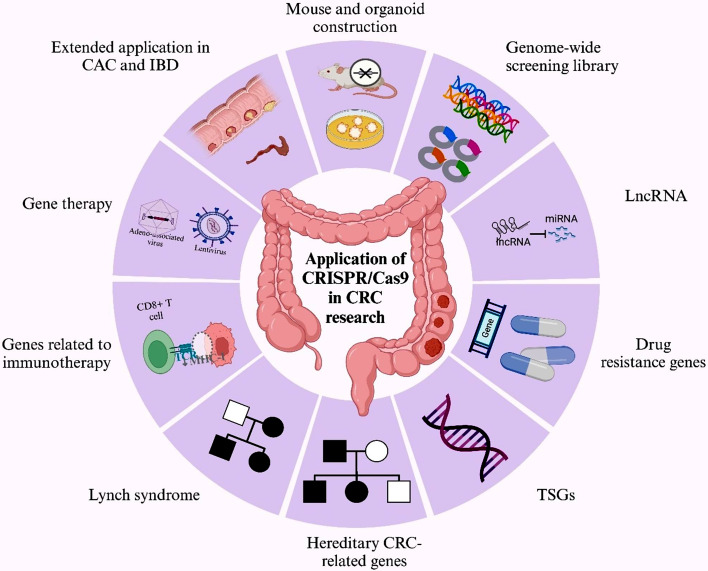
Current applications of the CRISPR/Cas9 system in CRC research, includes mouse and organoid construction, genome-wide screening library, deeper investigation of lncRNAs, drug resistance genes, TSGs, hereditary CRC-related genes, genes related to immunotherapy, gene therapy and identification of novel players involved in inflammation, LS, CAC and IBD
Fig. 5
Fig. 5
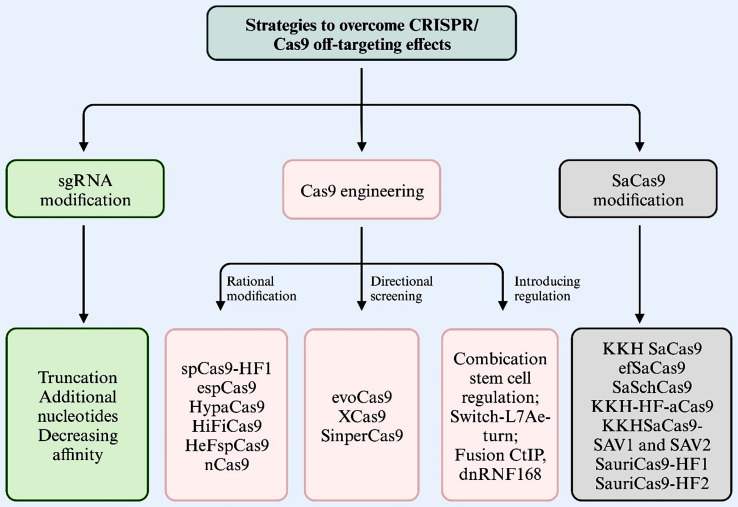
Summary of CRISPR/Cas9 off-target engineering, which divided into three sections: sgRNA modification, Cas9 engineering and SaCas9 modification

References

    1. Qiu H, Cao S, Xu R. Cancer incidence, mortality, and burden in China: a time-trend analysis and comparison with the United States and United Kingdom based on the global epidemiological data released in 2020. Cancer Commun (Lond) 2021;41(10):1037–48. doi: 10.1002/cac2.12197. - DOI - PMC - PubMed
    1. Sung H, Ferlay J, Siegel RL, Laversanne M, Soerjomataram I, Jemal A, et al. Global Cancer statistics 2020: GLOBOCAN estimates of incidence and Mortality Worldwide for 36 cancers in 185 countries. CA Cancer J Clin. 2021;71(3):209–49. doi: 10.3322/caac.21660. - DOI - PubMed
    1. Siegel RL, Miller KD, Jemal A. Cancer statistics, 2020. CA Cancer J Clin. 2020;70(1):7–30. doi: 10.3322/caac.21590. - DOI - PubMed
    1. Kim D, Xue JY, Lito P, Targeting KRAS(G12C): from inhibitory mechanism to modulation of Antitumor effects in patients. Cell. 2020;183(4):850–9. doi: 10.1016/j.cell.2020.09.044. - DOI - PMC - PubMed
    1. Dekker E, Tanis PJ, Vleugels JLA, Kasi PM, Wallace MB. Colorectal cancer. The Lancet. 2019;394(10207):1467–80. doi: 10.1016/S0140-6736(19)32319-0. - DOI - PubMed