Review
. 2024 Aug;40(8):1141-1159.
doi: 10.1007/s12264-023-01151-5. Epub 2023 Nov 23.

TRP Channels in Stroke

Affiliations
Review

TRP Channels in Stroke

Pengyu Zong et al. Neurosci Bull. 2024 Aug.

Abstract

Ischemic stroke is a devastating disease that affects millions of patients worldwide. Unfortunately, there are no effective medications for mitigating brain injury after ischemic stroke. TRP channels are evolutionally ancient biosensors that detect external stimuli as well as tissue or cellular injury. To date, many members of the TRP superfamily have been reported to contribute to ischemic brain injury, including the TRPC subfamily (1, 3, 4, 5, 6, 7), TRPV subfamily (1, 2, 3, 4) and TRPM subfamily (2, 4, 7). These TRP channels share structural similarities but have distinct channel functions and properties. Their activation during ischemic stroke can be beneficial, detrimental, or even both. In this review, we focus on discussing the interesting features of stroke-related TRP channels and summarizing the underlying cellular and molecular mechanisms responsible for their involvement in ischemic brain injury.

Keywords: Blood-brain barrier; Glial activation; Immune cell infiltration; Neuronal death; Stroke; TRP channels.


Figures

Fig. 1
Fig. 1
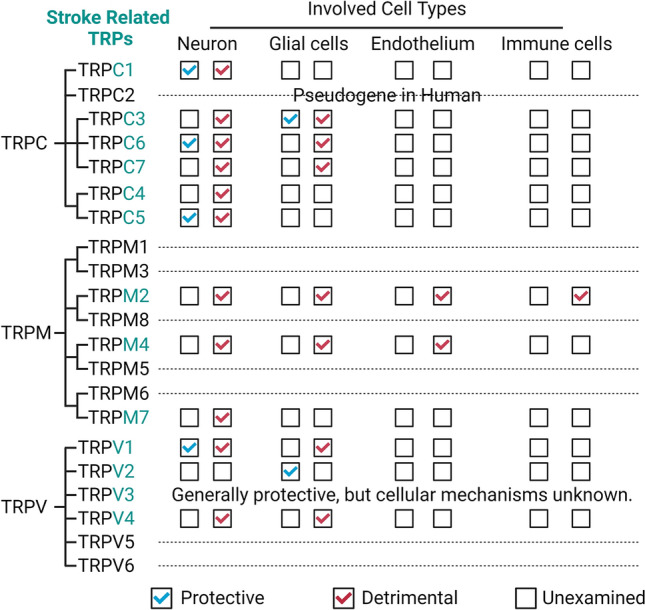
Stroke-related TRP channels. To date, several TRP channels in the TRPC, TRPM, and TRPV subfamilies have been shown to play a role in ischemic stroke. Evolutionarily, TRPM and TRPC channels share more similarities compared to TRPV channels. The roles of those TRP channels in each cell type during ischemic stroke are summarized here (Blue check indicates a protective role in that cell type during ischemic stroke, and red check indicates a detrimental role in ischemic stroke).
Fig. 2
Fig. 2
Stroke pathophysiology. Ischemia induces pathological changes in the neuro-micro-environment. Neuronal death is directly caused by energy imbalance and is accelerated by Ca2+ overload and activation of death signaling. The barrier function of endothelial cells is compromised by oxidative stress and Ca2+ overload during ischemia, which leads to endothelial cell degradation and plasma leakage. Tissue injury activates immune cells and glial cells, producing a profound inflammatory response. All those factors contribute to neuronal death and brain damage during ischemic stroke.
Fig. 3
Fig. 3
TRPMs in ischemic neuronal death. TRPM2 activation promotes neuronal death by physically and functionally associating with NMDAR, which is likely mediated by PKCγ. The resulting Ca2+ overload and mitochondrial disfunction induces neuronal death. TRPM4 physically associates with NMDAR but does not influence the channel function of NMDAR. Instead, TRPM4 enhances the activation of death signaling downstream to NMDAR. Also, TRPM4 forms a complex with SUR1 and AQP4, which may cause neuronal swelling. TRPM7 activation causes the overloading with neurotoxic Ca2+ and Zn2+, which appears to be independent of NMDAR-mediated excitotoxicity.

References

    1. Cosens DJ, Manning A. Abnormal electroretinogram from a Drosophila mutant. Nature 1969, 224: 285–287. 10.1038/224285a0 - DOI - PubMed
    1. Craig Montell. Molecular characterization of the Drosophila trp locus: A putative integral membrane protein required for phototransduction. Neuron 1989, 2: 1313–1323. 10.1016/0896-6273(89)90069-X - DOI - PubMed
    1. Hardie RC, Minke B. The trp gene is essential for a light-activated Ca2+ channel in Drosophila photoreceptors. Neuron 1992, 8(4): 643–651. 10.1016/0896-6273(92)90086-S - DOI - PubMed
    1. Zhu X, Chu PB, Peyton M, Birnbaumer L. Molecular cloning of a widely expressed human homologue for the Drosophila trp gene. FEBS Lett 1995, 373: 193–198. 10.1016/0014-5793(95)01038-G - DOI - PubMed
    1. Wes PD, Chevesich J, Jeromin A, Rosenberg C, Stetten G, Montell C. TRPC1, a human homolog of a Drosophila store-operated channel. Proc Natl Acad Sci U S A 1995, 92: 9652–9656. 10.1073/pnas.92.21.9652 - DOI - PMC - PubMed

Substances

LinkOut - more resources