


A conceptual design of circular adaptive façade module for reuse
- PMID: 37996556
- PMCID: PMC10667253
- DOI: 10.1038/s41598-023-47593-9
A conceptual design of circular adaptive façade module for reuse
Abstract
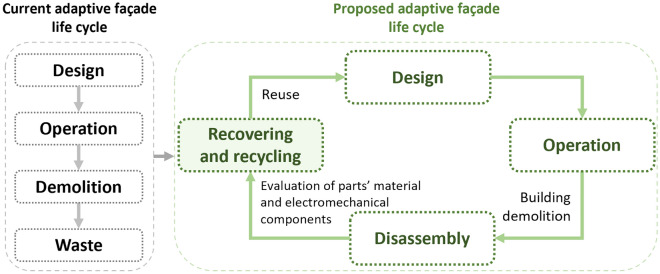
Climate change has an impact on the ecosystem, and subsequently, it affects the built environment. Building envelope has a vital role in controlling the integration between indoor and outdoor environmental quality. The responsivity of the façade has proven its efficiency in optimizing the global energy performance of buildings. Adaptive façades are multifunctional reconciling envelope dynamic systems that improve sustainability with the purpose of utilizing environmental parameters. This paper tackles the research gap in integrating façades circularity, adaptive envelopes, and design for disassembly. The research investigates the merge between biodegradability, circularity of adaptive façades components, and interior space micro-climate control for energy efficiency. This paper presents a proof of concept for a circular adaptive façade during two phases in its life cycle: operation and reuse phases. A scientific quantitative method took place which is based on a hybrid method; computational simulation, smart control, and an up-scale model. Adaptability is investigated through the façade life cycle from design to disassembly instead of demolition and consequent waste production, by exploiting sustainable materials. As a result, an empirical prototype is constructed. The prototype provides 3 levels of adaptability across the design, operation, and disassembly for reuse. Subsequently, this work proposes an up-scale physical model that can help in mitigating the climate change effects.
© 2023. The Author(s).
Conflict of interest statement
The authors declare no competing interests.
Figures




References
-
- United Nations, Cities—United Nations Sustainable Development. https://www.un.org/sustainabledevelopment/cities/ (Accessed 31 October 2023).
-
- ÜrgeVorsatz D, Metz B. Energy efficiency: How far does it get us in controlling climate change? Energy Effic. 2009;2:87–94. doi: 10.1007/s12053-009-9049-7. - DOI
-
- European Environment Agency, Climate-ADAPT 10 case studies - How Europe is adapting to climate change, 28, 10.2800/097442 (2018).
-
- European Commission, Directive (EU) 2018/844 of the European Parliament and of the Council of 30 May 2018 amending Directive 2010/31/EU on the energy performance of buildings and Directive 2012/27/EU on energy efficiency, https://rb.gy/lntlha (2018).
-
- Egypt Electricity Holding Company (EEHC), Egypt Electricity Holding Company Annual Report,” 1–90, http://www.moee.gov.eg/test_new (2021).
LinkOut - more resources
Full Text Sources
Research Materials
Miscellaneous
