


Effect of adding hip exercises to general rehabilitation treatment of knee osteoarthritis on patients' physical functions: a randomized clinical trial
- PMID: 37996958
- PMCID: PMC10668394
- DOI: 10.1186/s13102-023-00772-7
Effect of adding hip exercises to general rehabilitation treatment of knee osteoarthritis on patients' physical functions: a randomized clinical trial
Abstract
Background: Hip adductor and abductor strength were both reduced in KOA patients. But to date, most of the researches have only focused on quadriceps combined with hip abductor strengthening versus quadriceps strengthening.
Objective: The aim of the study is to evaluate the effect of adding hip abductor and adductor strengthening to quadriceps strengthening on lower limb strength, knee pain and physical function in patients with medial compartmental knee osteoarthritis.
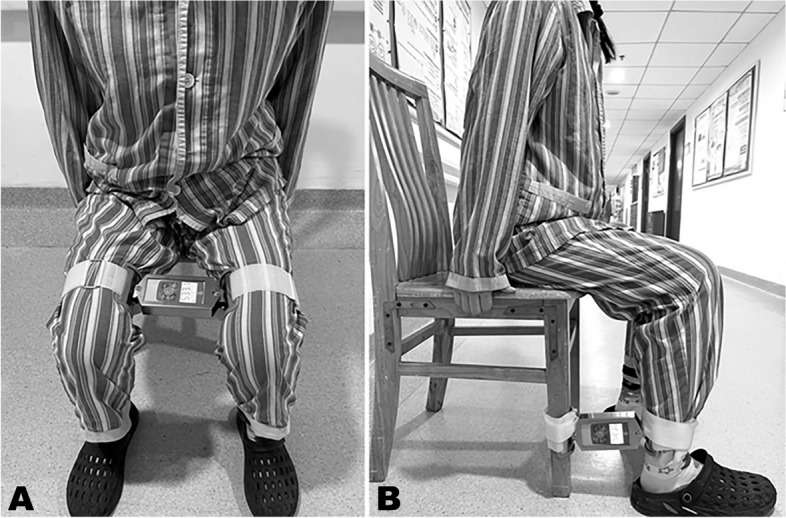
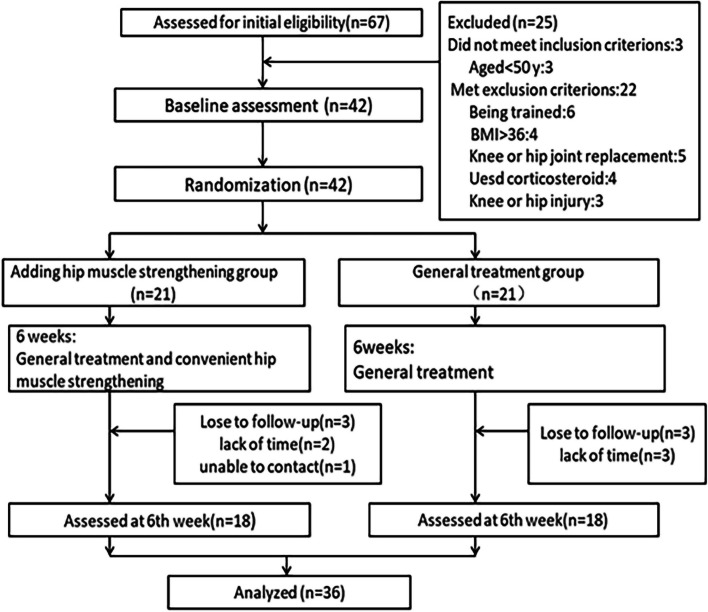
Methods: In this study, 42 participants, were randomly divided into two groups: the general treatment group (GT group) and the added-hip-exercise group (AH group). All participants were given a general rehabilitation treatment. The AH group performed hip abductor and adductor strengthening in addition to the general rehabilitation treatment. Knee and hip muscle strength, Five Times Sit-to-Stand Test (FTSST), the Timed Up and Go Test (TUGT), Numerical Rating Scale (NRS), and Western Ontario and McMaster Universities Osteoarthritis Index (WOMAC) scores were assessed at baseline and 6 weeks. A two-sided 2-sample unpaired t test was performed to compare the difference in mean change scores between AH and GT groups.
Results: Finally, 36 participants completed the study: both groups consist of 18 participants. In the per-protocol analysis, the AH group had a greater improvement in knee extension strength (mean changes, 7.84 versus 36.48; P < 0.001) and hip abduction strength (mean changes, 5.05 versus 26.62; P = 0.001) than the control group. Similarly, the AH group had a greater improvement in the FTSST time (mean changes, 0.40 s versus 3.57 s; P < 0.001) and the TUFT time (mean changes, 0.18 s versus 1.67 s; P = 0.002) than the GH group. No statistical difference was found in the change of WOMAC pain scores and NRS between the 2 groups.
Conclusions: Older adults with knee OA in the AH group had superior muscle strength, symptoms and daily activity performance at the 6th week than those in the GT group. And adding hip exercises could expedite improvement of pain at the 2th week, but not at the 6th week.
Trial registration: Clinical trial registration numbers and date of registration: ChiCTR-IOR-16009124, Registered 30 August 2016.
Keywords: Five times Sit-to-Stand Test; Hip exercises; Isometric muscle strengthening; Knee; Numerical Rating Scale; Osteoarthritis; Rehabilitation; The Western Ontario and McMaster Universities; Timed Up and Go Test.
© 2023. The Author(s).
Conflict of interest statement
The authors declare no competing interests.
Figures
References
Grants and funding
LinkOut - more resources
Full Text Sources
Medical
Miscellaneous
