


Relationship between Depression and Anxiety during Pregnancy, Delivery-Related Outcomes, and Healthcare Utilization in Michigan Medicaid, 2012-2021
- PMID: 37998413
- PMCID: PMC10671817
- DOI: 10.3390/healthcare11222921
Relationship between Depression and Anxiety during Pregnancy, Delivery-Related Outcomes, and Healthcare Utilization in Michigan Medicaid, 2012-2021
Abstract
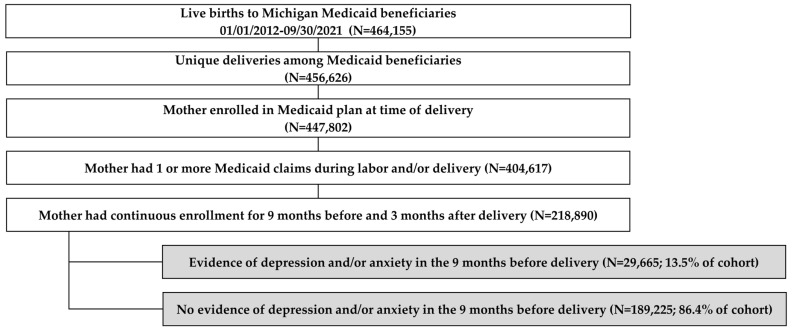
To evaluate associations between depression and/or anxiety disorders during pregnancy (DAP), delivery-related outcomes, and healthcare utilization among individuals with Michigan Medicaid-funded deliveries. We conducted a retrospective delivery-level analysis comparing delivery-related outcomes and healthcare utilization among individuals with and without DAP between January 2012 and September 2021. We used generalized estimating equation models assessing cesarean and preterm delivery; 30-day readmission after delivery; severe maternal morbidity within 42 days of delivery; and ambulatory, inpatient, emergency department or observation (ED), psychotherapy, or substance use disorders (SUD) visits during pregnancy. We adjusted models for age, race/ethnicity, urbanicity, federal poverty level, and obstetric comorbidities. Among 170,002 Michigan Medicaid enrollees with 218,890 deliveries, 29,665 (13.6%) had diagnoses of DAP. Compared to those without DAP, individuals with DAP were more often White, rural dwelling, had lower income, and had more comorbidities. In adjusted models, deliveries with DAP had higher odds of cesarean and preterm delivery OR = 1.02, 95% CI: [1.00, 1.05] and OR = 1.15, 95% CI: [1.11, 1.19] respectively), readmission within 30 days postpartum (OR = 1.14, 95% CI: [1.07, 1.22]), SMM within 42 days (OR = 1.27, 95% CI: [1.18, 1.38]), and utilization compared to those without DAP diagnoses (ambulatory: OR = 7.75, 95% CI: [6.75, 8.88], inpatient: OR = 1.13, 95% CI: [1.11, 1.15], ED: OR = 1.86, 95% CI: [1.80, 1.92], psychotherapy: OR = 172.8, 95% CI: [160.10, 186.58], and SUD: OR = 5.6, 95% CI: [5.37, 5.85]). Among delivering individuals in Michigan Medicaid, DAP had significant associations with adverse delivery-related outcomes and greater healthcare use. Early detection and intervention to address mental illness during pregnancy may help mitigate burdens of these complex yet treatable disorders.
Keywords: anxiety; depression; infant health; maternal health; maternal health services; medicaid; pregnancy.
Conflict of interest statement
The authors declare no conflict of interest. The funders had no role in the design of the study; in the collection, analyses, or interpretation of data; in the writing of the manuscript’ or in the decision to publish the results.
Figures
References
-
- Maternal Mental Health Leadership Alliance . Fact Sheet: Maternal Mental Health. Maternal Mental Health Leadership Alliance; Arlington, VA, USA: 2020.
-
- Wilson Center . What Explains the United States’ Dismal Maternal Mortality Rates? Wilson Center; Washington, DC, USA: 2015.
-
- World Bank . Maternal Mortality Ratio (Modeled Estimate per 100,000 Live Births)—High Income. World Bank; Washington, DC, USA: 2023.
-
- Centers for Disease Control and Prevention . How Does CDC Identify Severe Maternal Morbidity. Centers for Disease Control and Prevention; Atlanta, GA, USA: 2023.
Grants and funding
LinkOut - more resources
Full Text Sources
