


Effectiveness and Safety of Progressive Loading-Motion Style Acupuncture Treatment for Acute Low Back Pain after Traffic Accidents: A Randomized Controlled Trial
- PMID: 37998431
- PMCID: PMC10671479
- DOI: 10.3390/healthcare11222939
Effectiveness and Safety of Progressive Loading-Motion Style Acupuncture Treatment for Acute Low Back Pain after Traffic Accidents: A Randomized Controlled Trial
Abstract
Background: Traffic injuries include acute low back pain (LBP) needing active treatment to prevent chronicity. This two-armed, parallel, assessor-blinded, randomized controlled trial evaluated the effectiveness and safety of progressive loading-motion style acupuncture treatment (PL-MSAT) for acute LBP following traffic accidents.
Methods: Based on an effect size of 1.03, 104 participants were recruited and divided in a 1:1 ratio into PL-MAST and control groups using block randomization. Both groups underwent integrative Korean medicine treatment (IKMT) daily; only the PL-MSAT group underwent three PL-MSAT sessions. The outcomes were assessed before and after the treatment sessions and at 1 and 3 months post-discharge. The primary outcome was the difference in the numeric rating scale (NRS) for LBP. The secondary outcomes included a visual analog scale for LBP, leg pain status, the Oswestry disability index, lumbar active range of motion (ROM), quality of life, Patient Global Impression of Change, and Post-Traumatic Stress Disorder Checklist adverse events.
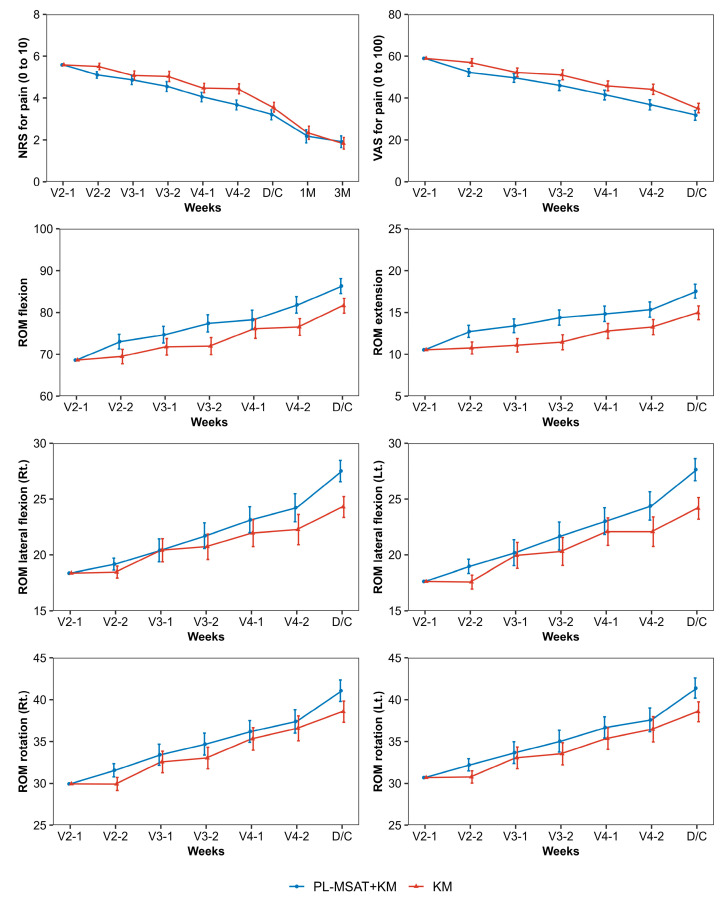
Results: In the modified intention-to-treat analysis, 50 and 51 participants were included in the PL-MSAT and control groups. On Day 4, the mean LBP NRS score was 3.67 (3.44-3.90) in the PL-MSAT group, indicating a significantly lower NRS 0.77 (0.44-1.11) compared to 4.44 (4.20-4.68) for the control group (p < 0.001). The PL-MSAT group exhibited greater ROM flexion (-5.31; -8.15 to -2.48) and extension (-2.09; -3.39 to -0.80). No significant differences were found for the secondary outcomes and follow-ups.
Conclusions: Compared with IKMT alone, PL-MSAT plus IKMT showed significantly better outcomes for reducing pain and increasing the ROM in acute LBP.
Keywords: Korean traditional medicine; acupuncture; exercise therapy; low back pain; progressive loading–motion style acupuncture treatment; randomized controlled trial.
Conflict of interest statement
The authors declare no conflict of interest.
Figures



References
-
- Global Status Report on Road Safety 2018. World Health Organization; Geneva, Switzerland: 2018.
-
- Lee J.-M. Statistical Analysis of Traffic Accidents in 2021. KoROAD; Wonju, Republic of Korea: 2022.
-
- Automobile Insurance Treatment Cost Statistics 2021. Health Insurance Review & Assessment Service; Wonju, Republic of Korea: 2022.
-
- Bortsov A.V., Platts-Mills T.F., Peak D.A., Jones J.S., Swor R.A., Domeier R.M., Lee D.C., Rathlev N.K., Hendry P.L., Fillingim R.B., et al. Effect of pain location and duration on life function in the year after motor vehicle collision. Pain. 2014;155:1836–1845. doi: 10.1016/j.pain.2014.06.013. - DOI - PMC - PubMed
-
- Feinberg R.K., Hu J., Weaver M.A., Fillingim R.B., Swor R.A., Peak D.A., Jones J.S., Rathlev N.K., Lee D.C., Domeier R.M., et al. Stress-related psychological symptoms contribute to axial pain persistence after motor vehicle collision: Path analysis results from a prospective longitudinal study. Pain. 2017;158:682–690. doi: 10.1097/j.pain.0000000000000818. - DOI - PMC - PubMed
LinkOut - more resources
Full Text Sources
Miscellaneous
