


July 14th 2016 Nice Terrorist Attack Court Trial: A Protocol on Sleep Quality and Somatic Symptoms as Markers of Risk for Traumatic Reactivation in Adolescents Exposed to This Attack
- PMID: 37998445
- PMCID: PMC10671086
- DOI: 10.3390/healthcare11222953
July 14th 2016 Nice Terrorist Attack Court Trial: A Protocol on Sleep Quality and Somatic Symptoms as Markers of Risk for Traumatic Reactivation in Adolescents Exposed to This Attack
Abstract
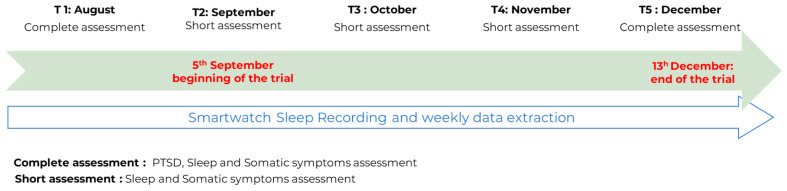
The court trial of the 14th of July 2016 terrorist attack in Nice (France) opened in September 2022 and ended in December 2022. Engaging in court proceedings, whether as a victim or a witness, can lead to a significant risk of traumatic reactivation (i.e., the re-emergence of post-traumatic stress symptoms). The present protocol aimed to improve knowledge of the pathophysiology of traumatic reactivation due to the media coverage of the trial by assessing sleep disturbances and somatic symptoms that could reappear if there is a traumatic reactivation. Method and Analysis: This is a monocentric longitudinal study, with recruitment solely planned at the Nice Pediatric Psychotrauma Center (NPPC). We intended to include 100 adolescents aged 12 to 17 years who were directly or indirectly exposed to the attack and included in the "14-7" program). Assessments began one month before the trial, in August 2022, and were scheduled once a month until the end of the trial. A smartwatch recorded sleep activity. Somatic and PTSD symptoms and sleep were assessed through validated questionnaires. The main analyses comprised the variance and regression analyses of predictors of clinical evolution over time. Ethics and Dissemination: The National Ethics Committee "NORD OUEST III" approved the "14-7" program protocol (number 2017-A02212-51). The specific amendment for this research was approved in April 2022 by the same national ethical committee. Inclusions started in August 2022.
Keywords: child and adolescent psychiatry; circadian rhythm disorders; mass trauma; post-traumatic stress disorders; sleep disorders; somatic symptoms; traumatic reactivation.
Conflict of interest statement
The authors declare no conflict of interest.
Figures
References
-
- Angel C.M., Sherman L.W., Strang H., Ariel B., Bennett S., Inkpen N., Keane A., Richmond T.S. Short-term effects of restorative justice conferences on post-traumatic stress symptoms among robbery and burglary victims: A randomized controlled trial. J. Exp. Criminol. 2014;10:291–307. doi: 10.1007/s11292-014-9200-0. - DOI
-
- Lloyd A., Borrill J. Examining the effectiveness of restorative justice in reducing victims’ post-traumatic stress. Psychol. Inj. Law. 2020;13:77–89. doi: 10.1007/s12207-019-09363-9. - DOI
-
- Christenson R.M., Walker J.I., Ross D.R., Maltbie A.A. Reactivation of traumatic conflicts. Am. J. Psychiatry. 1981;138:984–985. - PubMed
LinkOut - more resources
Full Text Sources
Miscellaneous
