Review
. 2023 Nov 19;10(11):471.
doi: 10.3390/jcdd10110471.

The Atrioventricular Conduction Axis Revisited for the 21st Century

Affiliations
Review

The Atrioventricular Conduction Axis Revisited for the 21st Century

Damian Sanchez-Quintana et al. J Cardiovasc Dev Dis. .

Abstract

Although first described in the final decade of the 19th century, the axis responsible for atrioventricular conduction has long been the source of multiple controversies. Some of these continue to reverberate. When first described by His, for example, many doubted the existence of the bundle we now name in his honour, while Kent suggested that multiple pathways crossed the atrioventricular junctions in the normal heart. It was Tawara who clarified the situation, although many of his key definitions have not universally been accepted. In key studies in the third decade of the 20th century, Mahaim then suggested the presence of ubiquitous connections that provided "paraspecific" pathways for atrioventricular conduction. In this review, we show the validity of these original investigations, based on our own experience with a large number of datasets from human hearts prepared by serial histological sectioning. Using our own reconstructions, we show how the atrioventricular conduction axis can be placed back within the heart. We emphasise that newly emerging techniques will be key in providing the resolution to map cellular detail to the gross evidence provided by the serial sections.

Keywords: Mahaim conduction; atrioventricular node; bundle branches; bundle of His.


Conflict of interest statement

The authors declare no conflict of interest.

Figures

Figure 1
Figure 1
The illustrations have been taken from the initial publication by Wilhelm His Junior [2], and re-labelled. Panel (A) shows the short axis of the non-branching atrioventricular bundle, with panel (B) showing the course of the bundle relative to the aortic root as seen from the right side.
Figure 2
Figure 2
The image is taken from one of the plates prepared by Tawara to show the overall arrangement of the atrioventricular conduction axis [6] and reorientated to approximate to an attitudinally appropriate arrangement, with the atrial chambers seen to the left hand, the ventricular chambers to the right hand, and the left-sided chambers to the top of the panel. The purple shading shows the insulating tissues of the atrioventricular junctions, with yellow showing working myocardium and orange the conduction axis.
Figure 3
Figure 3
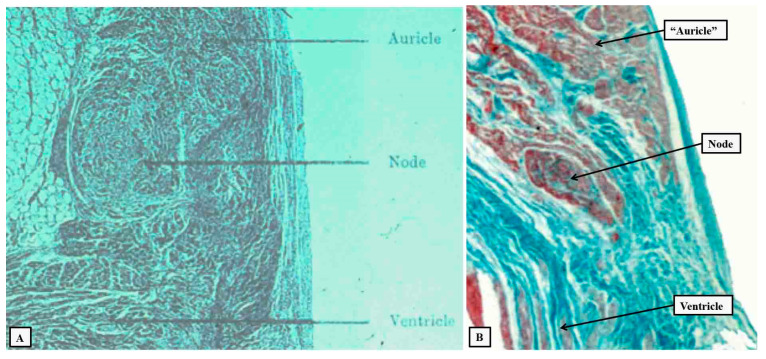
Panel (A) is a reproduction of the image presented to the Physiological Society by Kent in 1913 [15], allegedly to demonstrate the presence of a lateral right-sided atrioventricular pathway. Kent labelled the structure as a “node”. As is shown in panel (B), such entities do exist, but in the normal heart they are sequestered within the vestibule of the tricuspid valve.
Figure 4
Figure 4
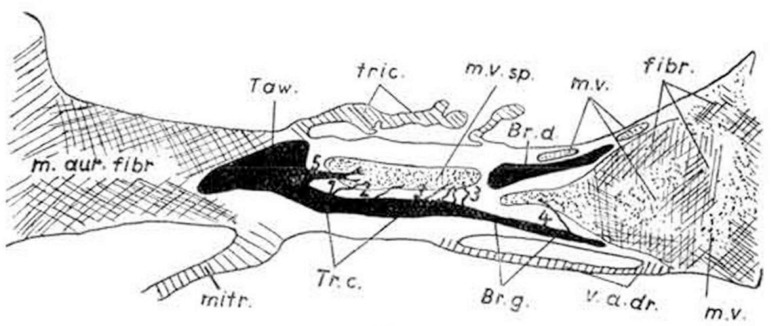
The drawing is taken from the book published by Mahaim in 1931 [21]. It shows the “superior septal pathways”, numbered 1 through 5, which Mahaim suggested provided a “paraspecific” system for atrioventricular conduction [24].
Figure 5
Figure 5
The section is taken from a fetal heart at 30 weeks’ gestation, with the section cut in a sagittal fashion across the crest of the muscular ventricular septum. It shows multiple fasciculo-ventricular connections extending between the branching atrioventricular bundle and the septal working myocardium. These pathways are to be found in the majority of hearts subsequent to birth [25].
Figure 6
Figure 6
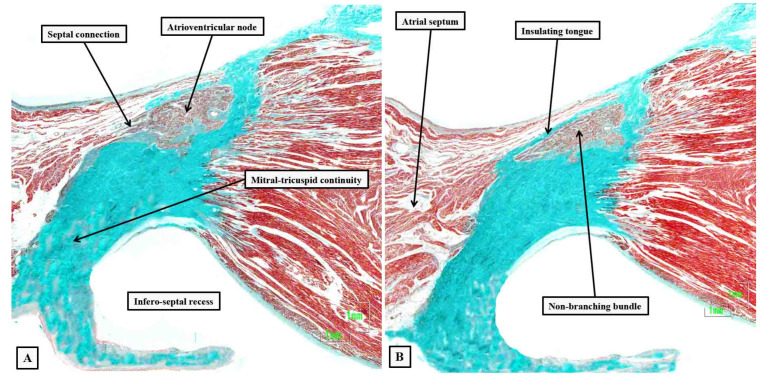
Serial histological sections, cut through the apex of the triangle of Koch normal to the hinge of the septal leaflet of the tricuspid valve of an adult human heart, which is shown at the top of the panels, showing the criterion proposed by Tawara to distinguish between the compact atrioventricular node (panel A) and the non-branching atrioventricular bundle (panel B). The distinguishing feature is the tongue of fibrous tissue that, in panel (B), separates the axis from the working atrial myocardium.
Figure 7
Figure 7
Images of serial histological sections from an adult human heart show how the components of the atrial component of the conduction axis come together in the pyramid of Koch to form the compact node, which then becomes insulated as it penetrates the fibrous tissues of the atrioventricular junctions. Panel (A) shows the inferior extensions in the walls of the inferior pyramidal space. Panels (B,C) show how the extensions merge to form the body of the compact atrioventricular node. The node then receives additional septal connections, as shown in panels (D,E), with the last connection, as seen in panel (E), representing the fast pathway into the node. Panel (F) then shows how the axis becomes insulated as it forms the non-branching atrioventricular bundle. It is the inferior nodal extensions, as seen in panels (A,B), which constitute the slow pathway.
Figure 8
Figure 8
The images show short axis sections through an adult human heart cut in the plane of the atrioventricular junctions, with panel (A) superior to panel (B). The insets are magnified to show the location of the atrioventricular conduction axis. Panel (A) shows the atrioventricular node separated from the non-branching bundle by the insulating tissues of the atrioventricular junctions, with Panel (B) showing the axis branching on the crest of the muscular ventricular septum.
Figure 9
Figure 9
Serial sections showing the entirety of the conduction axis in a 6-month-old infant, with the plane of section comparable to that shown in Figure 7. Panels (AC) show the formation of the atrioventricular node, with panel (D) showing the last septal connection. Panels (E,F) show the components of the ventricular part of the axis, with panel (H) showing the close approximation of the superior fascicle of the left bundle to the nadir of the right coronary aortic sinus. A fasciculo-ventricular (F-V) pathway from the right bundle branch is seen in panel (G). The black bar shows 1 mm. The star shows the infero-septal recess.
Figure 10
Figure 10
Gross dissections made to show the approximate locations of the components of the conduction axis seen relative to the right-sided (panel A) and left-sided (panel B) chambers. The ramifications of the bundle branches have been enhanced by Indian ink on the septal surfaces.
Figure 11
Figure 11
The panels show the variability in the adjacency of the superior fascicle of the left bundle to the nadir of the hinge of the right coronary aortic leaflet. In both hearts, the membranous septum has been illuminated from the right side, with the images showing the subaortic outflow tract as seen from the front. The double-headed black arrow shows the virtual basal plane of the aortic root.
Figure 12
Figure 12
Dissections made in an infant heart to show the inter-relations between the inferior pyramidal space and the infero-septal recess of the left ventricular outflow tract. Panel (A) shows the right atrial wall and the adjacent septal myocardium of the right ventricle, which was removed by a section parallel to the endocardial surfaces to leave the components shown in panel (B). The cut passes across the ventricular septum into the left ventricular outflow tract. Panel (C) then shows the left-sided surface of the parts removed to produce the image shown in panel (A). Taken together, the cuts show how the apex of the inferior pyramidal space is directly adjacent to the inferior extent of the infero-septal recess.
Figure 13
Figure 13
Panel (A) shows a view of the opened left ventricular outflow tract of an infant heart viewed from the front. The parts have been marked to show how the so-called central fibrous body is made up of the membranous septum, the area of mitral-to-tricuspid continuity that forms the roof of the infero-septal recess, and the rightward end of the area of fibrous continuity between the leaflets of the aortic and mitral valves, with that component defined as the right fibrous trigone. The leftward end is the left fibrous trigone. The central fibrous body is also directly continuous with the interleaflet triangle between the right and non-coronary sinuses of the aortic root. Panel (B) is a “four chamber” section of an adult heart showing how the roof of the infero-septal recess supports the antero-inferior buttress of the atrial septum.
Figure 14
Figure 14
Serial histological sections taken through the infero-septal recess of an adult heart, orientated to show the long axis of the aortic root, with the cavities of the right-sided chambers seen to the left hand. Panel (A) shows how the area of mitral-to-tricuspid continuity forms the roof of the recess, with the membranous septum forming its rightward wall, the non-branching bundle occupying the septal component in this section. Panel (B) is an anterior and cephalad section cutting through the base of the non-coronary aortic sinus. It shows how the rightward end of the area of fibrous continuity between the aortic and mitral valvar leaflets forms the right fibrous trigone. The double-headed arrow shows the atrioventricular component of the membranous septum forming the rightward wall of the recess, with the non-branching bundle now occupying the interventricular component of the membranous septum.

References

    1. Gaskell W.H. On the innervation of the heart, with special reference to the heart of the tortoise. J. Physiol. 1883;4:43–127. doi: 10.1113/jphysiol.1883.sp000121. - DOI - PMC - PubMed
    1. His W., Jr. Die Thatigkeit des embryonalen Herzens und deren Bedeutung fllr die Lehre von der Herzbewegung beim Erwachsenen. Arb. Med. Klin. Leipz. 1893;1:14–49.
    1. Kent A.F.S. Researches on the structure and function of the mammalian heart. J. Physiol. 1893;14:233–254. doi: 10.1113/jphysiol.1893.sp000451. - DOI - PMC - PubMed
    1. Keith A. The auriculo-ventricular bundle of His. Lancet. 1906;167:623–625. doi: 10.1016/S0140-6736(01)80227-0. - DOI
    1. Keith A., Flack M.W. The auriculo-ventricular bundle of the human heart. Lancet. 1906;168:359–364. doi: 10.1016/S0140-6736(01)32375-9. - DOI - PMC - PubMed

LinkOut - more resources