Review
. 2023 Nov 4;13(11):1131.
doi: 10.3390/metabo13111131.

Acid and Alkali Taste Sensation

Affiliations
Review

Acid and Alkali Taste Sensation

Prakash Pandey et al. Metabolites. .

Abstract

Living organisms rely on pH levels for a multitude of crucial biological processes, such as the digestion of food and the facilitation of enzymatic reactions. Among these organisms, animals, including insects, possess specialized taste organs that enable them to discern between acidic and alkaline substances present in their food sources. This ability is vital, as the pH of these compounds directly influences both the nutritional value and the overall health impact of the ingested substances. In response to the various chemical properties of naturally occurring compounds, insects have evolved peripheral taste organs. These sensory structures play a pivotal role in identifying and distinguishing between nourishing and potentially harmful foods. In this concise review, we aim to provide an in-depth examination of the molecular mechanisms governing pH-dependent taste responses, encompassing both acidic and alkaline stimuli, within the peripheral taste organs of the fruit fly, Drosophila melanogaster, drawing insights from a comprehensive analysis of existing research articles.

Keywords: Alkaliphile; OTOP1; acid; alkali; taste.


Conflict of interest statement

The authors declare no conflict of interest.

Figures
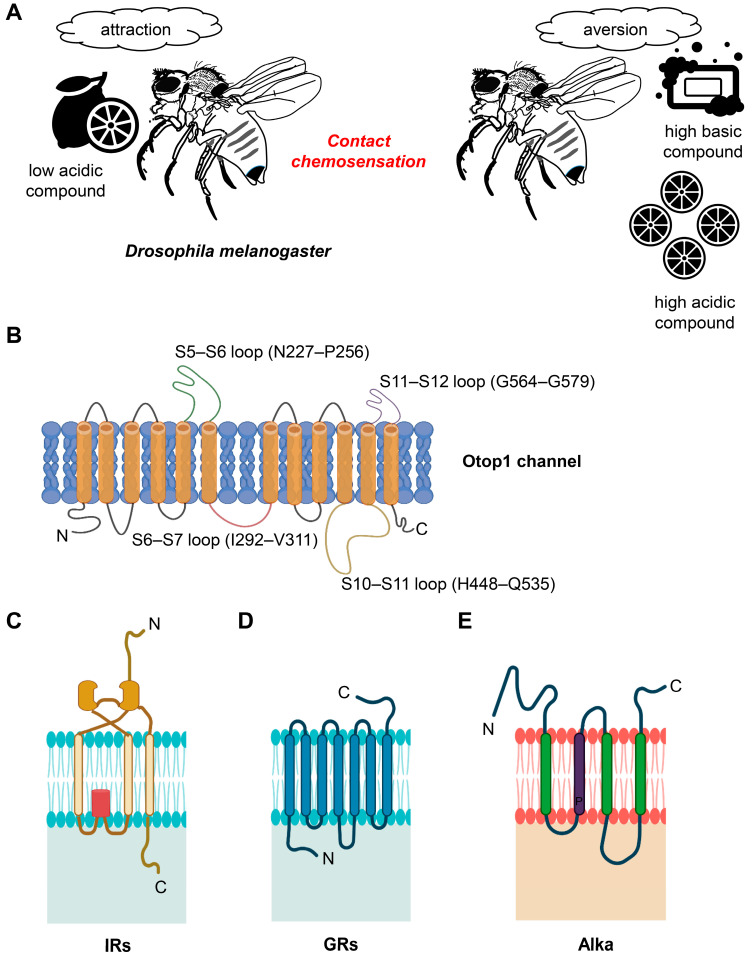
Figure 1
Figure 1
Behavior of acid and basic compounds and structure of OTOP1, GRs, IRs, and Alka. (A) Representation of D. melanogaster’s sensitivity to pH Levels. D. melanogaster is attracted to compounds with low acidity (low pH) while displaying aversion to highly acidic and highly basic compounds (high pH). (B) Human Otop1 channel membrane configuration. The human Otop1 channel is thought to have a membrane-spanning structure, with the N domain encompassing transmembrane segments S1 through S6, the C domain including S7 to S12, interconnected loops between these segments, and intracellular termini. (C) Architectural features of GRs. GRs possess a unique architectural composition characterized by seven transmembrane domains (TMDs), with their C-terminal regions located externally, distinguishing them from typical G-protein coupled receptors. (D) Topology of IRs. IRs exhibit a three-TMD structure, including a pore region, which shares structural similarities with mammalian glutamate receptors. (E) Proposed structural arrangement of alka. Alka is anticipated to have a structural configuration that includes a persistent proline residue (P) within the TM2 segment.

References

    1. Bausenwein Á., Dittrich A., Fischbach K.-F. The optic lobe of Drosophila melanogaster: II. Sorting of retinotopic pathways in the medulla. Cell Tissue Res. 1992;267:17–28. doi: 10.1007/BF00318687. - DOI - PubMed
    1. Tuthill J.C., Wilson R.I. Mechanosensation and adaptive motor control in insects. Curr. Biol. 2016;26:R1022–R1038. doi: 10.1016/j.cub.2016.06.070. - DOI - PMC - PubMed
    1. Nadrowski B., Effertz T., Senthilan P.R., Göpfert M.C. Antennal hearing in insects–new findings, new questions. Hear. Res. 2011;273:7–13. doi: 10.1016/j.heares.2010.03.092. - DOI - PubMed
    1. Boekhoff-Falk G., Eberl D.F. The Drosophila auditory system. Wiley Interdiscip. Rev. Dev. Biol. 2014;3:179–191. doi: 10.1002/wdev.128. - DOI - PMC - PubMed
    1. Keil T.A. Functional morphology of insect mechanoreceptors. MRT. 1997;39:506–531. doi: 10.1002/(SICI)1097-0029(19971215)39:6<506::AID-JEMT5>3.0.CO;2-B. - DOI - PubMed

LinkOut - more resources
