


Protection Conferred by COVID-19 Vaccination, Prior SARS-CoV-2 Infection, or Hybrid Immunity Against Omicron-Associated Severe Outcomes Among Community-Dwelling Adults
- PMID: 38001037
- PMCID: PMC11093681
- DOI: 10.1093/cid/ciad716
Protection Conferred by COVID-19 Vaccination, Prior SARS-CoV-2 Infection, or Hybrid Immunity Against Omicron-Associated Severe Outcomes Among Community-Dwelling Adults
Abstract
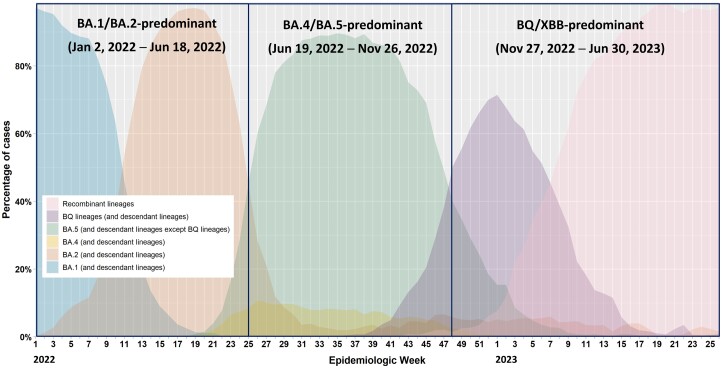
Introduction: We assessed protection from coronavirus disease 2019 (COVID-19) vaccines and/or prior severe acute respiratory syndrome coronavirus 2 (SARS-CoV-2) infection against Omicron-associated severe outcomes during successive sublineage-predominant periods.
Methods: We used a test-negative design to estimate protection by vaccines and/or prior infection against hospitalization/death among community-dwelling, polymerase chain reaction (PCR)-tested adults aged ≥50 years in Ontario, Canada, between 2 January 2022 and 30 June 2023. Multivariable logistic regression was used to estimate the relative change in the odds of hospitalization/death with each vaccine dose (2-5) and/or prior PCR-confirmed SARS-CoV-2 infection (compared with unvaccinated, uninfected subjects) up to 15 months since the last vaccination or infection.
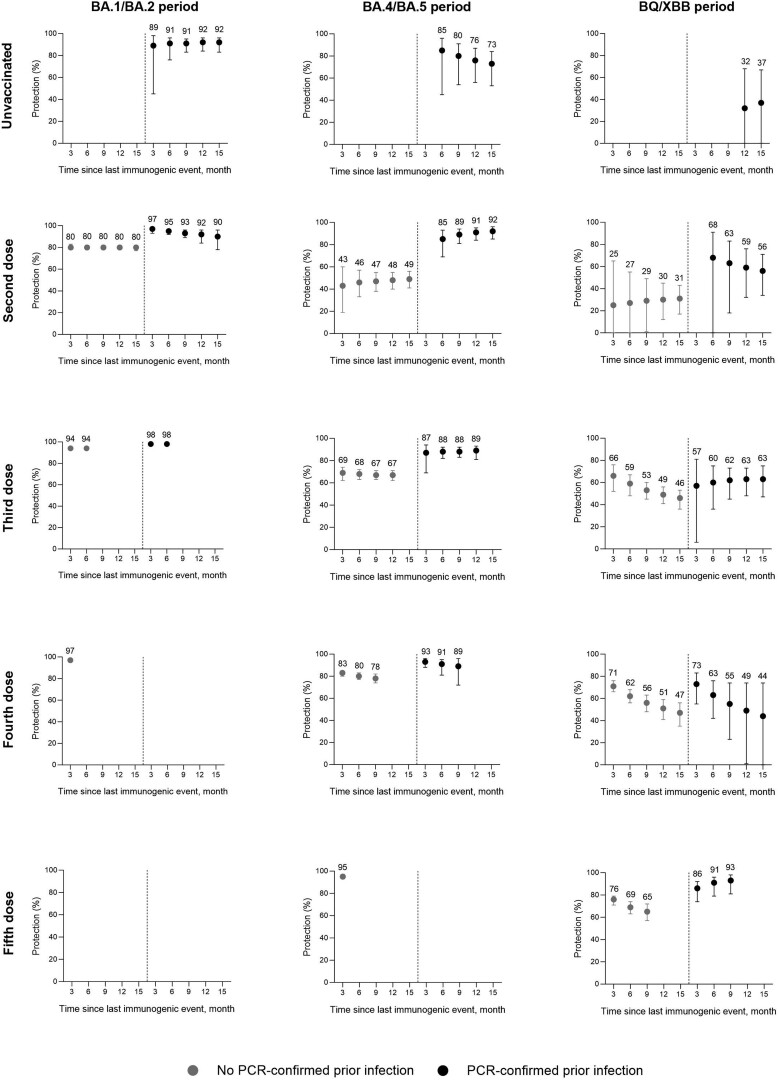
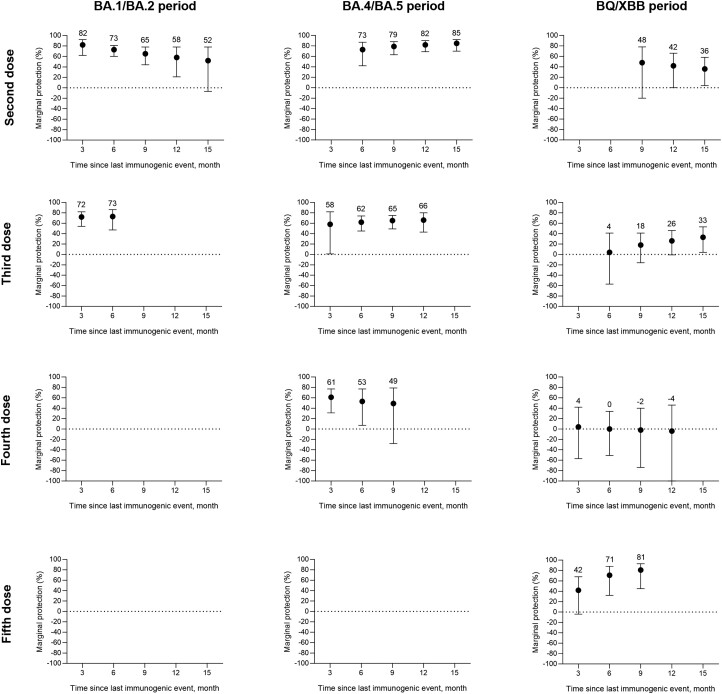
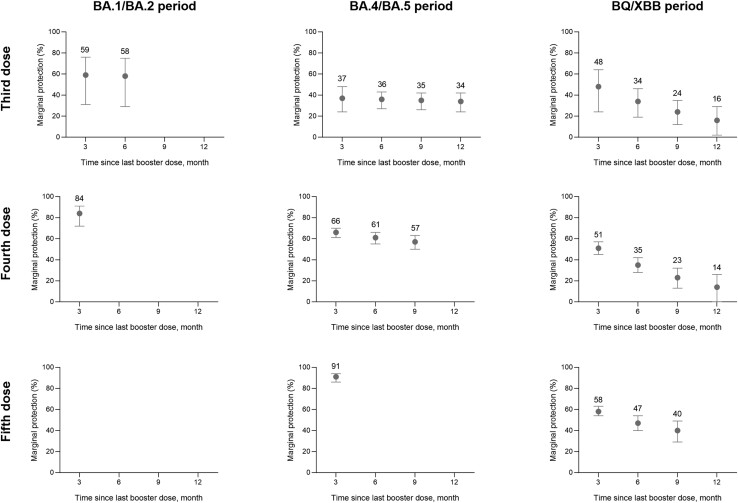
Results: We included 18 526 cases with Omicron-associated severe outcomes and 90 778 test-negative controls. Vaccine protection was high during BA.1/BA.2 predominance but was generally <50% during periods of BA.4/BA.5 and BQ/XBB predominance without boosters. A third/fourth dose transiently increased protection during BA.4/BA.5 predominance (third-dose, 6-month: 68%, 95% confidence interval [CI] 63%-72%; fourth-dose, 6-month: 80%, 95% CI 77%-83%) but was lower and waned quickly during BQ/XBB predominance (third-dose, 6-month: 59%, 95% CI 48%-67%; 12-month: 49%, 95% CI 41%-56%; fourth-dose, 6-month: 62%, 95% CI 56%-68%, 12-months: 51%, 95% CI 41%-56%). Hybrid immunity conferred nearly 90% protection throughout BA.1/BA.2 and BA.4/BA.5 predominance but was reduced during BQ/XBB predominance (third-dose, 6-month: 60%, 95% CI 36%-75%; fourth-dose, 6-month: 63%, 95% CI 42%-76%). Protection was restored with a fifth dose (bivalent; 6-month: 91%, 95% CI 79%-96%). Prior infection alone did not confer lasting protection.
Conclusions: Protection from COVID-19 vaccines and/or prior SARS-CoV-2 infections against severe outcomes is reduced when immune-evasive variants/subvariants emerge and may also wane over time. Our findings support a variant-adapted booster vaccination strategy with periodic review.
Keywords: COVID-19 vaccination; Omicron; adults; hybrid immunity; severe outcomes.
© The Author(s) 2023. Published by Oxford University Press on behalf of Infectious Diseases Society of America.
Conflict of interest statement
Potential conflicts of interest. N. L. has previously received honoraria for consultancy work, speaking in educational programs, and/or travel support from: Shionogi Inc., Gilead Sciences Canada Inc., Janssen Inc., GlaxoSmithKline plc., Sanofi Pasteur Ltd., F. Hoffmann-La Roche Ltd., Genentech Inc., CIDARA Therapeutics Inc., Clarion Healthcare, bioStrategies, Technospert, Aligos; all unrelated to this work. K. W. is a shareholder and board member and Co-founder and Chief Scientific Officer of CANImmunize Inc. and has served on independent scientific advisory boards for Medicago (Independent Data Monitoring Committee) and Moderna (Global Advisory Core Consultancy Group). J. G. reports a position as a paid consultant scientific editor for GIDEON Informatics, Inc., which is unrelated to the current work. S. E. W. reports being a co-investigator on a grant related to public health surveillance of invasive pneumococcal disease (no involvement in administration of funds) for the Canadian Immunization Research Network and a co-investigator on a grant on immunization data in Canada (no involvement in administration of funds) for CIRN; travel support to attend the Future of Vaccinology conference in October 2023 as an invited speaker from McMaster University (Hamilton, ON) and a role as an unpaid volunteer member for Canada's National Advisory Committee on Immunization (NACI). All other authors report no potential conflicts. All authors have submitted the ICMJE Form for Disclosure of Potential Conflicts of Interest. Conflicts that the editors consider relevant to the content of the manuscript have been disclosed.
Figures
References
-
- UK Health and Security Agency . COVID-19 vaccine monthly surveillance reports (week 39 2021 to week 14 2023). Available at: https://www.gov.uk/government/publications/covid-19-vaccine-weekly-surve.... Accessed 15 August 2023.
Publication types
MeSH terms
LinkOut - more resources
Full Text Sources
Medical
Miscellaneous
