. 2023 Nov 12;12(11):1994.
doi: 10.3390/antiox12111994.

Cocoa Polyphenols Prevent Age-Related Hearing Loss and Frailty in an In Vivo Model

Affiliations

Cocoa Polyphenols Prevent Age-Related Hearing Loss and Frailty in an In Vivo Model

Rosalía Fátima Heredia et al. Antioxidants (Basel). .

Abstract

Age-related hearing loss (ARHL) impairs the quality of life in elderly persons. ARHL is associated with comorbidities, such as depression, falls, or frailty. Frailty syndrome is related to poor health outcomes in old age. ARHL is a potentially modifiable risk factor for frailty. Oxidative stress has been proposed as a key factor underlying the onset and/or development of ARHL and frailty. Cocoa has high levels of polyphenols and provides many health benefits due to its antioxidant properties. Male and female C57Bl/6J mice were randomly assigned to two study groups: animals receiving a cocoa-supplemented diet and the other receiving a standard diet. Then, at the ages of 6, 14, and 22 months, hearing and frailty were measured in all mice. Auditory steady-state responses (ASSR) threshold shifts were measured to different frequencies. The frailty score was based on the "Valencia Score" adapted to the experimental animals. The total antioxidant capacity and total polyphenols in urine samples were also measured. Significant improvements in hearing ability are observed in the cocoa groups at 6, 14, and 22 months compared to the no cocoa group. The cocoa diet significantly retards the development of frailty in mice. Cocoa increases the concentration of polyphenols excreted in the urine, which increases the total antioxidant capacity. In conclusion, cocoa, due to its antioxidant properties, leads to significant protection against ARHL and frailty.

Keywords: age related hearing loss; antioxidants; cocoa polyphenol; experimental animals; frailty; total antioxidant capacity; total urinary polyphenol.


Conflict of interest statement

The authors declare no conflict of interest.

Figures
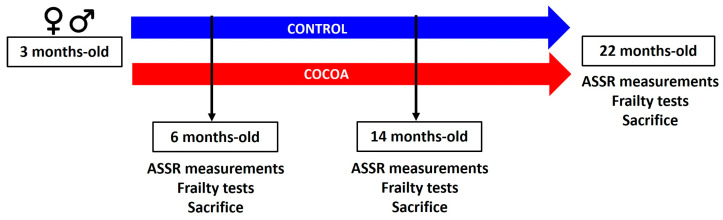
Figure 1
Figure 1
Comprehensive overview of the experimental timeline and procedures.
Figure 2
Figure 2
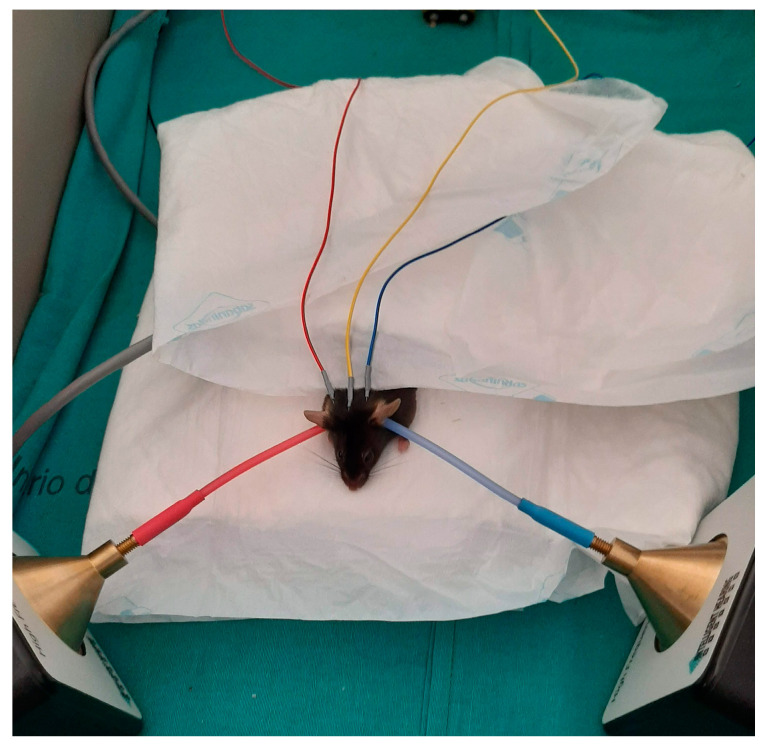
Auditory steady-state response measurements in mice.
Figure 3
Figure 3
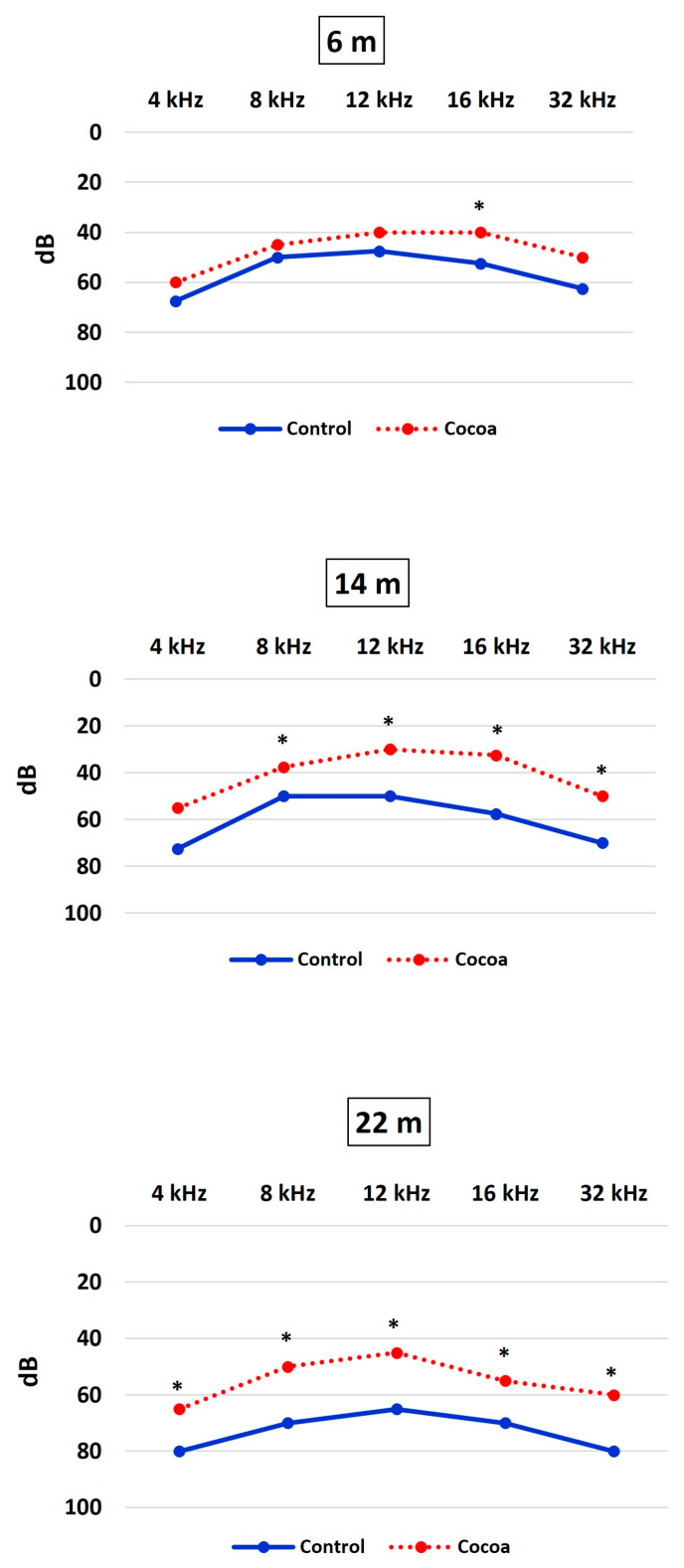
The cocoa diet prevents age-related hearing loss. The ASSR threshold shifts within frequencies (4–32 kHz) were measured in C57Bl/6J mice at different ages (6 months, 14 months, and 22 months) and treatments (control and cocoa diet). Data are expressed as median ± SD of hearing levels expressed in decibels of the sound pressure level (dB), asterisks indicate significant differences (p < 0.05) in between-group comparisons at each time (evaluated using Student’s t-test).
Figure 4
Figure 4
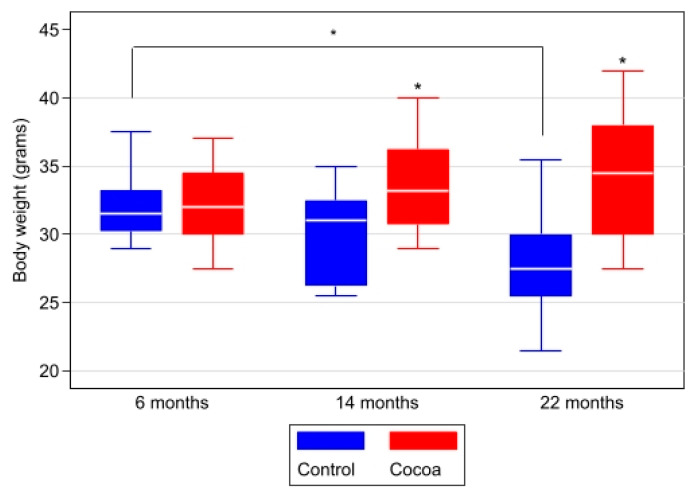
Cocoa prevents age-related loss of body weight. Animals’ body weights were recorded at 6, 14, and 22 months. Data are expressed as median (Q1, Q3) of body weight in grams. Box-plot graph with medians, Q1, Q3, and asterisks indicating significant differences (p < 0.05) in between-group comparisons at each time (evaluated using Mann–Whitney–Wilcoxon test) and within-group between moments (evaluated using Kruskal–Wallis test and post hoc Sidak test for pairwise comparisons).
Figure 5
Figure 5
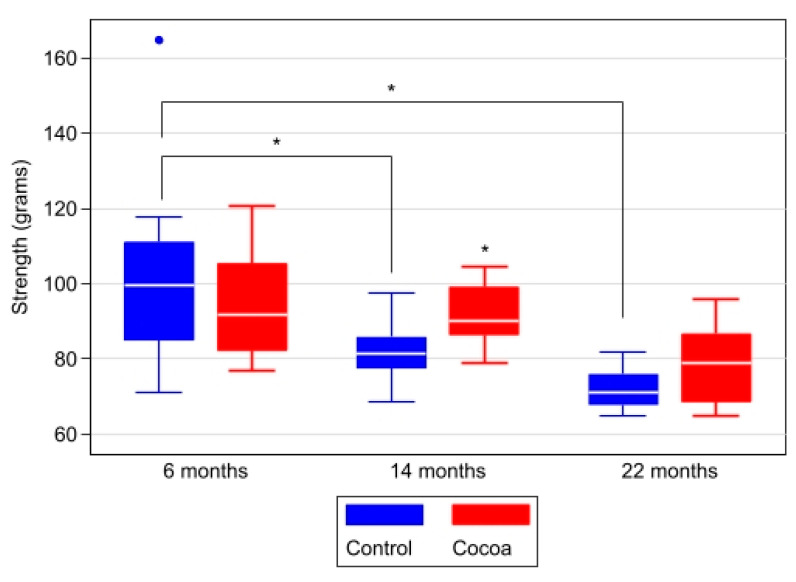
The cocoa diet improves the grip strength in aged mice. Reference mice grip strength values at different ages were obtained. Data are expressed as median (Q1, Q3) of grip strength in grams. Box-plot graph with medians, Q1, Q3, and asterisks indicating significant differences (p < 0.05) in between-group comparisons at each time (evaluated using Mann–Whitney–Wilcoxon test) and within-group between moments (evaluated using Kruskal–Wallis test and post hoc Sidak test for pairwise comparisons).
Figure 6
Figure 6
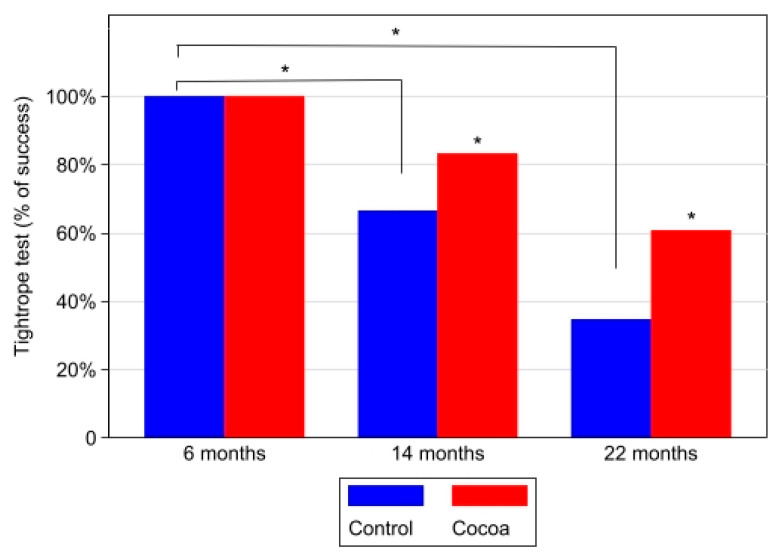
The cocoa-rich diet ameliorates motor coordination in aged mice. It was determined as the percentage of animals that successfully passed the tightrope test at different ages (6, 14, and 22 months). Box-plot graph with medians, Q1, Q3, and asterisks indicating significant differences (p < 0.05) in between-group comparisons at each time (evaluated using Mann–Whitney–Wilcoxon test) and within-group between moments (evaluated using Kruskal–Wallis test and post hoc Sidak test for pairwise comparisons).
Figure 7
Figure 7
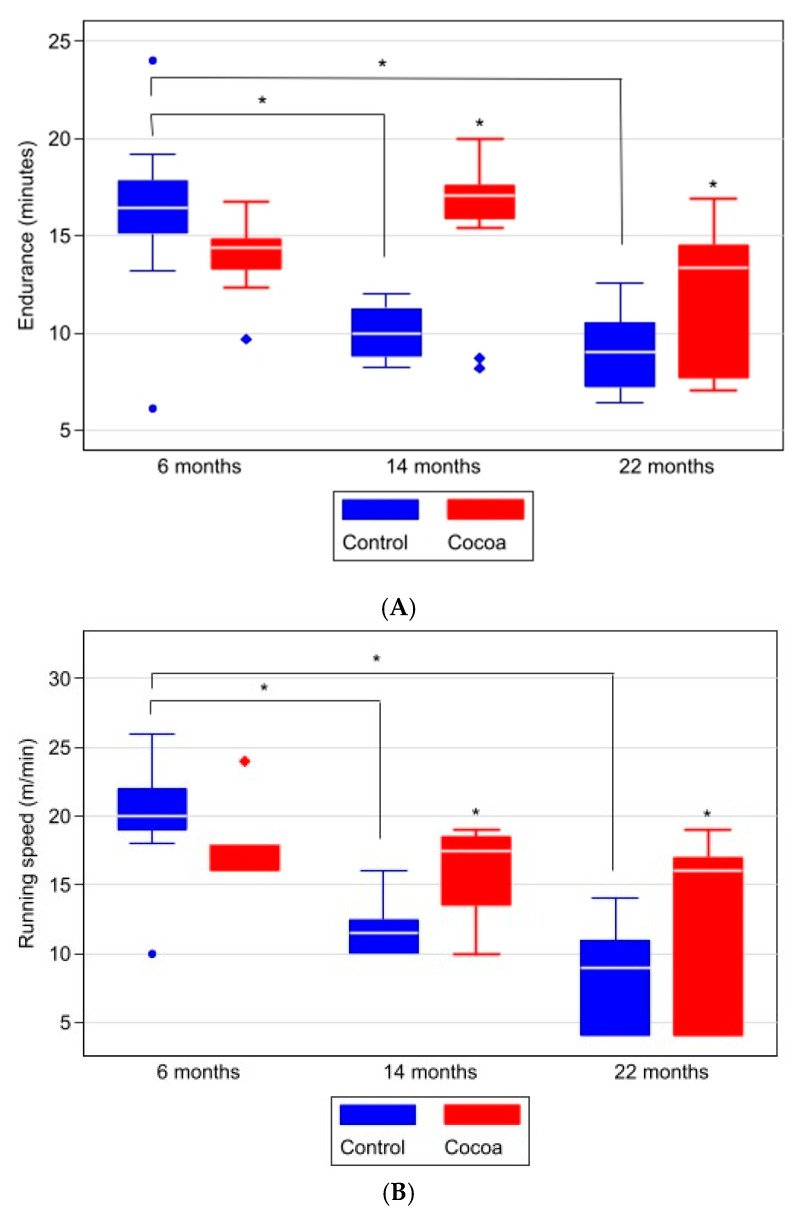
The cocoa diet increases endurance and running speed in older mice. We determined the running time (A) and running speed (B) values at different ages in mice. Data are expressed median (Q1, Q3) of body weight in grams. Box-plot graph with medians, Q1, Q3, and asterisks indicating significant differences (p < 0.05) in between-group comparisons at each time (evaluated using Mann–Whitney–Wilcoxon test) and within-group between moments (evaluated using Kruskal–Wallis test and post hoc Sidak test for pairwise comparisons).
Figure 8
Figure 8
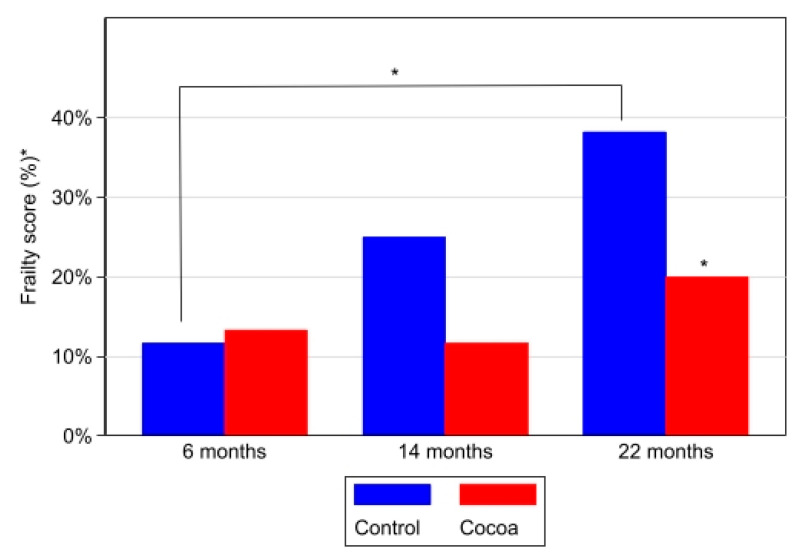
Cocoa decreased frailty in elderly mice. The frailty score for each age group of animals was calculated as follows: the total number of tests failed by the animals at each age group was divided by the total number of tests performed by these animals and expressed as a percentage. Box-plot graph with medians, Q1, Q3, and asterisks indicating significant differences (p < 0.05) in between-group comparisons at each time (evaluated using Mann–Whitney–Wilcoxon test) and within-group between moments (evaluated using Kruskal–Wallis test and post hoc Sidak test for pairwise comparisons). * Total number of tests failed by animals at each age group, divided by the total number of tests performed by these animals.
Figure 9
Figure 9
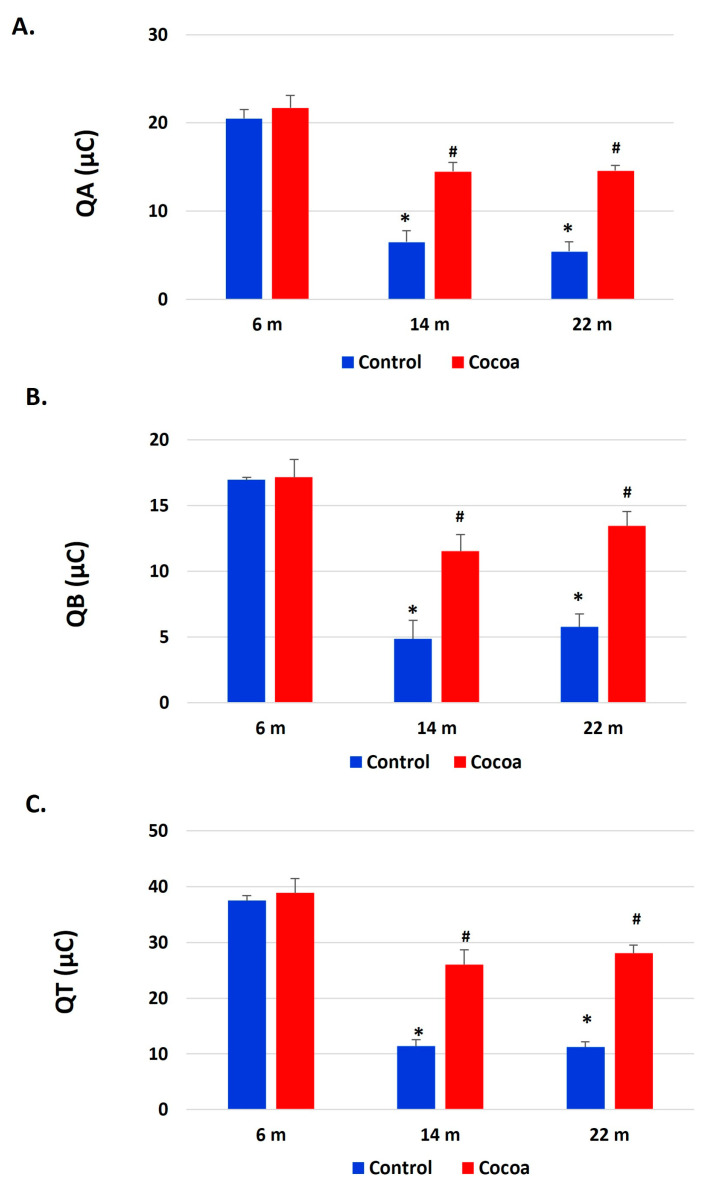
Cocoa treatment modulated total antioxidant response. (A) QA (fast antioxidants), (B) QB (slow antioxidants), and (C) QT (total antioxidant response: QA + QB) (µC) were measured by e-BQC lab system in plasma of mice at different ages (6 months, 14 months, and 22 months). The values represent the mean ± SD of micro-Coulomb (µC). * p < 0.05 vs. 6-month-old control group; # p < 0.05 vs. their respective control (evaluated using Student’s t-test).
Figure 10
Figure 10
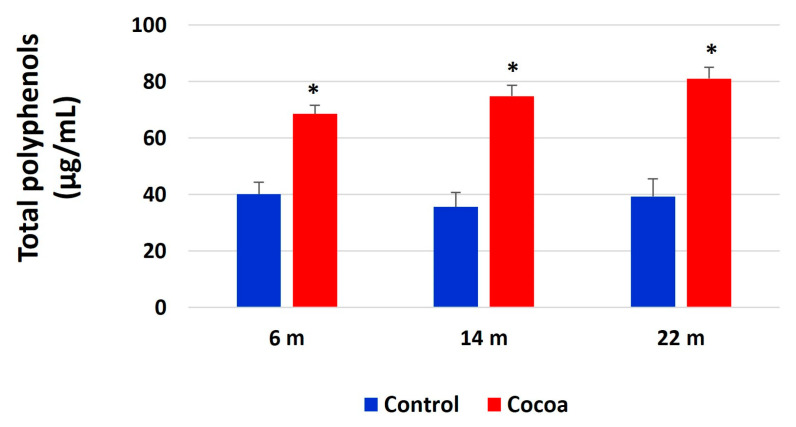
Cocoa intake increases total polyphenols in urine. Total polyphenols in urine were measured by BQC Phenolic Quantification Assay Kit in urine of mice at different ages (6 months, 14 months, and 22 months). The values represent the mean ± SD of µg/mL. * p < 0.05 vs. their respective control group (evaluated using Student’s t-test).

Similar articles

Cited by

  • A biomarker framework for auditory system aging: the Aging Biomarker Consortium consensus statement.
    Aging Biomarker Consortium; Fu X, Wang S, Wu Y, Sun Y, Liu W, Xi X, Li GL, Liu K, Yuan W, Chen F, Wang H, Yang T, Liu Y, Zheng J, Shi H, Qu J, Chen X, Suo L, Huang Y, Xu X, Tang X, Li X, Xu L, Gao X, Yu L, Shu Y, Zhang W, Sun J, Yuan H, Gong S, Li W, Ma X, Zha D, Gao J, Li H, He Z, Liu GH, Pei G, Kong W, Wang H, Chai R. Aging Biomarker Consortium, et al. Life Med. 2025 Mar 7;4(1):lnaf011. doi: 10.1093/lifemedi/lnaf011. eCollection 2025 Feb. Life Med. 2025. PMID: 40226444 Free PMC article.

References

    1. Gates G.A., Mills J.H. Presbycusis. Lancet. 2005;366:1111–1120. doi: 10.1016/S0140-6736(05)67423-5. - DOI - PubMed
    1. Chadha S., Kamenov K., Cieza A. The world report on hearing. Bull. World Health Organ. 2021;99:242. doi: 10.2471/BLT.21.285643. - DOI - PMC - PubMed
    1. Fetoni A.R., Picciotti P.M., Paludetti G., Troiani D. Pathogenesis of presbycusis in animal models: A review. Exp. Gerontol. 2011;46:413–425. doi: 10.1016/j.exger.2010.12.003. - DOI - PubMed
    1. Bielefeld E.C., Tanaka C., Chen G.D., Henderson D. Age-related hearing loss: Is it a preventable condition? Hear. Res. 2010;264:98–107. doi: 10.1016/j.heares.2009.09.001. - DOI - PMC - PubMed
    1. Yamasoba T., Lin F.R., Someya S., Kashio A., Sakamoto T., Kondo K. Current concepts in age-related hearing loss: Epidemiology and mechanistic pathways. Hear. Res. 2013;303:30–38. doi: 10.1016/j.heares.2013.01.021. - DOI - PMC - PubMed

LinkOut - more resources