


Association between Variation in Body Fat Mass Magnitude and Intake of Nutrients, including Carbohydrates, Fat, and B Vitamins, in a Cohort of Highly Trained Female Athletes
- PMID: 38002209
- PMCID: PMC10670790
- DOI: 10.3390/foods12224152
Association between Variation in Body Fat Mass Magnitude and Intake of Nutrients, including Carbohydrates, Fat, and B Vitamins, in a Cohort of Highly Trained Female Athletes
Abstract
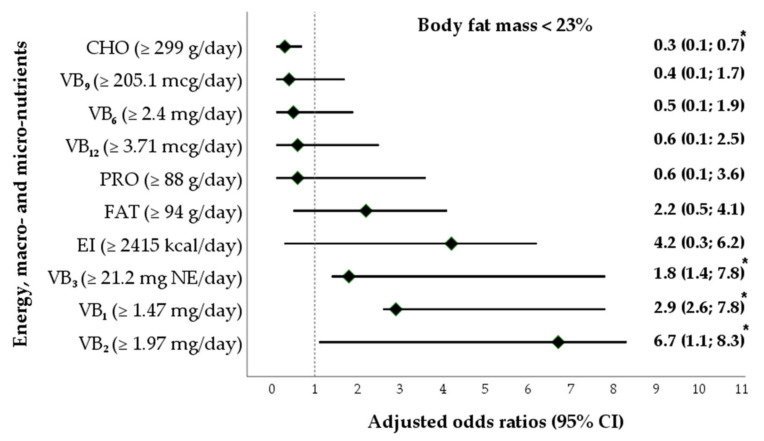
The most common sports nutrition strategies were constructed not only for maximizing musculoskeletal adaptations to exercise, but also to minimize health risks in athletes. Given the lack of research highlighting the potential effects of the intake of carbohydrates, fats, and B vitamins on body fat percentage in a population of female athletes, this study aimed to elucidate whether the intake of macronutrients and B vitamins could be associated with the variation in body fat percentage in a cohort of professional female athletes. This cross-sectional study was weighted to represent Lithuanian elite female athletes (n = 89). The dietary assessment of the female athletes was carried out using a 3-day dietary recall method. Their body composition was assessed using the bioelectrical impedance analysis method. For females, the reported average intakes of energy, carbohydrates, protein, and fat were 2475 kcal/day, 5.1 g/kg/day, 1.5 g/kg/day, and 36.7%, respectively. Excess B vitamin intake was revealed, ranging within plus 1-2 standard deviations (SDs) around the mean requirements. As a consequence, excessive body fat percentage was potentially factored as a negative outcome in maintaining optimal body composition in female athletes. Multivariate logistic regression analysis of a sample of female athletes revealed that, despite a slightly positive energy balance (∆ 95 kcal/day), the carbohydrate-deficient diet (adjusted odds ratio (aOR) 0.3, 95% confidence interval (CI) 0.1; 0.7), along with higher intakes of vitamin B1 (aOR 2.9, 95% CI 2.6; 7.8), vitamin B2 (aOR 6.7, 95% CI 1.1; 8.3), and vitamin B3 (aOR 1.8, 95% CI 1.4; 7.8) from food, was associated with a lower percentage of body fat. Therefore, more attention should be given to the intake of B vitamins in professional athletes with a range of body fat mass percentages for the purpose of achieving long-term goals of maintaining body composition and fitness.
Keywords: B vitamins; body fat mass; carbohydrates; fat; female athletes; food composition; nutrition.
Conflict of interest statement
The authors declare no conflict of interest.
Figures


References
-
- World Health Organization Obesity and Overweight. [(accessed on 3 August 2023)]. Available online: https://www.who.int/news-room/fact-sheets/detail/obesity-and-overweight.
-
- Hassapidou M., Vlassopoulos A., Kalliostra M., Govers E., Mulrooney H., Ells L., Salas X.R., Muscogiuri G., Darleska T.H., Busetto L., et al. European Association for the study of obesity position statement on medical nutrition therapy for the management of overweight and obesity in adults developed in collaboration with the European federation of the associations of dietitians. Obes. Facts. 2023;16:11–28. doi: 10.1159/000528083. - DOI - PMC - PubMed
-
- Thomas D.T., Erdman K.A., Burke L.M. American College of Sports Medicine Joint Position Statement. Nutrition and athletic performance. Med. Sci. Sports Exerc. 2016;48:543–568. - PubMed
-
- International Olympic Committee IOC consensus statement on sports nutrition 2010. Int. J. Sport Nutr. Exerc. Metab. 2010;29:S3–S4.
LinkOut - more resources
Full Text Sources
Research Materials
