Review
. 2023 Nov 20;12(22):4179.
doi: 10.3390/foods12224179.

The Role of Gluten in Food Products and Dietary Restriction: Exploring the Potential for Restoring Immune Tolerance

Affiliations
Review

The Role of Gluten in Food Products and Dietary Restriction: Exploring the Potential for Restoring Immune Tolerance

Li Ye et al. Foods. .

Abstract

Wheat is extensively utilized in various processed foods due to unique proteins forming from the gluten network. The gluten network in food undergoes morphological and molecular structural changes during food processing, affecting the final quality and digestibility of the food. The present review introduces the formation of the gluten network and the role of gluten in the key steps of the production of several typical food products such as bread, pasta, and beer. Also, it summarizes the factors that affect the digestibility of gluten, considering that different processing conditions probably affect its structure and properties, contributing to an in-depth understanding of the digestion of gluten by the human body under various circumstances. Nevertheless, consumption of gluten protein may lead to the development of celiac disease (CD). The best way is theoretically proposed to prevent and treat CD by the inducement of oral tolerance, an immune non-response system formed by the interaction of oral food antigens with the intestinal immune system. This review proposes the restoration of oral tolerance in CD patients through adjunctive dietary therapy via gluten-encapsulated/modified dietary polyphenols. It will reduce the dietary restriction of gluten and help patients achieve a comprehensive dietary intake by better understanding the interactions between gluten and food-derived active products like polyphenols.

Keywords: celiac disease; dietary restriction; digestibility; food processing; gluten; interaction; oral tolerance.


Conflict of interest statement

The authors declare no conflict of interest.

Figures
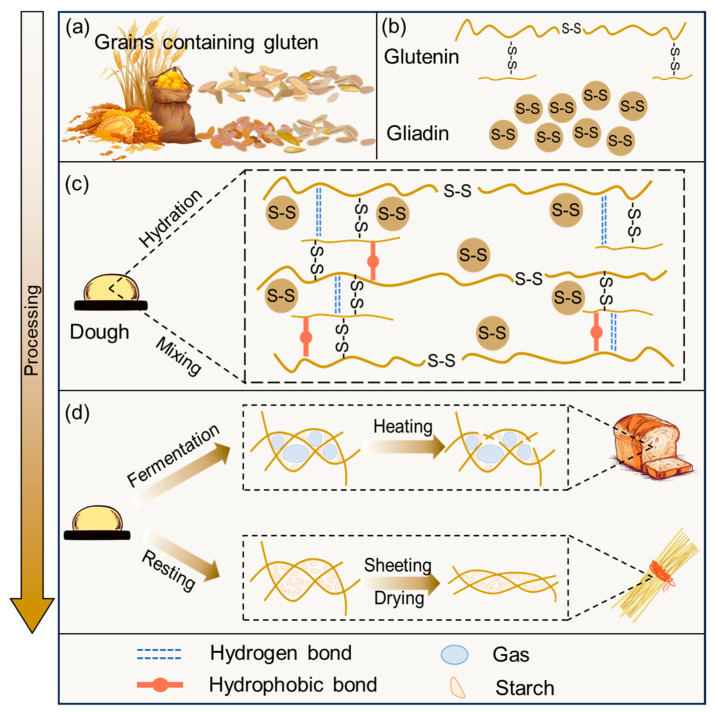
Figure 1
Figure 1
Classification and function of gluten. (a) Grains consist of gluten. (b) Structure of glutelin and gliadin. (c) Gluten structure of the dough. (d) Changes of gluten in the dough after processing.
Figure 2
Figure 2
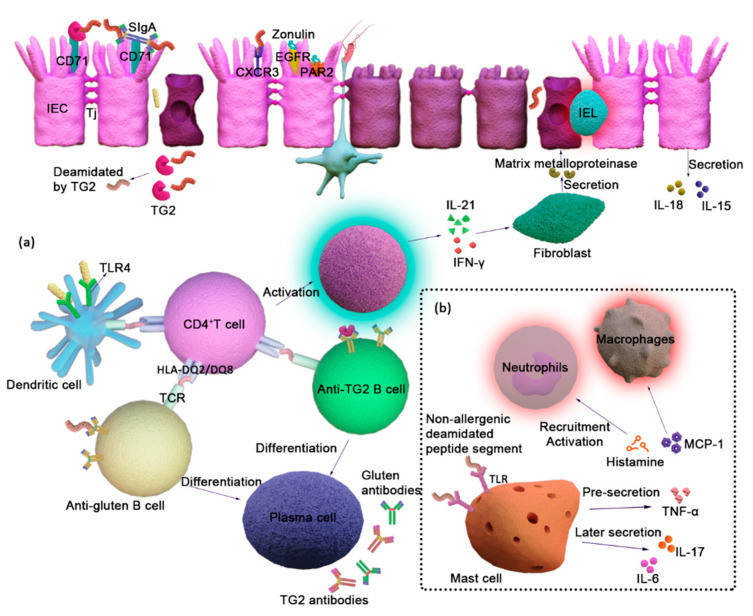
(a) Pathological mechanisms of CD. (b) Mast cells are involved in the pathophysiology of CD. The allergenic peptides actively enter the lamina propria via the epithelial pathway, where transglutaminase 2 deamidates them, increasing their affinity for HLA-DQ2 or HLA-DQ8, and the antigenic epitopes are picked up by antigen-presenting cells and transmitted to CD4+ T cells. B cells use surface receptors to recognize their antigens and to internalize them, and present processed gluten peptides to CD4+ cells. When HLA-DQ2 or HLA-DQ8, sensitizing peptides, and various T cell receptors interact, both T cells and B cells are activated. Once activated, gluten-specific CD4+ T cells begin to release inflammatory cytokines such as IFN-γ and IL-21, resulting in an inflammatory milieu in the small intestine’s lamina propria. Colonic fibroblasts secrete substantial levels of MMPs (matrix metalloproteinases) after IL-21 and IFN-γ stimulation, and the release and activation of MMP induce extracellular matrix proteolysis. Activated B cells can also develop into plasma cells, which release anti-gluten and TG2 antibodies.
Figure 3
Figure 3
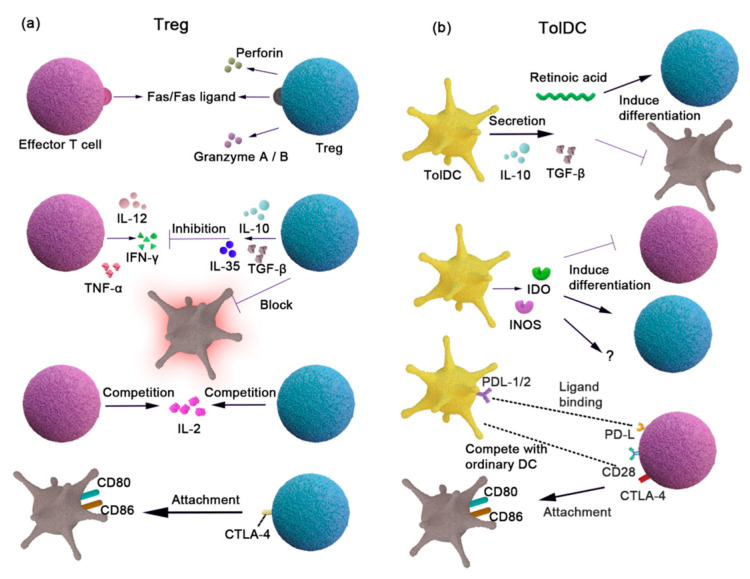
Tolerability mechanism of Treg and tolDC. (a) The nTreg mediates cell lysis through granzyme A/B and perforin secreted by cell-to-cell interaction, and iTreg mediates cell lysis through Fas/Fas ligand action on specific CD4+ T cells. TGF-β inhibited activated gluten-specific CD4+ T cells and promoted IL-10 secretion. IL-10 inhibits pro-inflammatory factor secretion (such as IFN-γ, IL-12, and TNF-α), blocking wheat toxic protein antigen presentation. This is through the competitive inhibition of IL-2 proliferation to other cells, the upregulation of cAMP, and inhibiting pro-inflammatory gene expression. Treg surface molecular CTLA-4 (CD152) attached to APCs’ stimulus molecules (CD80 and CD86) inhibits intercellular interdependence mechanisms. (b) PD-L1/2 (programmed death-ligand 1/2) and CTLA-4 (cytotoxic T-lymphocyte-related protein 4) are highly expressed on the surface and compete with CD80 and CD86 to bind to CD28 on the surface of other DCS. Secretion of IL-10 and TGF-regulatory effects of T cells and Treg; IDO (indoleamine 2, 3-dioxidase) and iNOS (inducible nitric oxide synthase) are secreted to induce Treg.
Figure 4
Figure 4
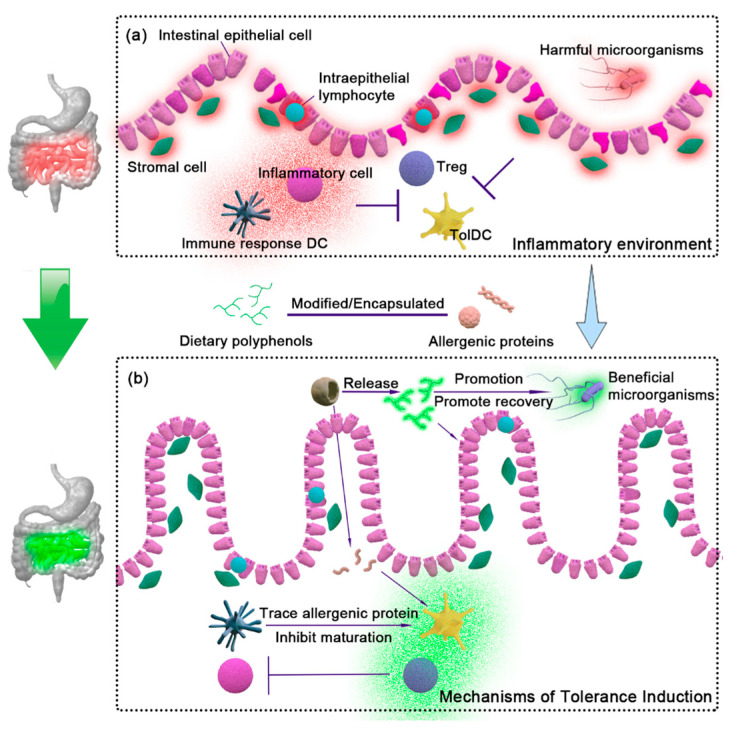
Hypothetical mechanism of polyphenol–gluten treatment of CD to restore oral tolerance. (a) Inflammation in the CD intestinal tract. (b) Polyphenol–gluten restores oral tolerance with CD. Wheat protein modifying or entrapping dietary polyphenols will release trace amounts of allergenic proteins after entering the intestinal tract, inhibit iDC maturation, promote T cell differentiation into Treg, and release dietary polyphenols to repair intestinal epithelial cells, regulate the intestinal flora, and restore oral tolerance in CD patients.
Figure 5
Figure 5
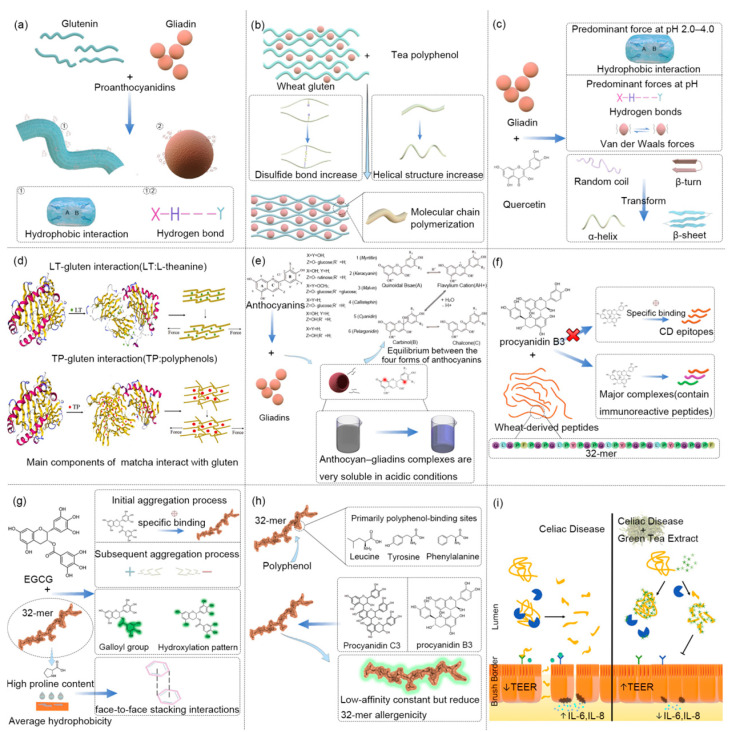
Interaction of gluten and dietary polyphenols. (a) Non-covalent linkage of proanthocyanidins to wheat proteins [115]. (b) Tea polyphenols promote structural changes and polymerization of wheat gluten [117]. (c) Different non-donor linkages between quercetin and gliadins at different pH and the structure of gliadin changes [118]. (d) Tea polyphenols form ternary hydrogen bonds with wheat protein to stabilize its network structure [116] (reproduced with permission from Ref. [116]. Copyright publisher Elsevier). (e) Anthocyans change the secondary structure of gliadin [119] (reproduced with permission from Ref. [119]. Copyright publisher Elsevier). (fh) Interaction mechanism of proanthocyanidin B3, EGCG, green tea polyphenols, proanthocyanidin monomers, polymers, and wheat protein peptides [121,122] (reproduced with permission from Refs. [121,122]. Copyright publisher Elsevier). (i) The complexes of green tea polyphenols and gliadins regulate inflammation [123] (reproduced with permission from Ref. [123]. Copyright publisher Wiley Company).

References

    1. Shewry P.R., Halford N.G. Cereal Seed Storage Proteins: Structures, Properties and Role in Grain Utilization. J. Exp. Bot. 2002;53:947–958. doi: 10.1093/jexbot/53.370.947. - DOI - PubMed
    1. This Vo Kientza H. Who Discovered the Gluten and Who Discovered Its Production by Lixiviation? N3AF. 2018;6:1–11. doi: 10.58630/pubac.not.a435750. - DOI
    1. Wieser H. Chemistry of Gluten Proteins. Food Microbiol. 2007;24:115–119. doi: 10.1016/j.fm.2006.07.004. - DOI - PubMed
    1. Schalk K., Lexhaller B., Koehler P., Scherf K.A. Isolation and Characterization of Gluten Protein Types from Wheat, Rye, Barley and Oats for Use as Reference Materials. PLoS ONE. 2017;12:e0172819. doi: 10.1371/journal.pone.0172819. - DOI - PMC - PubMed
    1. Lexhaller B., Colgrave M.L., Scherf K.A. Characterization and Relative Quantitation of Wheat, Rye, and Barley Gluten Protein Types by Liquid Chromatography–Tandem Mass Spectrometry. Front. Plant Sci. 2019;10:1530. doi: 10.3389/fpls.2019.01530. - DOI - PMC - PubMed

LinkOut - more resources