


Plant Life with and without Oxygen: A Metabolomics Approach
- PMID: 38003412
- PMCID: PMC10671363
- DOI: 10.3390/ijms242216222
Plant Life with and without Oxygen: A Metabolomics Approach
Abstract
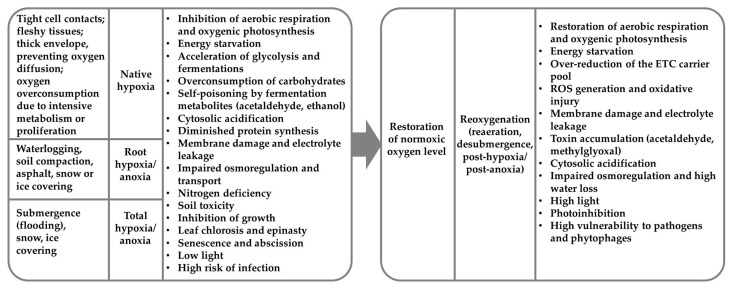
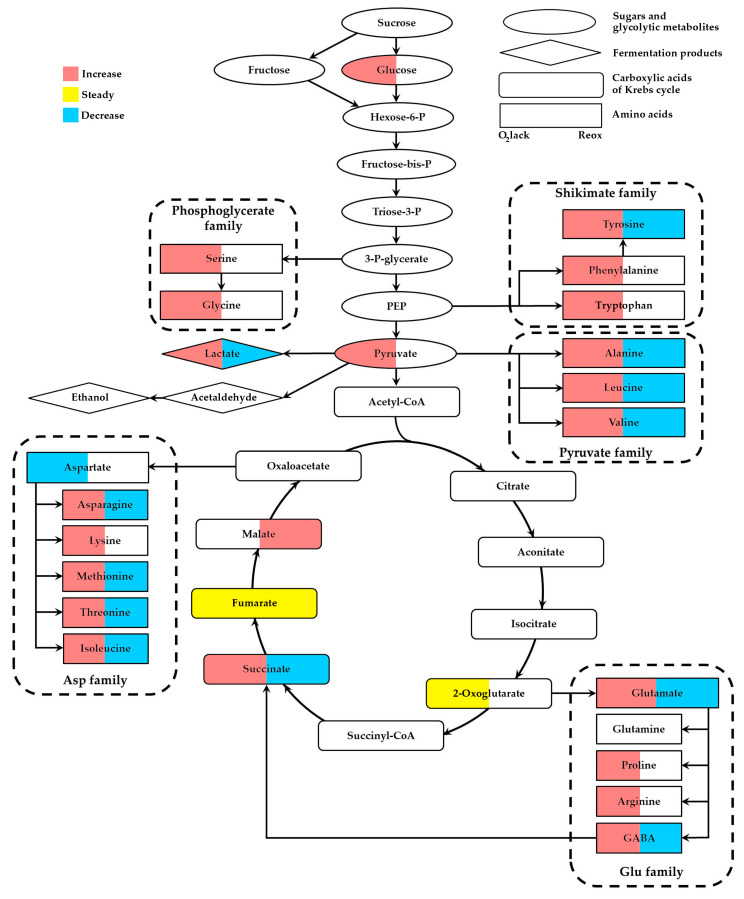
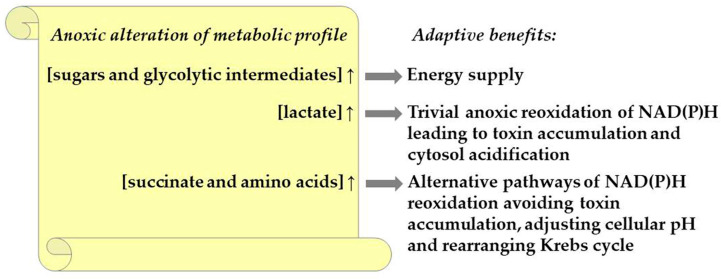
Oxygen deficiency is an environmental challenge which affects plant growth, the development and distribution in land and aquatic ecosystems, as well as crop yield losses worldwide. The capacity to exist in the conditions of deficiency or the complete lack of oxygen depends on a number of anatomic, developmental and molecular adaptations. The lack of molecular oxygen leads to an inhibition of aerobic respiration, which causes energy starvation and the acceleration of glycolysis passing into fermentations. We focus on systemic metabolic alterations revealed with the different approaches of metabolomics. Oxygen deprivation stimulates the accumulation of glucose, pyruvate and lactate, indicating the acceleration of the sugar metabolism, glycolysis and lactic fermentation, respectively. Among the Krebs-cycle metabolites, only the succinate level increases. Amino acids related to glycolysis, including the phosphoglycerate family (Ser and Gly), shikimate family (Phe, Tyr and Trp) and pyruvate family (Ala, Leu and Val), are greatly elevated. Members of the Asp family (Asn, Lys, Met, Thr and Ile), as well as the Glu family (Glu, Pro, Arg and GABA), accumulate as well. These metabolites are important members of the metabolic signature of oxygen deficiency in plants, linking glycolysis with an altered Krebs cycle and allowing alternative pathways of NAD(P)H reoxidation to avoid the excessive accumulation of toxic fermentation products (lactate, acetaldehyde, ethanol). Reoxygenation induces the downregulation of the levels of major anaerobically induced metabolites, including lactate, succinate and amino acids, especially members of the pyruvate family (Ala, Leu and Val), Tyr and Glu family (GABA and Glu) and Asp family (Asn, Met, Thr and Ile). The metabolic profiles during native and environmental hypoxia are rather similar, consisting in the accumulation of fermentation products, succinate, fumarate and amino acids, particularly Ala, Gly and GABA. The most intriguing fact is that metabolic alterations during oxidative stress are very much similar, with plant response to oxygen deprivation but not to reoxygenation.
Keywords: adaptation; anoxia; desubmergence; flooding; hypoxia; metabolomics; reoxygenation; submergence; tolerance; waterlogging.
Conflict of interest statement
The authors declare no conflict of interest.
Figures
Similar articles
-
Primary structure of murine major histocompatibility complex alloantigens: amino acid sequence of the amino-terminal one hundred and seventy-three residues of the H-2Kb glycoprotein.Biochemistry. 1980 Jan 22;19(2):306-15. doi: 10.1021/bi00543a009. Biochemistry. 1980. PMID: 6986168
-
The primary structure of iron-superoxide dismutase from Photobacterium leiognathi.J Biol Chem. 1987 Jan 25;262(3):1001-9. J Biol Chem. 1987. PMID: 3542995
-
Primary and tertiary structure of the principal human adenylate kinase.Eur J Biochem. 1976 Sep;68(1):281-90. doi: 10.1111/j.1432-1033.1976.tb10787.x. Eur J Biochem. 1976. PMID: 183954
-
The primary structure of human liver manganese superoxide dismutase.J Biol Chem. 1984 Oct 25;259(20):12595-601. J Biol Chem. 1984. PMID: 6386798
-
Amino acid sequence of Desulfovibrio vulgaris flavodoxin.J Biol Chem. 1977 Feb 25;252(4):1453-63. J Biol Chem. 1977. PMID: 402366
Cited by
-
Decoding plant responses to waterlogging: from stress signals to molecular mechanisms and their future implications.Plant Mol Biol. 2025 Jun 29;115(4):78. doi: 10.1007/s11103-025-01611-8. Plant Mol Biol. 2025. PMID: 40581894 Review.
-
Involvement of miR775 in the Post-Transcriptional Regulation of Fructose-1,6-Bisphosphate Aldolase in Maize (Zea mays L.) Leaves Under Hypoxia.Int J Mol Sci. 2025 Jan 21;26(3):865. doi: 10.3390/ijms26030865. Int J Mol Sci. 2025. PMID: 39940636 Free PMC article.
-
The Changes of Amino-Acid Metabolism between Wheat and Rice during Early Growth under Flooding Stress.Int J Mol Sci. 2024 May 11;25(10):5229. doi: 10.3390/ijms25105229. Int J Mol Sci. 2024. PMID: 38791268 Free PMC article.
-
Alterations in the Rice Coleoptile Metabolome During Elongation Under Submergence Stress.Int J Mol Sci. 2024 Dec 10;25(24):13256. doi: 10.3390/ijms252413256. Int J Mol Sci. 2024. PMID: 39769021 Free PMC article.
-
Biological Nano-Agrochemicals for Crop Production as an Emerging Way to Address Heat and Associated Stresses.Nanomaterials (Basel). 2024 Jul 26;14(15):1253. doi: 10.3390/nano14151253. Nanomaterials (Basel). 2024. PMID: 39120358 Free PMC article. Review.
References
-
- Chirkova T., Yemelyanov V. The study of plant adaptation to oxygen deficiency in Saint Petersburg University. Biol. Commun. 2018;63:17–31. doi: 10.21638/spbu03.2018.104. - DOI
Publication types
MeSH terms
Substances
Grants and funding
LinkOut - more resources
Full Text Sources
Miscellaneous
