


Low-Carbohydrate and Low-Fat Diet with Metabolic-Dysfunction-Associated Fatty Liver Disease
- PMID: 38004162
- PMCID: PMC10674227
- DOI: 10.3390/nu15224763
Low-Carbohydrate and Low-Fat Diet with Metabolic-Dysfunction-Associated Fatty Liver Disease
Abstract
Background: This observational cross-sectional study was designed to explore the effects of a low-carbohydrate diet (LCD) and a low-fat diet (LFD) on metabolic-dysfunction-associated fatty liver disease (MAFLD).
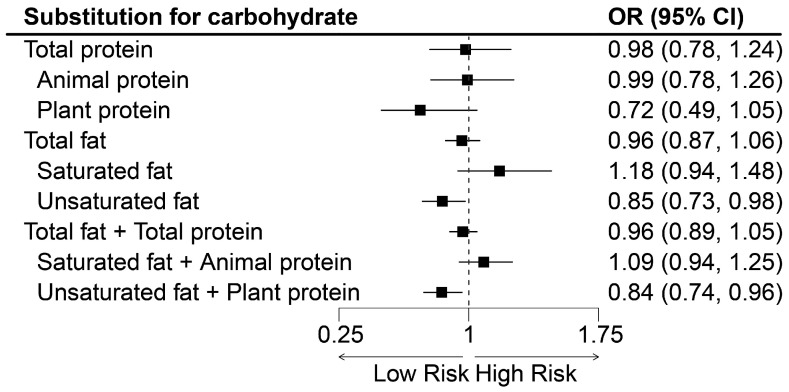
Methods: This study involved 3961 adults. The associations between LCD/LFD scores and MAFLD were evaluated utilizing a multivariable logistic regression model. Additionally, a leave-one-out model was applied to assess the effect of isocaloric substitution of specific macronutrients.
Results: Participants within the highest tertile of healthy LCD scores (0.63; 95% confidence interval [CI], 0.45-0.89) or with a healthy LFD score (0.64; 95%CI, 0.48-0.86) faced a lower MAFLD risk. Furthermore, compared with tertile 1, individuals with unhealthy LFD scores in terile 2 or tertile 3 had 49% (95%CI, 1.17-1.90) and 77% (95%CI, 1.19-2.63) higher risk levels for MAFLD, respectively.
Conclusions: Healthy LCD and healthy LFD are protective against MAFLD, while unhealthy LFD can increase the risk of MAFLD. Both the quantity and quality of macronutrients might have significant influences on MAFLD.
Keywords: low-carbohydrate diet; low-fat diet; metabolic-dysfunction-associated fatty liver disease; quality of macronutrients; severe fibrosis.
Conflict of interest statement
The authors declare no conflict of interest.
Figures
Similar articles
-
Associations of lower-carbohydrate and lower-fat diets with mortality among people with prediabetes.Am J Clin Nutr. 2022 Jul 6;116(1):206-215. doi: 10.1093/ajcn/nqac058. Am J Clin Nutr. 2022. PMID: 35421220
-
Associations of Lower-Carbohydrate and Lower-Fat Diets with Mortality among People with Cardiovascular Disease.J Nutr. 2024 Jun;154(6):1869-1879. doi: 10.1016/j.tjnut.2024.03.011. Epub 2024 Mar 14. J Nutr. 2024. PMID: 38490533
-
Low-carbohydrate diets, low-fat diets, and mortality in middle-aged and older people: A prospective cohort study.J Intern Med. 2023 Aug;294(2):203-215. doi: 10.1111/joim.13639. Epub 2023 May 3. J Intern Med. 2023. PMID: 37132226
-
Circulating angiopoietin-like proteins in metabolic-associated fatty liver disease: a systematic review and meta-analysis.Lipids Health Dis. 2021 May 25;20(1):55. doi: 10.1186/s12944-021-01481-1. Lipids Health Dis. 2021. PMID: 34034750 Free PMC article.
-
Effects of low-carbohydrate diets versus low-fat diets on metabolic risk factors in overweight and obese adults: A meta-analysis of randomized controlled trials.Front Nutr. 2022 Aug 9;9:935234. doi: 10.3389/fnut.2022.935234. eCollection 2022. Front Nutr. 2022. PMID: 36017224 Free PMC article.
Cited by
-
Dietary patterns in the progression of metabolic dysfunction-associated fatty liver disease to advanced liver disease: a prospective cohort study.Am J Clin Nutr. 2024 Sep;120(3):518-527. doi: 10.1016/j.ajcnut.2024.07.015. Epub 2024 Jul 17. Am J Clin Nutr. 2024. PMID: 39029661 Free PMC article.
-
The association between lifelines diet score and metabolic associated fatty liver disease: a case-control study.Front Nutr. 2025 May 15;12:1569814. doi: 10.3389/fnut.2025.1569814. eCollection 2025. Front Nutr. 2025. PMID: 40444252 Free PMC article.
-
Diagnostic indicators and lifestyle interventions of metabolic-associated fatty liver disease.Front Nutr. 2024 Jun 14;11:1424246. doi: 10.3389/fnut.2024.1424246. eCollection 2024. Front Nutr. 2024. PMID: 38946789 Free PMC article. Review.
-
Special correlation between diet and MASLD: positive or negative?Cell Biosci. 2025 Apr 12;15(1):44. doi: 10.1186/s13578-025-01382-1. Cell Biosci. 2025. PMID: 40221799 Free PMC article. Review.
-
Comparative Evaluation of a Low-Carbohydrate Diet and a Mediterranean Diet in Overweight/Obese Patients with Type 2 Diabetes Mellitus: A 16-Week Intervention Study.Nutrients. 2023 Dec 27;16(1):95. doi: 10.3390/nu16010095. Nutrients. 2023. PMID: 38201924 Free PMC article.
References
-
- Eslam M., Newsome P.N., Sarin S.K., Anstee Q.M., Targher G., Romero-Gomez M., Zelber-Sagi S., Wai-Sun Wong V., Dufour J.F., Schattenberg J.M., et al. A new definition for metabolic dysfunction-associated fatty liver disease: An international expert consensus statement. J. Hepatol. 2020;73:202–209. doi: 10.1016/j.jhep.2020.03.039. - DOI - PubMed
Publication types
MeSH terms
Substances
Grants and funding
LinkOut - more resources
Full Text Sources
Medical
