


Effects of Fenofibrate and Gemfibrozil on Kynurenic Acid Production in Rat Kidneys In Vitro: Old Drugs, New Properties
- PMID: 38004294
- PMCID: PMC10672417
- DOI: 10.3390/life13112154
Effects of Fenofibrate and Gemfibrozil on Kynurenic Acid Production in Rat Kidneys In Vitro: Old Drugs, New Properties
Abstract
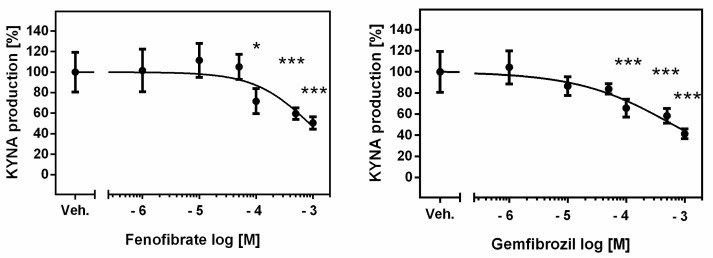
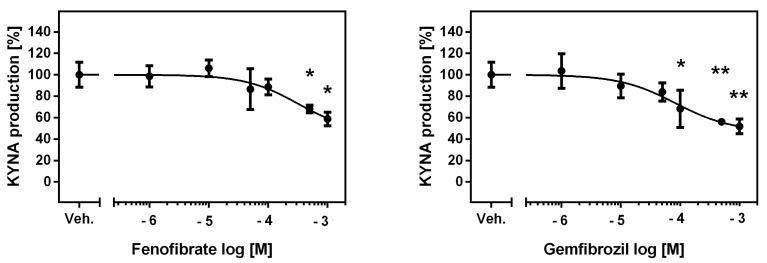
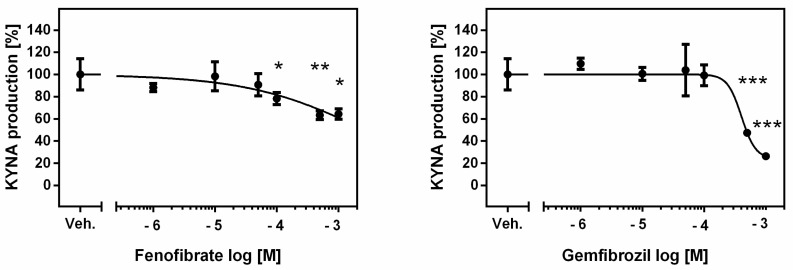
Kidney dysfunction significantly increases the cardiovascular risk, even in cases of minor functional declines. Hypertriglyceridemia is the most common lipid abnormality reported in patients with kidney disorders. PPAR-α (peroxisome proliferator-activated receptor-α) agonists called fibrates are the main agents used to lower triglyceride levels. Kynurenic acid (KYNA) is a tryptophan (Trp) derivative directly formed from L-kynurenine (L-KYN) by kynurenine aminotransferases (KATs). KYNA is classified as a uremic toxin, the level of which is correlated with kidney function impairments and lipid abnormalities. The aim of this study was to analyze the effect of the most commonly used triglyceride-lowering drugs, fenofibrate and gemfibrozil, on KYNA production and KAT activity in rat kidneys in vitro. The influence of fenofibrate and gemfibrozil on KYNA formation and KAT activity was tested in rat kidney homogenates in vitro. Fenofibrate and gemfibrozil at 100 µM-1 mM significantly inhibited KYNA synthesis in rat kidney homogenates. Both fibrates directly affected the KAT I and KAT II isoenzyme activities in a dose-dependent manner at similar concentrations. The presented results reveal the novel mechanism of action of fibrates in the kidneys and suggest their potential role in kidney function protection beyond the well-known anti-hyperlipidemic effect.
Keywords: fenofibrate; gemfibrozil; hypertriglyceridemia; kidney; kynurenic acid.
Conflict of interest statement
The funders had no role in the design of the study; in the collection, analyses, or interpretation of data; in the writing of the manuscript; or in the decision to publish the results.
Figures
Similar articles
-
Loop diuretics inhibit kynurenic acid production and kynurenine aminotransferases activity in rat kidneys.Pharmacol Rep. 2024 Dec;76(6):1415-1428. doi: 10.1007/s43440-024-00648-8. Epub 2024 Sep 11. Pharmacol Rep. 2024. PMID: 39261392 Free PMC article.
-
The influence of cyclooxygenase inhibitors on kynurenic acid production in rat kidney: a novel path for kidney protection?Pharmacol Rep. 2023 Apr;75(2):376-385. doi: 10.1007/s43440-023-00460-w. Epub 2023 Feb 14. Pharmacol Rep. 2023. PMID: 36788192 Free PMC article.
-
Kynurenic Acid Levels and Kynurenine Aminotransferase I, II and III Activities in Ganglia, Heart and Liver of Snail Helix Pomatia.Cell Physiol Biochem. 2023 Aug 18;57(4):279-297. doi: 10.33594/000000643. Cell Physiol Biochem. 2023. PMID: 37597169
-
Kynurenic acid and kynurenine aminotransferases in retinal aging and neurodegeneration.Pharmacol Rep. 2011;63(6):1324-34. doi: 10.1016/s1734-1140(11)70697-1. Pharmacol Rep. 2011. PMID: 22358081 Review.
-
The Synthesis of Kynurenic Acid in Mammals: An Updated Kynurenine Aminotransferase Structural KATalogue.Front Mol Biosci. 2019 Feb 27;6:7. doi: 10.3389/fmolb.2019.00007. eCollection 2019. Front Mol Biosci. 2019. PMID: 30873412 Free PMC article. Review.
Cited by
-
Loop diuretics inhibit kynurenic acid production and kynurenine aminotransferases activity in rat kidneys.Pharmacol Rep. 2024 Dec;76(6):1415-1428. doi: 10.1007/s43440-024-00648-8. Epub 2024 Sep 11. Pharmacol Rep. 2024. PMID: 39261392 Free PMC article.
-
Kynurenine Pathway after Kidney Transplantation: Friend or Foe?Int J Mol Sci. 2024 Sep 14;25(18):9940. doi: 10.3390/ijms25189940. Int J Mol Sci. 2024. PMID: 39337426 Free PMC article. Review.
References
Grants and funding
LinkOut - more resources
Full Text Sources
