


Employing a Plant Probiotic Actinomycete for Growth Promotion of Lettuce (Lactuca sativa L. var. longifolia) Cultivated in a Hydroponic System under Nutrient Limitation
- PMID: 38005691
- PMCID: PMC10675278
- DOI: 10.3390/plants12223793
Employing a Plant Probiotic Actinomycete for Growth Promotion of Lettuce (Lactuca sativa L. var. longifolia) Cultivated in a Hydroponic System under Nutrient Limitation
Abstract
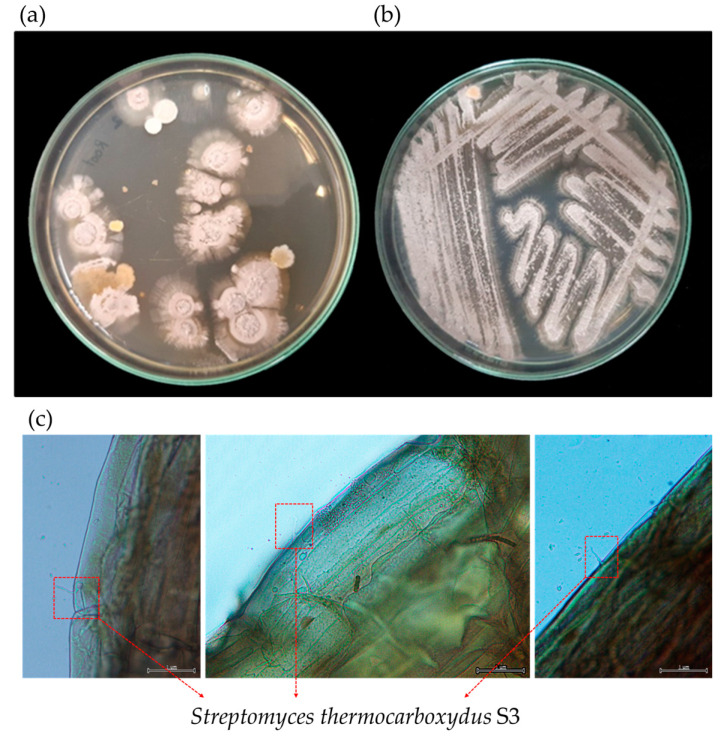
The consumption of lettuce is associated with an increased risk of ingesting nitrate, a naturally occurring and potentially harmful compound that can have adverse effects on human health. Hydroponic cultivation systems serve as effective tools for regulating nutrient solutions and nitrogen availability, which are essential for controlling nitrate levels. However, the techniques for reducing nutrient levels need to be appropriately calibrated based on lettuce growth responses and their interactions with the environment and growing conditions. Previous studies have demonstrated that plant probiotic actinomycetes can alleviate nutritional stress in various crops. However, there is a noticeable gap in research concerning the effects of actinomycetes on hydroponically grown lettuce, particularly under nutrient-limiting conditions. This study aimed to evaluate the effectiveness of the actinomycete Streptomyces thermocarboxydus S3 in enhancing lettuce growth in a nutrient-restricted hydroponic system. The results indicated that the detrimental effects of nutrient stress on lettuce were mitigated by the inoculation of lettuce with S. thermocarboxydus S3. This mitigation was evident in various growth parameters, including leaf count, shoot length, and the fresh and dry weights of both shoots and roots. In the presence of nutritional stress, S. thermocarboxydus S3 likely mitigated the negative effects on lettuce by reducing hydrogen peroxide levels, presumably through the synthesis of H2O2-scavenging enzymes. Furthermore, S. thermocarboxydus S3 successfully survived and colonized lettuce roots. Therefore, the inoculation of lettuce with S. thermocarboxydus S3 offers significant advantages for promoting lettuce growth in nutrient-limited hydroponic systems.
Keywords: hydroponic; lettuce; nutrient limitation; plant growth-promoting actinomycete; plant probiotic.
Conflict of interest statement
The authors declare no conflict of interest. The funders had no role in the design of the study; in the collection, analyses, or interpretation of data; in the writing of the manuscript; or in the decision to publish the results.
Figures


References
-
- Ahmed Z.F., Alnuaimi A.K., Askri A., Tzortzakis N. Evaluation of lettuce (Lactuca sativa L.) production under hydroponic system: Nutrient solution derived from fish waste vs. Inorganic nutrient solution. Horticulturae. 2021;7:292. doi: 10.3390/horticulturae7090292. - DOI
-
- Sapkota S., Sapkota S., Liu Z. Effects of nutrient composition and lettuce cultivar on crop production in hydroponic culture. Horticulturae. 2019;5:72. doi: 10.3390/horticulturae5040072. - DOI
-
- Majid M., Khan J.N., Shah Q.M.A., Masoodi K.Z., Afroza B., Parvaze S. Evaluation of hydroponic systems for the cultivation of lettuce (Lactuca sativa L., var. Longifolia) and comparison with protected soil-based cultivation. Agric. Water Manag. 2021;245:106572. doi: 10.1016/j.agwat.2020.106572. - DOI
-
- Spehia R.S., Devi M., Singh J., Sharma S., Negi A., Singh S., Chauhan N., Sharma D., Sharma J.C. Lettuce growth and yield in hoagland solution with an organic concoction. Int. J. Veg. Sci. 2018;24:557–566. doi: 10.1080/19315260.2018.1452815. - DOI
-
- Sebring R.L., Duiker S.W., Berghage R.D., Regan J.M., Lambert J.D., Bryant R.B. Gluconacetobacter diazotrophicus inoculation of two lettuce cultivars affects leaf and root growth under hydroponic conditions. Appl. Sci. 2022;12:1585. doi: 10.3390/app12031585. - DOI
Grants and funding
LinkOut - more resources
Full Text Sources
Other Literature Sources
Miscellaneous
