


Morphological and Photosynthetic Parameters of Green and Red Kale Microgreens Cultivated under Different Light Spectra
- PMID: 38005697
- PMCID: PMC10674929
- DOI: 10.3390/plants12223800
Morphological and Photosynthetic Parameters of Green and Red Kale Microgreens Cultivated under Different Light Spectra
Abstract
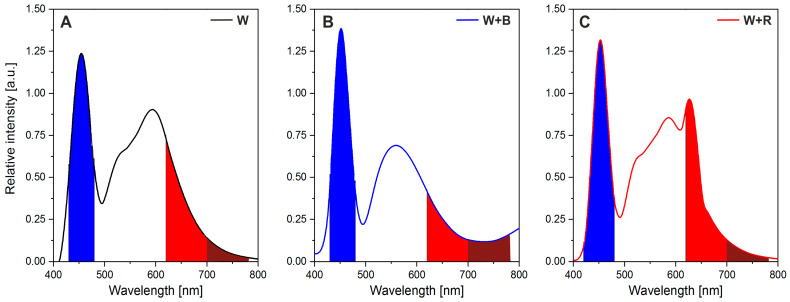
Microgreens are plants eaten at a very early stage of development, having a very high nutritional value. Among a large group of species, those from the Brassicaceae family, including kale, are very popularly grown as microgreens. Typically, microgreens are grown under controlled conditions under light-emitting diodes (LEDs). However, the effect of light on the quality of grown microgreens varies. The present study aimed to determine the effect of artificial white light with varying proportions of red (R) and blue (B) light on the morphological and photosynthetic parameters of kale microgreens with green and red leaves. The R:B ratios were for white light (W) 0.63, for red-enhanced white light (W + R) 0.75, and for white and blue light (W + B) 0.38 at 230 µmol m-2 s-1 PPFD. The addition of both blue and red light had a positive effect on the content of active compounds in the plants, including flavonoids and carotenoids. Red light had a stronger effect on the seedling area and the dry mass and relative chlorophyll content of red-leaved kale microgreens. Blue light, in turn, had a stronger effect on green kale, including dry mass. The W + B light combination negatively affected the chlorophyll content of both cultivars although the leaves were significantly thicker compared to cultivation under W + R light. In general, the cultivar with red leaves had less sensitivity to the photosynthetic apparatus to the spectrum used. The changes in PSII were much smaller in red kale compared to green kale. Too much red light caused a deterioration in the PSII vitality index in green kale. Red and green kale require an individual spectrum with different proportions of blue and red light at different growth stages to achieve plants with a large leaf area and high nutritional value.
Keywords: Brassica oleracea var. acephala L.; LEDs; blue light; red light.
Conflict of interest statement
The authors declare no conflict of interest.
Figures
References
-
- Treadwell D.D., Hochmuth R., Landrum L., Laughlin W. Microgreens: A New Specialty Crop. HS1164. UF/IFAS Extension; Gainesville, FL, USA: 2020. (Series of the Horticultural Sciences Department). - DOI
-
- Ying Q., Kong Y., Jones-Baumgardt C., Zheng Y. Responses of yield and appearance quality of four Brassicaceae microgreens to varied blue light proportion in red and blue light-emitting diodes lighting. Sci. Hortic. 2020;259:108857. doi: 10.1016/j.scienta.2019.108857. - DOI
-
- Pinto E., Almeida A.A., Aguiar A.A., Ferreira I.M. Comparison between the mineral profile and nitrate content of microgreens and mature lettuces. J. Food Compos. Anal. 2015;37:38–43. doi: 10.1016/j.jfca.2014.06.018. - DOI
-
- Drozdowska M., Leszczyńska T., Koronowicz A., Piasna-Słupecka E., Domagała D., Kusznierewicz B. Young shoots of red cabbage are a better source of selected nutrients and glucosinolates in comparison to the vegetable at full maturity. Eur. Food Res. Technol. 2020;246:2505–2515. doi: 10.1007/s00217-020-03593-x. - DOI
LinkOut - more resources
Full Text Sources
