


Improved detection of aberrant splicing with FRASER 2.0 and the intron Jaccard index
- PMID: 38006880
- PMCID: PMC10716352
- DOI: 10.1016/j.ajhg.2023.10.014
Improved detection of aberrant splicing with FRASER 2.0 and the intron Jaccard index
Abstract
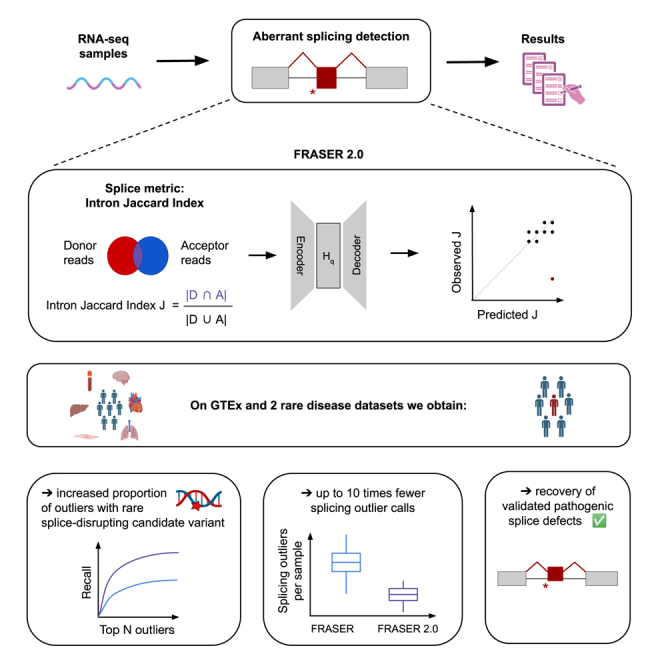
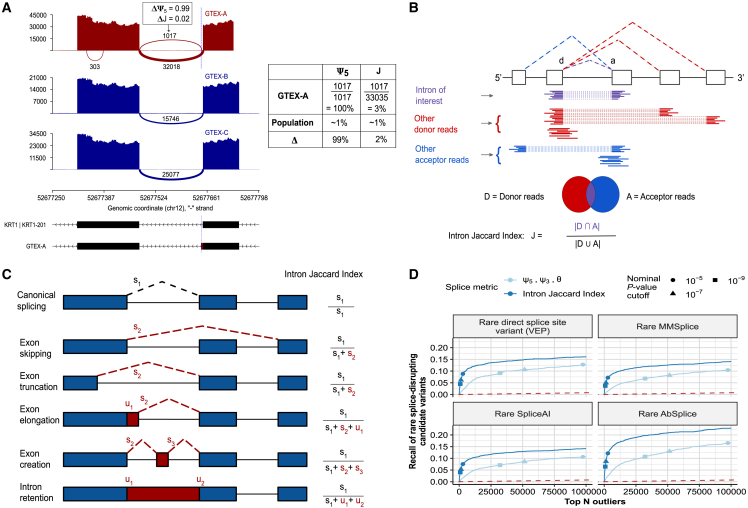
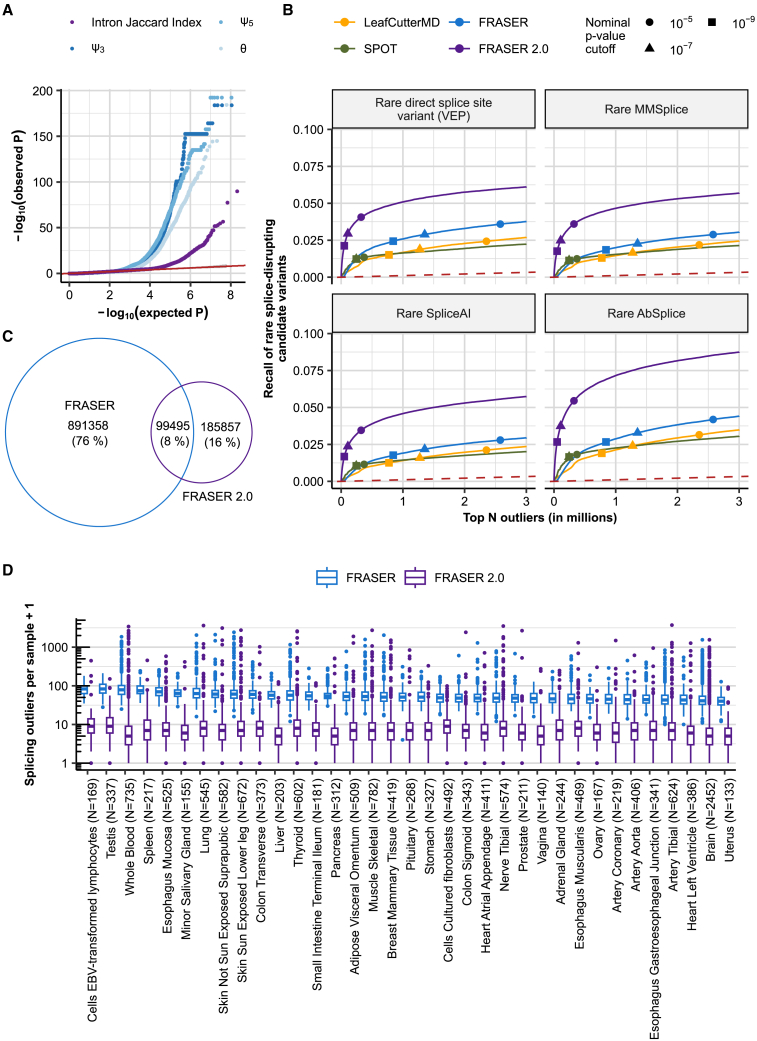
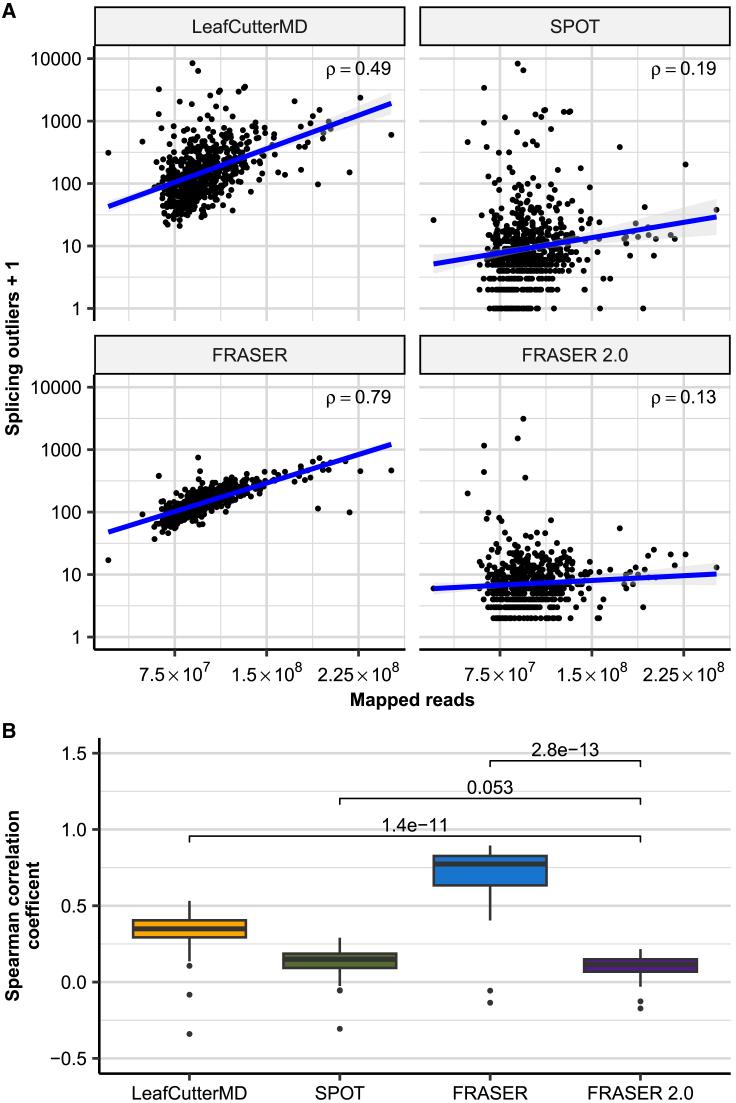
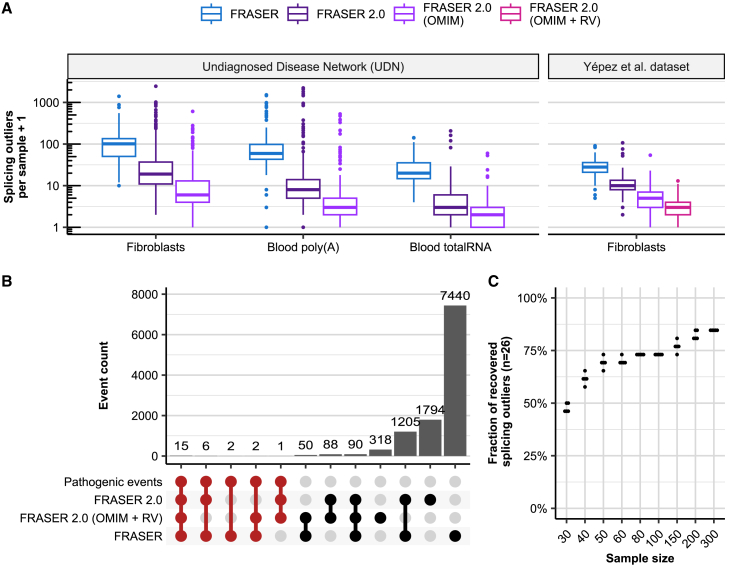
Detection of aberrantly spliced genes is an important step in RNA-seq-based rare-disease diagnostics. We recently developed FRASER, a denoising autoencoder-based method that outperformed alternative methods of detecting aberrant splicing. However, because FRASER's three splice metrics are partially redundant and tend to be sensitive to sequencing depth, we introduce here a more robust intron-excision metric, the intron Jaccard index, that combines the alternative donor, alternative acceptor, and intron-retention signal into a single value. Moreover, we optimized model parameters and filter cutoffs by using candidate rare-splice-disrupting variants as independent evidence. On 16,213 GTEx samples, our improved algorithm, FRASER 2.0, called typically 10 times fewer splicing outliers while increasing the proportion of candidate rare-splice-disrupting variants by 10-fold and substantially decreasing the effect of sequencing depth on the number of reported outliers. To lower the multiple-testing correction burden, we introduce an option to select the genes to be tested for each sample instead of a transcriptome-wide approach. This option can be particularly useful when prior information, such as candidate variants or genes, is available. Application on 303 rare-disease samples confirmed the relative reduction in the number of outlier calls for a slight loss of sensitivity; FRASER 2.0 recovered 22 out of 26 previously identified pathogenic splicing cases with default cutoffs and 24 when multiple-testing correction was limited to OMIM genes containing rare variants. Altogether, these methodological improvements contribute to more effective RNA-seq-based rare diagnostics by drastically reducing the amount of splicing outlier calls per sample at minimal loss of sensitivity.
Keywords: Aberrant splicing; RNA-seq; outlier detection; rare disease; rare disease diagnostics; rare variant.
Copyright © 2023 American Society of Human Genetics. Published by Elsevier Inc. All rights reserved.
Conflict of interest statement
Declaration of interests The authors declare no competing interests.
Figures
Update of
-
Improved detection of aberrant splicing using the Intron Jaccard Index.medRxiv [Preprint]. 2023 Apr 3:2023.03.31.23287997. doi: 10.1101/2023.03.31.23287997. medRxiv. 2023. Update in: Am J Hum Genet. 2023 Dec 7;110(12):2056-2067. doi: 10.1016/j.ajhg.2023.10.014. PMID: 37066374 Free PMC article. Updated. Preprint.
References
-
- Rogalska M.E., Vivori C., Valcárcel J. Regulation of pre-mRNA splicing: roles in physiology and disease, and therapeutic prospects. Nat. Rev. Genet. 2022:1–19. - PubMed
-
- López-Bigas N., Audit B., Ouzounis C., Parra G., Guigó R. Are splicing mutations the most frequent cause of hereditary disease? FEBS Lett. 2005;579:1900–1903. - PubMed
-
- Baralle D., Buratti E. RNA splicing in human disease and in the clinic. Clin. Sci. 2017;131:355–368. - PubMed
Publication types
MeSH terms
Grants and funding
- U01 HG007690/HG/NHGRI NIH HHS/United States
- U54 NS108251/NS/NINDS NIH HHS/United States
- U01 HG010219/HG/NHGRI NIH HHS/United States
- U01 HG007674/HG/NHGRI NIH HHS/United States
- U01 HG007672/HG/NHGRI NIH HHS/United States
- U01 HG010233/HG/NHGRI NIH HHS/United States
- U01 HG010230/HG/NHGRI NIH HHS/United States
- U01 HG007943/HG/NHGRI NIH HHS/United States
- U01 HG010217/HG/NHGRI NIH HHS/United States
- U01 HG007942/HG/NHGRI NIH HHS/United States
- U01 HG010215/HG/NHGRI NIH HHS/United States
- U01 HG007708/HG/NHGRI NIH HHS/United States
- U01 TR001395/TR/NCATS NIH HHS/United States
- U01 HG007709/HG/NHGRI NIH HHS/United States
- U54 NS093793/NS/NINDS NIH HHS/United States
- U01 HG007530/HG/NHGRI NIH HHS/United States
- U01 TR002471/TR/NCATS NIH HHS/United States
- U01 HG007703/HG/NHGRI NIH HHS/United States
LinkOut - more resources
Full Text Sources
