


Across ages and places: Unpredictability of maternal sensory signals and child internalizing behaviors
- PMID: 38007106
- PMCID: PMC10843791
- DOI: 10.1016/j.jad.2023.11.068
Across ages and places: Unpredictability of maternal sensory signals and child internalizing behaviors
Abstract
Background: Patterns of sensory inputs early in life play an integral role in shaping the maturation of neural circuits, including those implicated in emotion and cognition. In both experimental animal models and observational human research, unpredictable sensory signals have been linked to aberrant developmental outcomes, including poor memory and effortful control. These findings suggest that sensitivity to unpredictable sensory signals is conserved across species and sculpts the developing brain. The current study provides a novel investigation of unpredictable maternal sensory signals in early life and child internalizing behaviors. We tested these associations in three independent cohorts to probe the generalizability of associations across continents and cultures.
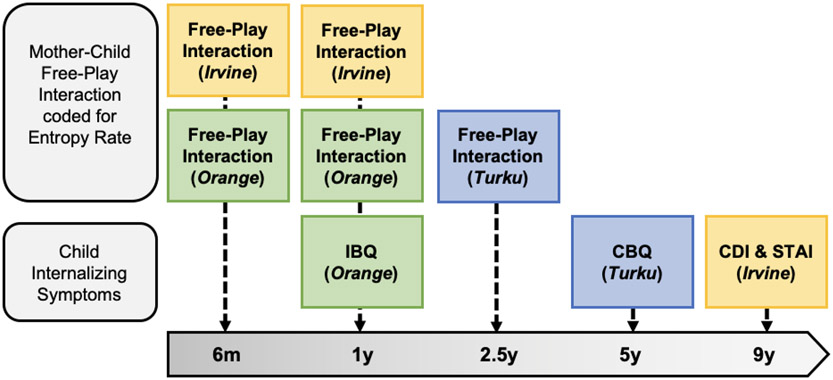
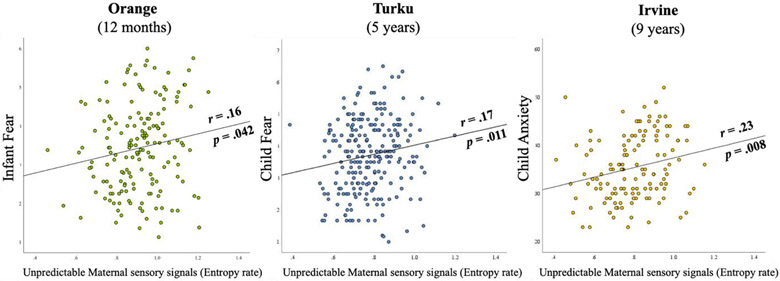
Method: The three prospective longitudinal cohorts were based in Orange, USA (n = 163, 47.2 % female, Mage = 1 year); Turku, Finland (n = 239, 44.8 % female, Mage = 5 years); and Irvine, USA (n = 129, 43.4 % female, Mage = 9.6 years). Unpredictability of maternal sensory signals was quantified during free-play interactions. Child internalizing behaviors were measured via parent report (Orange & Turku) and child self-report (Irvine).
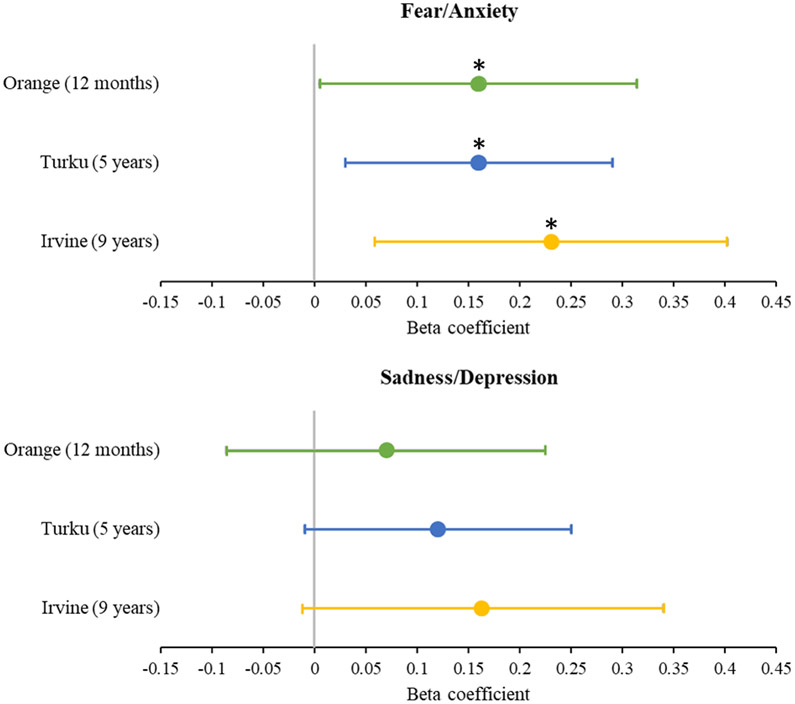
Results: Early life exposure to unpredictable maternal sensory signals was associated with greater child fearfulness/anxiety in all three cohorts, above and beyond maternal sensitivity and sociodemographic factors. The association between unpredictable maternal sensory signals and child sadness/depression was relatively weaker and did not reach traditional thresholds for statistical significance.
Limitations: The correlational design limits our ability to make causal inferences.
Conclusions: Findings across the three diverse cohorts suggest that unpredictable maternal signals early in life shape the development of internalizing behaviors, particularly fearfulness and anxiety.
Keywords: Anxiety; Depression; Early-life stress; Internalizing behaviors; Maternal care; Unpredictability.
Copyright © 2023 Elsevier B.V. All rights reserved.
Conflict of interest statement
Declaration of competing interest No conflicts of interests were reported by the authors.
Figures
References
-
- Achenbach TM, & Rescorla L (2001). Manual for the ASEBA school-age forms and profiles. Burlington, VT: University of Vermont, Research Center for Children, Youth, and Families.
-
- Ainsworth MDS, Blehar MC, Waters E, & Wall SN (1978). Patterns of Attachment: A Psychological Study of the Strange Situation. Earlbaum. 10.4324/9780203758045 - DOI
-
- Biringen Z, Moorlag A, Meyer B, Wood J, Aberle J, Altenhofen S, & Bennett S (2008). The Emotional Availability (EA) intervention with child care professionals. Journal of Early Childhood and Infant Psychology, 4, 39–52.
