


Evaluating the impact of an information-based education and training platform on the incidence, severity, and coping resources status of workplace violence among nurses: a quasi-experimental study
- PMID: 38007470
- PMCID: PMC10675880
- DOI: 10.1186/s12912-023-01606-0
Evaluating the impact of an information-based education and training platform on the incidence, severity, and coping resources status of workplace violence among nurses: a quasi-experimental study
Abstract
Background: Workplace violence among nurses has emerged as a critical issue, posing a significant threat to their occupational safety. Education and training are the primary measures employed to prevent and respond to workplace violence. However, the current approaches have proven ineffective, possibly due to a lack of consideration for the specific needs of clinical nurses. Therefore, it is essential to explore the effectiveness of an informational education and training platform tailored to nurses' requirements. This study aimed to investigate the impact of such a platform on the incidence, severity, and coping resources of WPV in nurses.
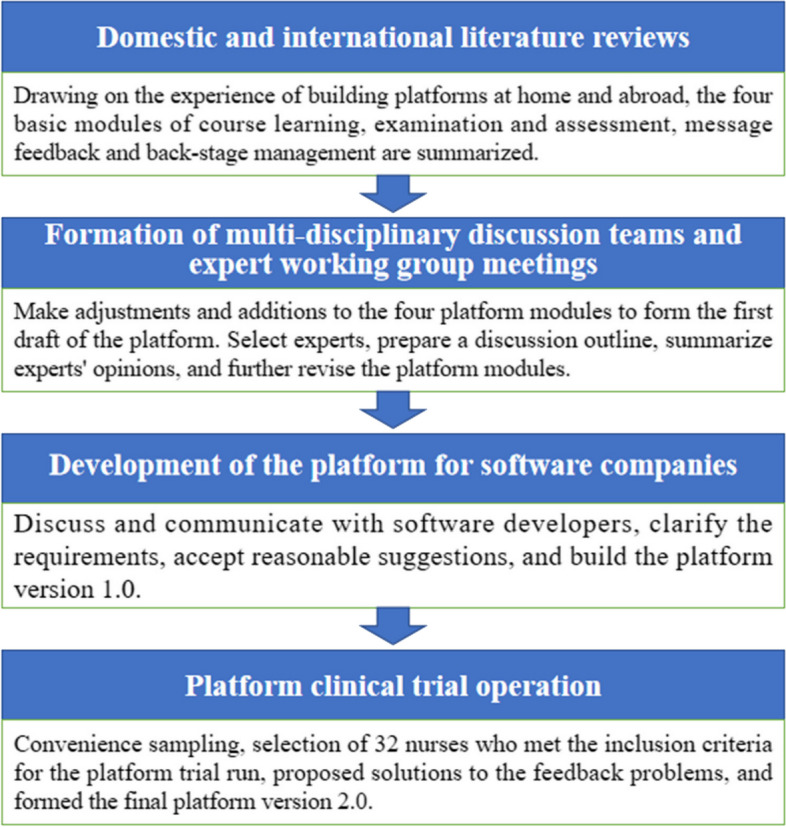
Methods: This research was a quasi-experimental study. An information-based education and training platform focused on nurse workplace violence was developed through literature reviews, expert meetings, consultations with software development companies, and a trial run. A tertiary general hospital in Suzhou was selected, in which hospital district A was the intervention group and hospital district B was the control group. A total of 276 nurses were recruited, 140 in the intervention group and 136 in the control group. The nurses' incidence, severity, coping resources status, and evaluation of the application were measured before the intervention and at 1, 3, and 6 months after the intervention.
Results: The overall incidence of workplace violence, verbal aggression, and verbal threat among nurses showed statistically significant differences (P < 0.05) for the time effect, while the incidence of physical aggression demonstrated statistically significant differences (P < 0.05) for the between-group effect and the time effect. The severity of physical violence among nurses exhibited statistically significant differences (P < 0.05) for the between-group effect and time effect, and the severity of psychological violence showed statistically significant differences (P < 0.05) for the time effect. Nurses' total coping resources score and dimensions also showed statistically significant differences in terms of group, time, and interaction effects (P < 0.001). The evaluation questionnaire for the mobile application indicated usefulness scores of 2 (1, 2); ease of learning scores of 2 (1, 2); ease of use scores of 2 (1, 2); trust scores of 2 (1, 2.75); acceptance score of 1 (1, 2); and satisfaction scores of 2 (1, 2).
Conclusions: Implementing the nurse workplace violence information-based education and training platform proved beneficial in reducing the incidence and severity of workplace violence among nurses and enhancing their coping resources. This outcome suggested the platform's potential for further application and promotion in clinical settings.
Keywords: Education and training; Information technology; Nurses; Platform; Questionnaire investigation; Workplace violence.
© 2023. The Author(s).
Conflict of interest statement
The authors declare no competing interests.
Figures
Similar articles
-
The effectiveness of a workplace violence prevention strategy based on situational prevention theory for nurses in managing violent situations: a quasi-experimental study.BMC Health Serv Res. 2023 Oct 26;23(1):1164. doi: 10.1186/s12913-023-10188-1. BMC Health Serv Res. 2023. PMID: 37885009 Free PMC article.
-
The effectiveness of mindfulness based programs in reducing stress experienced by nurses in adult hospital settings: a systematic review of quantitative evidence protocol.JBI Database System Rev Implement Rep. 2015 Oct;13(10):21-9. doi: 10.11124/jbisrir-2015-2380. JBI Database System Rev Implement Rep. 2015. PMID: 26571279
-
Trajectories of the current situation and characteristics of workplace violence among nurses: a nine-year follow-up study.BMC Health Serv Res. 2021 Nov 11;21(1):1220. doi: 10.1186/s12913-021-07245-y. BMC Health Serv Res. 2021. PMID: 34763686 Free PMC article.
-
Psychological Workplace Violence and Health Outcomes in South Korean Nurses.Workplace Health Saf. 2022 May;70(5):228-234. doi: 10.1177/21650799211025997. Epub 2021 Jul 26. Workplace Health Saf. 2022. PMID: 34308700 Review.
-
Managing Workplace Violence With Evidence-Based Interventions: A Literature Review.J Psychosoc Nurs Ment Health Serv. 2016 Sep 1;54(9):31-6. doi: 10.3928/02793695-20160817-05. J Psychosoc Nurs Ment Health Serv. 2016. PMID: 27576226 Review.
References
-
- Lin WQ, Jiang W, Yuan LX, Zhang SC, Jing MJ, Zhang HS, Luo JL, Lei YX, Wang PX. Workplace Violence and Job Performance among Community Healthcare Workers in China: The Mediator Role of Quality of Life. Int J Environ Res Public Health. 2015;12(11):14872–14886. doi: 10.3390/ijerph121114872. - DOI - PMC - PubMed
Grants and funding
- 71874117/National Natural Science Foundation of China
- 71874117/National Natural Science Foundation of China
- 71874117/National Natural Science Foundation of China
- 71874117/National Natural Science Foundation of China
- 71874117/National Natural Science Foundation of China
- SKY2023141/Suzhou People's Livelihood Science and Technology
- SKY2023141/Suzhou People's Livelihood Science and Technology
- SKY2023141/Suzhou People's Livelihood Science and Technology
- SKY2023141/Suzhou People's Livelihood Science and Technology
- SKY2023141/Suzhou People's Livelihood Science and Technology
- BXQN202234/First Affiliated Hospital of Soochow University Natural Science Foundation Cultivation Program
- BXQN202234/First Affiliated Hospital of Soochow University Natural Science Foundation Cultivation Program
- BXQN202234/First Affiliated Hospital of Soochow University Natural Science Foundation Cultivation Program
- BXQN202234/First Affiliated Hospital of Soochow University Natural Science Foundation Cultivation Program
- BXQN202234/First Affiliated Hospital of Soochow University Natural Science Foundation Cultivation Program
LinkOut - more resources
Full Text Sources
