


Community-guided, autism-adapted group cognitive behavioral therapy for depression in autistic youth (CBT-DAY): Preliminary feasibility, acceptability, and efficacy
- PMID: 38009186
- PMCID: PMC11128473
- DOI: 10.1177/13623613231213543
Community-guided, autism-adapted group cognitive behavioral therapy for depression in autistic youth (CBT-DAY): Preliminary feasibility, acceptability, and efficacy
Abstract
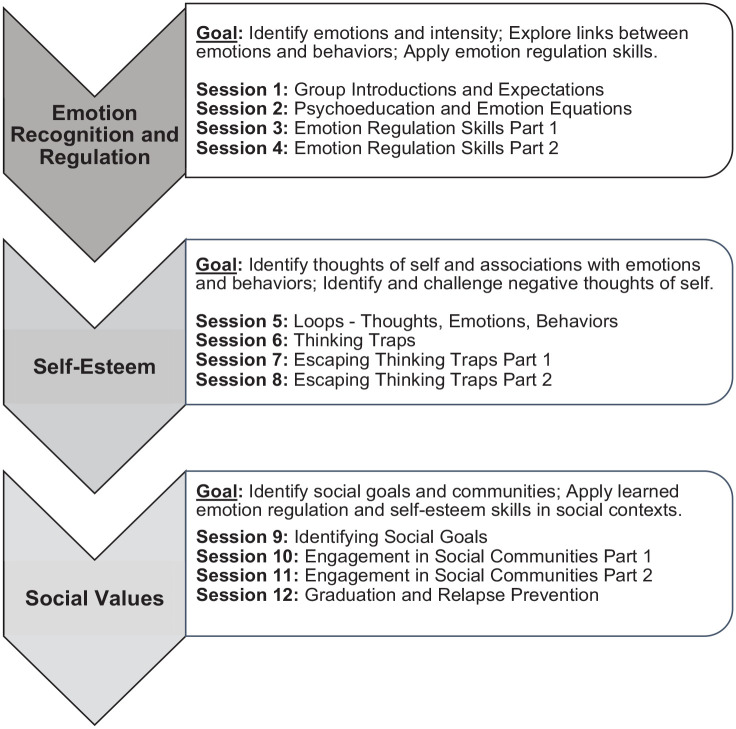
Depression in youth is a significant public health problem worldwide, particularly for autistic youth who are over twice as likely to experience depression than their non-autistic peers. Although pathways to depression are complex, emotional reactivity and negative self-esteem are two risk factors for depression in autistic and non-autistic youth. Although autistic youth are more likely to experience depression than their non-autistic peers, psychotherapy options for autistic youth are very limited; community guidance in the development and testing of psychotherapy programs is a promising approach in autism. Therefore, in this study, we designed an autism-adapted CBT-DAY, in collaboration with autistic community members. Specifically, CBT-DAY combined neurodiversity-affirming and cognitive behavioral approaches to target emotional reactivity and self-esteem in youth to improve depressive symptom severity in a group setting across 12 weeks. We examined the preliminary feasibility, acceptability, and efficacy of CBT-DAY in a pilot non-randomized trial. In addition, we implemented a rigorous protocol for assessing, monitoring, and addressing potential harms in this intervention. Results from 24 autistic youth (11-17 years old) suggest that CBT-DAY may be feasible to use in an outpatient clinical setting and generally acceptable to youth and their caregivers. Participation in CBT-DAY may be associated with significant improvements in youth emotional reactivity and self-esteem, as well as depressive symptom severity per self-report only. Exploratory analyses showed that participation in CBT-DAY may also be associated with significant improvements in internalizing symptoms. Findings demonstrate the potential promise of neurodiversity-affirming and cognitive behavioral approaches to treating depressive symptoms in some autistic youth.
Keywords: autism; cognitive behavioral therapy; community-guided intervention; depression; harms monitoring; youth.
Conflict of interest statement
Declaration of conflicting interestsThe author(s) declared the following potential conflicts of interest with respect to the research, authorship, and/or publication of this article: Jessica Schwartzman received partial salary support from facilitating the group therapy as a clinical provider in the Psychiatry Autism Research Team Clinic. Zachary Williams has received consulting fees from Roche, Autism Speaks, and the May Institute. He also serves on the family advisory committee of the Autism Speaks Autism Care Network Vanderbilt site and on the autistic researcher review board of the Autism Intervention Research Network on Physical Health (AIR-P). Zachary Williams and Marissa Roth co-facilitated a portion of the therapy groups as clinical trainees and received clinical supervision hours in this role; they were not financially compensated. The other authors have no conflicts of interest to declare.
References
-
- Attkisson C. C., Greenfield T. K. (1999). The UCSF client satisfaction scales: I. The client satisfaction Questionnaire-8. In Maruish M. E. (Eds.), The use of psychological testing for treatment planning and outcomes assessment (pp. 799–891). Lawrence Erlbaum.
-
- Avenevoli S., Swendsen J., He J. P., Burstein M., Merikangas K. R. (2015). Major depression in the national comorbidity survey–adolescent supplement: Prevalence, correlates, and treatment. Journal of the American Academy of Child and Adolescent Psychiatry, 54(1), 37–44.e2. 10.1016/j.jaac.2014.10.010 - DOI - PMC - PubMed
-
- Ben-Shachar M., Lüdecke D., Makowski D. (2020). effectsize: Estimation of effect size indices and standardized parameters. Journal of Open Source Software, 5(56), Article 2815. 10.21105/joss.02815 - DOI
Publication types
MeSH terms
Grants and funding
LinkOut - more resources
Full Text Sources
Medical
