


Effect of ventilation modalities on the early prognosis of patients with poststroke sleep apnea
- PMID: 38010089
- PMCID: PMC10863924
- DOI: 10.1002/acn3.51956
Effect of ventilation modalities on the early prognosis of patients with poststroke sleep apnea
Abstract
Objective: Continuous positive airway pressure (CPAP) is the primary modality for treating sleep apnea after acute ischemic stroke (AIS). However, not all patients are well adherent to CPAP. Finding an alternative modality of ventilation to CPAP is essential.
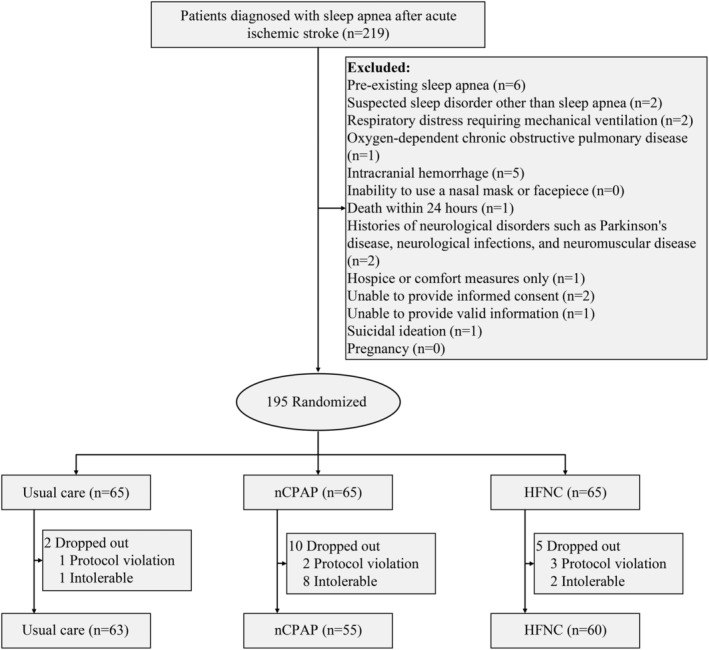
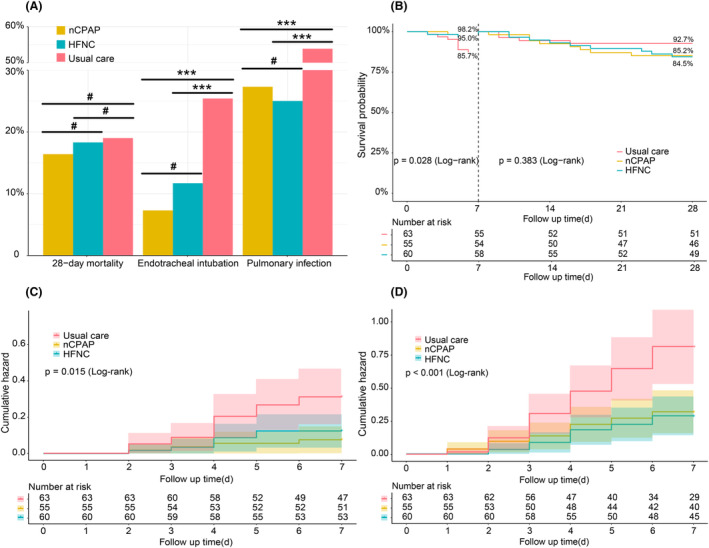
Methods: This prospective randomized clinical trial was conducted from 1 May 2022 to 8 January 2023 at the Department of Neurology, Wuhan Union Hospital. Participants diagnosed with sleep apnea after AIS were grouped according to block randomization principles into the usual care group (nasal cannula and facemask), nasal continuous positive airway pressure (nCPAP) group, and high-flow nasal cannula (HFNC) group. Rates of pulmonary infection and endotracheal intubation within 1 week of hospitalization and 28-day mortality (poststroke) were the primary outcomes (early prognosis).
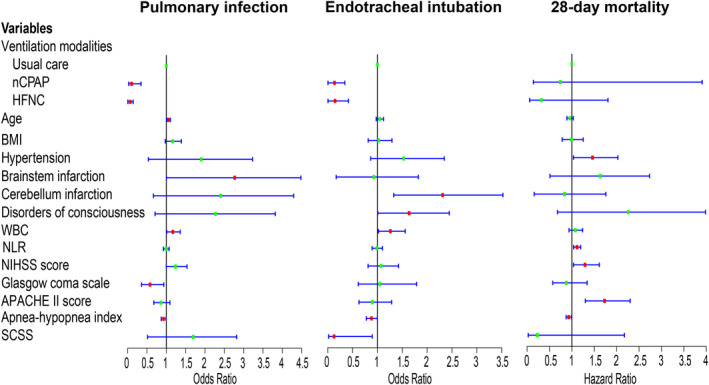
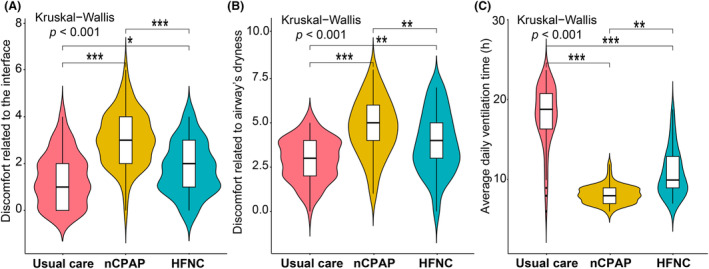
Results: In the trial, 178 patients (119 males [66.85%]; mean [SD] age, 61.04 [11.78] years) were eventually enrolled in the usual care group (n = 63), the nCPAP group (n = 55), and the HFNC group (n = 60). After ventilation, the nCPAP and HFNC groups were more effective than the usual care group in reducing the rate of pulmonary infection, endotracheal intubation, and improving neurological function and sleep apnea severity. However, there was no difference in 28-day mortality. Additionally, the improvement in prognosis was consistent between nCPAP and HFNC. In the comparison of comfort, the HFNC group was superior to nCPAP.
Interpretation: nCPAP and HFNC reduced early pulmonary infection rates and endotracheal intubation rates. For patients with poor compliance with nCPAP, HFNC may be the best alternative.
© 2023 The Authors. Annals of Clinical and Translational Neurology published by Wiley Periodicals LLC on behalf of American Neurological Association.
Conflict of interest statement
The authors declare no conflict of interests.
Figures
References
-
- Labarca G, Dreyse J, Drake L, Jorquera J, Barbe F. Efficacy of continuous positive airway pressure (CPAP) in the prevention of cardiovascular events in patients with obstructive sleep apnea: systematic review and meta‐analysis. Sleep Med Rev. 2020;52:101312. doi: 10.1016/j.smrv.2020.101312 - DOI - PubMed
Publication types
MeSH terms
Grants and funding
LinkOut - more resources
Full Text Sources
Medical