


Research priorities for improving menstrual health across the life-course in low- and middle-income countries
- PMID: 38010372
- PMCID: PMC10795652
- DOI: 10.1080/16549716.2023.2279396
Research priorities for improving menstrual health across the life-course in low- and middle-income countries
Abstract
Background: Research on menstrual health is required to understand menstrual needs and generate solutions to improve health, wellbeing, and productivity. The identification of research priorities will help inform where to invest efforts and resources.
Objectives: To identify research priorities for menstrual health across the life-course, in consultation with a range of stakeholder groups from a variety of geographic regions, and to identify if menstrual health research priorities varied by expertise.
Methods: A modified version of the Child Health and Nutrition Research Initiative approach was utilized to reach consensus on a set of research priorities. Multisector stakeholders with menstrual health expertise, identified through networks and the literature, were invited to submit research questions through an online survey. Responses were consolidated, and individuals were invited to rank these questions based on novelty, potential for intervention, and importance/impact. Research priority scores were calculated and evaluated by participants' characteristics.
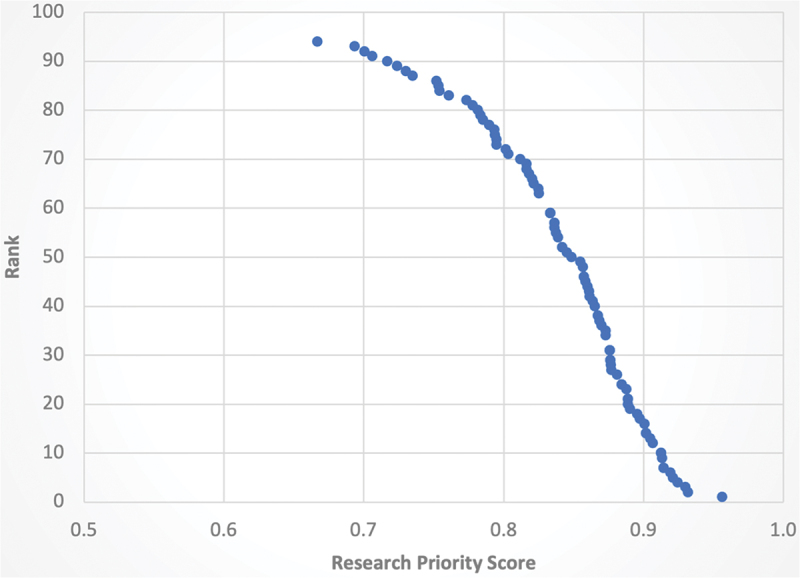
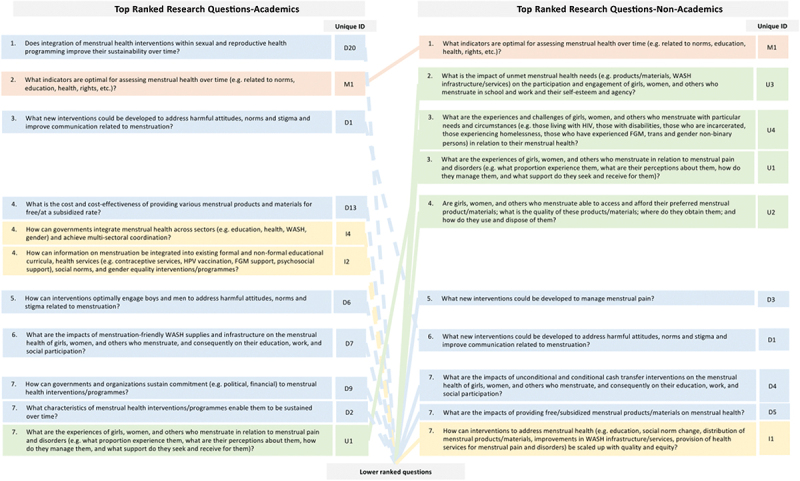
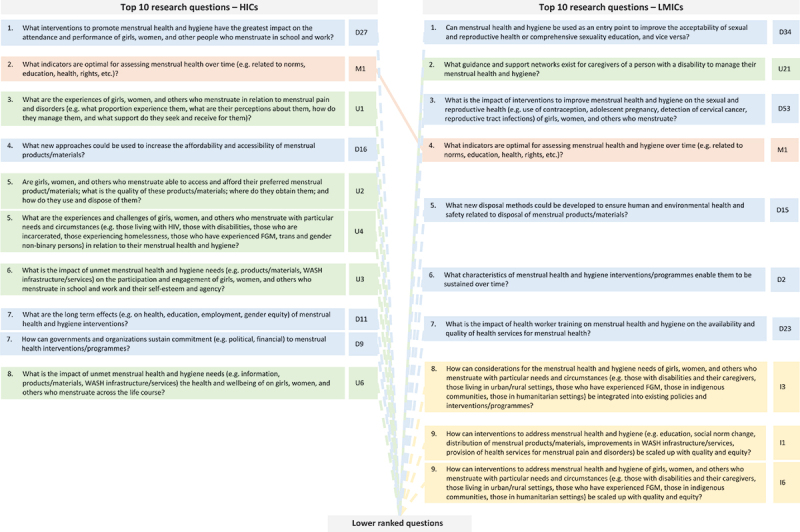
Results: Eighty-two participants proposed 1135 research questions, which were consolidated into 94 unique research questions. The mean number of questions did not differ between low- and middle-income country (LMIC) and high-income country (HIC) participants, but significantly more questions were raised by participants with expertise in mental health and WASH. Sixty-six participants then ranked these questions. The top ten-ranked research questions included four on 'understanding the problem', four on 'designing and implementing interventions', one on 'integrating and scaling up', and one on 'measurement'. Indicators for the measurement of adequate menstrual health over time was ranked the highest priority by all stakeholders. Top ten-ranked research questions differed between academics and non-academics, and between participants from HICs and LMICs, reflecting differences in needs and knowledge gaps.
Conclusions: A list of ranked research priorities was generated through a consultative process with stakeholders across LMICs and HICs which can inform where to invest efforts and resources.
Keywords: Education; Menstrual hygiene management; WASH; gender equity; menstrual health.
Conflict of interest statement
No potential conflict of interest was reported by the author(s).
Figures
References
-
- Phillips-Howard PA, Caruso B, Torondel B, Zulaika G, Sahin M, Sommer M. Menstrual hygiene management among adolescent schoolgirls in low- and middle-income countries: research priorities. Glob Health Action. 2016;9:33032. doi: 10.3402/gha.v9.33032 PubMed PMID: 27938648; PubMed Central PMCID: PMCPMC5148805. - DOI - PMC - PubMed
-
- Hennegan J, Shannon AK, Rubli J, Schwab KJ, Melendez-Torres GJ, Myers JE. Women’s and girls’ experiences of menstruation in low- and middle-income countries: a systematic review and qualitative metasynthesis. PLoS Med. 2019;16:e1002803. doi: 10.1371/journal.pmed.1002803 Epub 2019 May 17. PubMed PMID: 31095568; PubMed Central PMCID: PMCPMC6521998. - DOI - PMC - PubMed
-
- Mehjabeen D, Hunter EC, Mahfuz MT, Mobashara M, Rahman M, Sultana F. A qualitative content analysis of rural and urban school students’ menstruation-related questions in Bangladesh. Int J Environ Res Public Health. 2022;19. doi: 10.3390/ijerph191610140 Epub 2022 Aug 16. PubMed PMID: 36011779; PubMed Central PMCID: PMCPMC9408576. - DOI - PMC - PubMed
Publication types
MeSH terms
LinkOut - more resources
Full Text Sources
