. 2023 Nov 27;6(1):221.
doi: 10.1038/s41746-023-00961-1.

Causal inference using observational intensive care unit data: a scoping review and recommendations for future practice

Affiliations

Causal inference using observational intensive care unit data: a scoping review and recommendations for future practice

J M Smit et al. NPJ Digit Med. .

Abstract

This scoping review focuses on the essential role of models for causal inference in shaping actionable artificial intelligence (AI) designed to aid clinicians in decision-making. The objective was to identify and evaluate the reporting quality of studies introducing models for causal inference in intensive care units (ICUs), and to provide recommendations to improve the future landscape of research practices in this domain. To achieve this, we searched various databases including Embase, MEDLINE ALL, Web of Science Core Collection, Google Scholar, medRxiv, bioRxiv, arXiv, and the ACM Digital Library. Studies involving models for causal inference addressing time-varying treatments in the adult ICU were reviewed. Data extraction encompassed the study settings and methodologies applied. Furthermore, we assessed reporting quality of target trial components (i.e., eligibility criteria, treatment strategies, follow-up period, outcome, and analysis plan) and main causal assumptions (i.e., conditional exchangeability, positivity, and consistency). Among the 2184 titles screened, 79 studies met the inclusion criteria. The methodologies used were G methods (61%) and reinforcement learning methods (39%). Studies considered both static (51%) and dynamic treatment regimes (49%). Only 30 (38%) of the studies reported all five target trial components, and only seven (9%) studies mentioned all three causal assumptions. To achieve actionable AI in the ICU, we advocate careful consideration of the causal question of interest, describing this research question as a target trial emulation, usage of appropriate causal inference methods, and acknowledgement (and examination of potential violations of) the causal assumptions.


Conflict of interest statement

All authors have completed the ICMJE uniform disclosure form at www.icmje.org/coi_disclosure.pdf. Jeremy Labrecque is supported by Veni grant 09150162010213 from the Netherlands Organisation for Scientific Research (NWO) and the Netherlands Organisation for Health Research and Development (ZonMW). The authors declare no further competing financial or non-financial interests.

Figures

Fig. 1
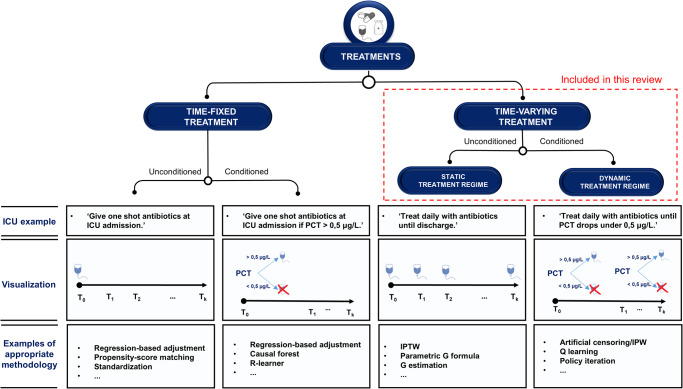
Fig. 1. Taxonomy of treatment types.
Treatments can be time-fixed or time-varying, and both these variants can be unconditioned, or conditioned on one or more (static and/or time-varying) patient characteristics, i.e., more ‘individualized’. Which methodology is appropriate to estimate causal effects of treatment using observational data, depends on the treatment type. The bottom row contains examples of some (not all) methodologies which could be used for the corresponding treatment type. Even when an appropriate method is used, satisfaction of the three causal assumptions (and hence, unbiased causal estimates) is not guaranteed. ICU intensive care unit, IPTW inverse-probability-of-treatment weighting, IPW inverse-probability weighting, PCT procalcitonin.
Fig. 2
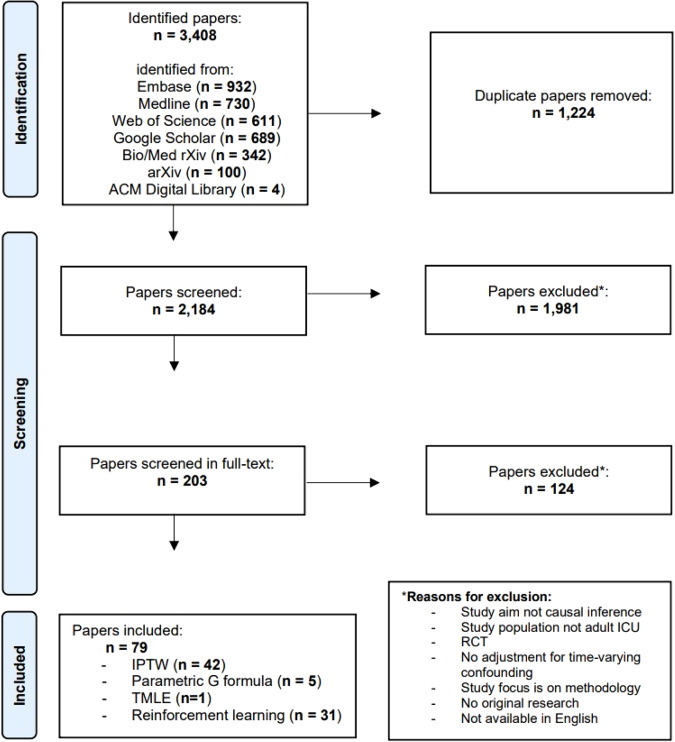
Fig. 2. Flowchart of study selection.
This flow diagram displays the screening strategy for the inclusion of studies in this scoping review.
Fig. 3
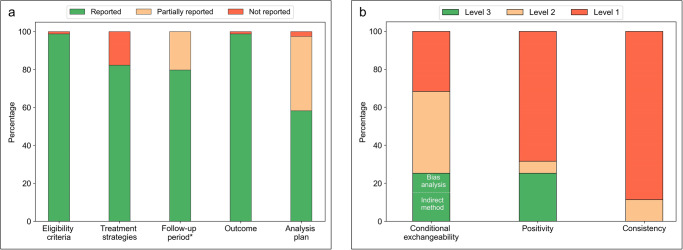
Fig. 3. Quality of Reporting summary plots.
a Reporting quality of the target trial components. *For the follow-up component, the studies that used simulated patient data (n = 5) are not taken into account. b Reporting quality of causal assumptions (level 1 = assumption not mentioned, level 2 = assumption mentioned, level 3 = attempt to check for potential violations of the assumption reported).
Fig. 4
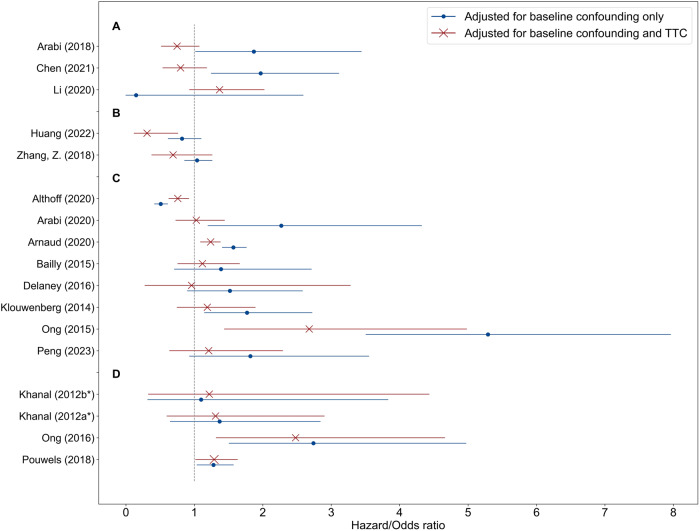
Fig. 4. Influence of adjusting for treatment-affected time-varying confounding.
Treatment effect estimates adjusted only for baseline confounding versus adjusted for baseline and treatment-affected time-varying confounding (TTC) reported by sixteen of the included studies. Treatment effects were reported in terms of odds or hazard ratios (including the reported 95% CIs). In three studies (A), the point estimates moved to the opposite direction, in two (B) and eight (C) studies, the estimates moved away from and towards the null hypothesis, respectively. In three studies (D), there was a marginal difference in point estimates. Pouwels et al. (2020) estimated treatment effect on length-of-stay (in terms of days) by adjusting for baseline confounding and by adjusting for baseline confounding and TTC, and found a marginal difference in point estimates. *Khanal et al. (2012) compared prolonged intermittent renal replacement therapy with two different alternative treatments.

References

    1. Komorowski, M. Artificial intelligence in intensive care: are we there yet? Intensive Care Med. 45, 1298–1300 (2019). - PubMed
    1. Yoon, J. H., Pinsky, M. R. & Clermont, G. Artificial intelligence in critical care medicine. Crit. Care26, 75 (2022). - PMC - PubMed
    1. Topol EJ. High-performance medicine: the convergence of human and artificial intelligence. Nat. Med. 2019;25:44–56. doi: 10.1038/s41591-018-0300-7. - DOI - PubMed
    1. van de Sande D, van Genderen ME, Huiskens J, Gommers D, van Bommel J. Moving from bytes to bedside: a systematic review on the use of artificial intelligence in the intensive care unit. Intensive Care Med. 2021;47:750–760. doi: 10.1007/s00134-021-06446-7. - DOI - PMC - PubMed
    1. Komorowski, M. Clinical Management of Sepsis can be Improved by Artificial Intelligence: Yes. Intensive Care Medicine (Springer, 2020). - PubMed

Publication types