This is a preprint.
Characterizing the Racial Discrepancy in Hypoxemia Detection in VV-ECMO: An ELSO Registry Analysis
- PMID: 38014220
- PMCID: PMC10680917
- DOI: 10.21203/rs.3.rs-3617237/v1
Characterizing the Racial Discrepancy in Hypoxemia Detection in VV-ECMO: An ELSO Registry Analysis
Update in
-
Characterizing the Racial Discrepancy in Hypoxemia Detection in Venovenous Extracorporeal Membrane Oxygenation: An Extracorporeal Life Support Organization Registry Analysis.Lung. 2024 Aug;202(4):471-481. doi: 10.1007/s00408-024-00711-4. Epub 2024 Jun 10. Lung. 2024. PMID: 38856932 Free PMC article.
Abstract
Importance: Skin pigmentation influences peripheral oxygen saturation (SpO2) measured by pulse oximetry compared to the arterial saturation of oxygen (SaO2) measured via arterial blood gas analysis. However, data on SpO2-SaO2 discrepancy are limited in venovenous-extracorporeal membrane oxygenation (VV-ECMO) patients.
Objective: To determine whether there is racial/ethnical discrepancy between SpO2 and SaO2 in patients receiving VV-ECMO. We hypothesized VV-ECMO cannulation, in addition to race/ethnicity, accentuates the SpO2-SaO2 discrepancy due to significant hemolysis.
Design: Retrospective cohort study of the Extracorporeal Life Support Organization Registry from 1/2018-5/2023.
Setting: International, multicenter registry study including over 500 ECMO centers.
Participants: Adults (≥ 18 years) supported with VV-ECMO with concurrently measured SpO2 and SaO2 measurements.
Exposure: Race/ethnicity and ECMO cannulation.
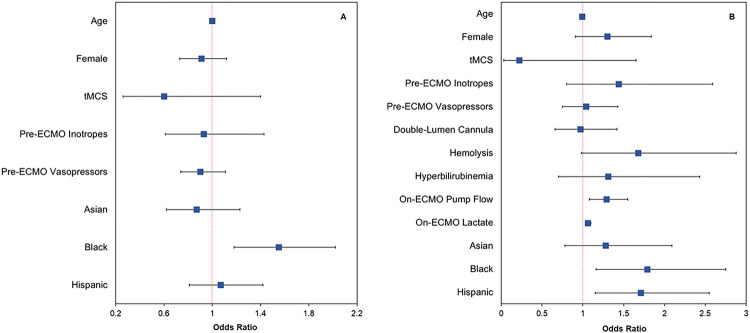
Main outcomes and measures: Occult hypoxemia (SaO2 ≤ 88% with SpO2 ≥ 92%) was our primary outcome. Multivariable logistic regressions were performed to examine whether race/ethnicity was associated with occult hypoxemia in pre-ECMO and on-ECMO SpO2-SaO2 calculations. Covariates included age, sex, temporary mechanical circulatory support, pre-vasopressors, and pre-inotropes for pre-ECMO analysis, plus single-lumen versus double-lumen cannulation, hemolysis, hyperbilirubinemia, ECMO pump flow rate, and on-ECMO 24h lactate for on-ECMO analysis.
Results: Of 13,171 VV-ECMO patients (median age = 48.6 years, 66% male), there were 7,772 (59%) White, 2,114 (16%) Hispanic, 1,777 (14%) Black, and 1,508 (11%) Asian patients. The frequency of on-ECMO occult hypoxemia was 2.0% (N = 233). Occult hypoxemia was more common in Black and Hispanic versus White patients (3.1% versus 1.7%, P < 0.001 and 2.5% versus 1.7%, P = 0.025, respectively).In multivariable logistic regression, Black patients were at higher risk of pre-ECMO occult hypoxemia versus White patients (adjusted odds ratio [aOR] = 1.55, 95% confidence interval [CI] = 1.18-2.02, P = 0.001). For on-ECMO occult hypoxemia, Black patients (aOR = 1.79, 95%CI = 1.16-2.75, P = 0.008) and Hispanic patients (aOR = 1.71, 95%CI = 1.15-2.55, P = 0.008) had higher risk versus White patients. Furthermore, higher pump flow rate (aOR = 1.29, 95%CI = 1.08-1.55, P = 0.005) and higher on-ECMO 24h lactate (aOR = 1.06, 95%CI = 1.03-1.10, P < 0.001) significantly increased the risk of on-ECMO occult hypoxemia.
Conclusions and relevance: Hispanic and Black VV-ECMO patients experienced occult hypoxemia more than White patients. SaO2 should be carefully monitored during ECMO support for Black and Hispanic patients especially for those with high pump flow and lactate values at risk for occult hypoxemia.
Keywords: arterial blood gas; hypoxemia; pulse oximetry; racial/ethnical disparities; venovenous extracorporeal membrane oxygenation.
Conflict of interest statement
Dr. Tonna is supported by a Career Development Award from the National Institutes of Health/National Heart, Lung, And Blood Institute (K23 HL141596). Dr. Tonna is the Chair of the Registry Committee of the Extracorporeal Life Support Organization (ELSO). Dr. Brodie receives research support from and consults for LivaNova. He has been on the medical advisory boards for Abiomed, Xenios, Medtronic, Inspira and Cellenkos. He is the President-elect of the Extracorporeal Life Support Organization (ELSO) and the Chair of the Executive Committee of the International ECMO Network (ECMONet), and he writes for UpToDate. Dr. Lorusso is a consultant for Medtronic, LivaNova, Getinge and ASbiomed, and Member of the Medical Advisory Board of Eurosets and Xenios. He is the ELSO Research Committee Chair, and Honorary Secretary of EuroELSO. The authors do not have any additional conflicts of interest to declare. SPK is supported by NHLBI (5K08HL14332). SMC is supported by NHLBI (1K23HL157610).Disclosures: The authors have nothing to disclose
Figures


References
-
- Castro D, Patil SM, Keenaghan M. Arterial Blood Gas. StatPearls. StatPearls Publishing Copyright © 2022, StatPearls Publishing LLC.; 2022. - PubMed
Publication types
Grants and funding
LinkOut - more resources
Full Text Sources