


Efficacy and Adherence Rates of a Novel Community-Informed Virtual World-Based Cardiac Rehabilitation Program: Protocol for the Destination Cardiac Rehab Randomized Controlled Trial
- PMID: 38014699
- PMCID: PMC10727355
- DOI: 10.1161/JAHA.123.030883
Efficacy and Adherence Rates of a Novel Community-Informed Virtual World-Based Cardiac Rehabilitation Program: Protocol for the Destination Cardiac Rehab Randomized Controlled Trial
Abstract
Background: Innovative restructuring of cardiac rehabilitation (CR) delivery remains critical to reduce barriers and improve access to diverse populations. Destination Cardiac Rehab is a novel virtual world technology-based CR program delivered through the virtual world platform, Second Life, which previously demonstrated high acceptability as an extension of traditional center-based CR. This study aims to evaluate efficacy and adherence of the virtual world-based CR program compared with center-based CR within a community-informed, implementation science framework.
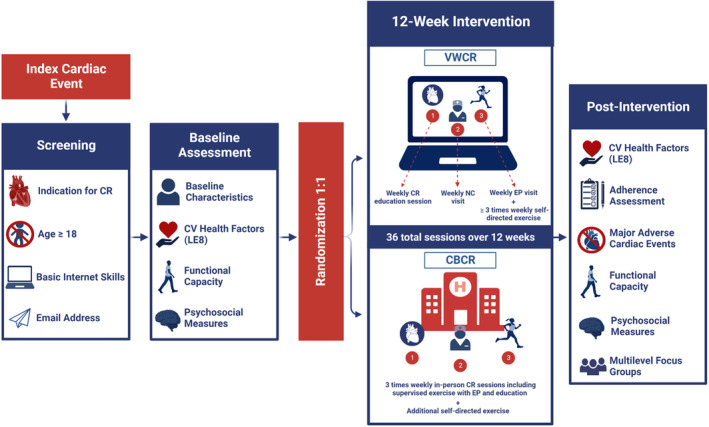
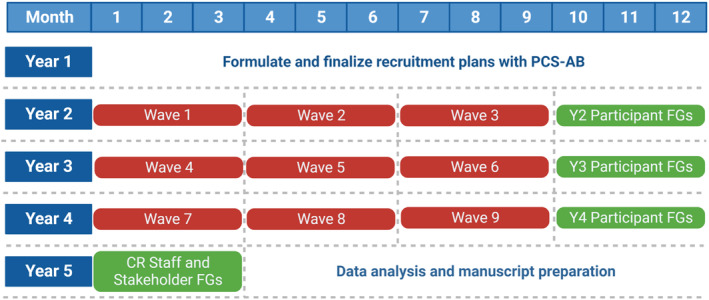
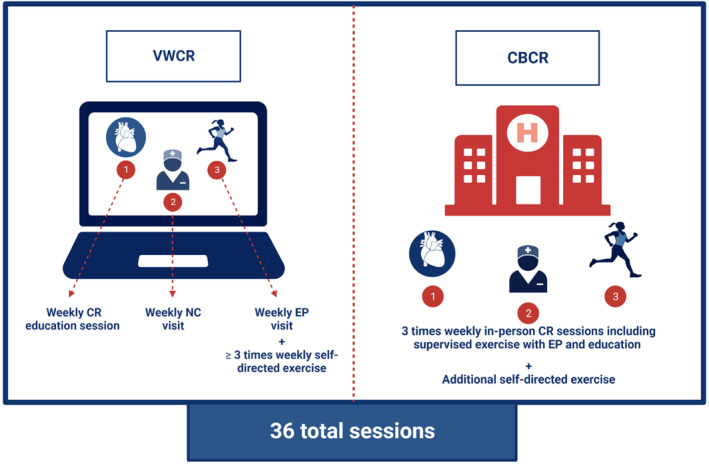
Methods: Using a noninferiority, hybrid type 1 effectiveness-implementation, randomized controlled trial, 150 patients with an eligible cardiovascular event will be recruited from 6 geographically diverse CR centers across the United States. Participants will be randomized 1:1 to either the 12-week Destination Cardiac Rehab or the center-based CR control groups. The primary efficacy outcome is a composite cardiovascular health score based on the American Heart Association Life's Essential 8 at 3 and 6 months. Adherence outcomes include CR session attendance and participation in exercise sessions. A diverse patient/caregiver/stakeholder advisory board was assembled to guide recruitment, implementation, and dissemination plans and to contextualize study findings. The institutional review board-approved randomized controlled trial will enroll and randomize patients to the intervention (or control group) in 3 consecutive waves/year over 3 years. The results will be published at data collection and analyses completion.
Conclusions: The Destination Cardiac Rehab randomized controlled trial tests an innovative and potentially scalable model to enhance CR participation and advance health equity. Our findings will inform the use of effective virtual CR programs to expand equitable access to diverse patient populations.
Registration: URL: https://www.clinicaltrials.gov; Unique identifier: NCT05897710.
Keywords: cardiac rehabilitation; cardiovascular health; health disparities; home‐based programs; social determinants of health.
Figures

References
-
- Ritchey MD, Maresh S, McNeely J, Shaffer T, Jackson SL, Keteyian SJ, Brawner CA, Whooley MA, Chang T, Stolp H, et al. Tracking cardiac rehabilitation participation and completion among Medicare beneficiaries to inform the efforts of a national initiative. Circ Cardiovasc Qual Outcomes. 2020;13:e005902. doi: 10.1161/circoutcomes.119.005902 - DOI - PMC - PubMed
-
- Thomas RJ, Balady G, Banka G, Beckie TM, Chiu J, Gokak S, Ho PM, Keteyian SJ, King M, Lui K, et al. 2018 ACC/AHA clinical performance and quality measures for cardiac rehabilitation: a report of the American College of Cardiology/American Heart Association Task Force on Performance Measures. J Am Coll Cardiol. 2018;71:1814–1837. doi: 10.1016/j.jacc.2018.01.004 - DOI - PubMed
