


Liraglutide 3.0 mg and mental health: can psychiatric symptoms be associated to adherence to therapy? Insights from a clinical audit
- PMID: 38015342
- PMCID: PMC10684642
- DOI: 10.1007/s40519-023-01625-5
Liraglutide 3.0 mg and mental health: can psychiatric symptoms be associated to adherence to therapy? Insights from a clinical audit
Abstract
Introduction: Liraglutide 3.0 mg, a glucagon-like peptide-1 (GLP-1) analogue, is a medication approved for obesity treatment. This study aimed to investigate the relationship between psychiatric symptoms, including depression, anxiety, and binge eating, and their impact on therapy adherence.
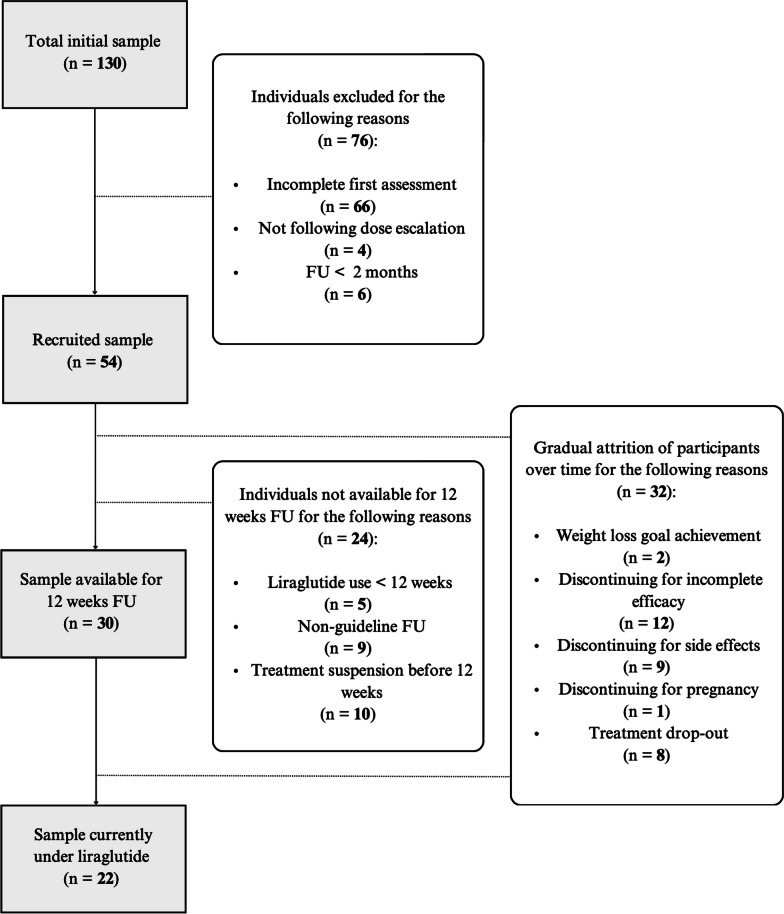
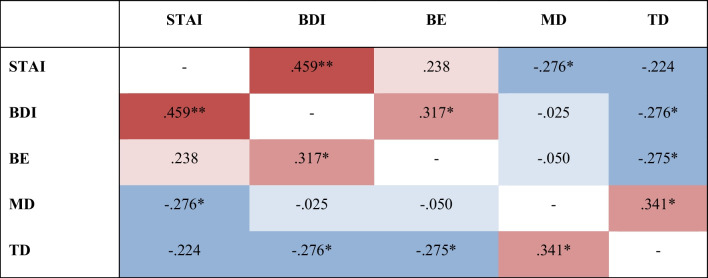
Methods: A clinical audit was carried out on a cohort of 54 adults with obesity treated with liraglutide 3.0 mg. We retrospectively analyzed the connection between psychiatric symptoms assessed through the State-Trait Anxiety Inventory (STAI), Beck Depression Inventory (BDI), and Binge Eating Scale (BES). Adherence to therapy was assessed by the maximum dosage (MD) and treatment duration (TD).
Results: Notably, a discontinuation rate of 59% was encountered. However, among those who continued the treatment, we observed a negative association between anxiety symptoms (STAI score) and MD, depression symptoms (BDI score) and TD, and a higher likelihood of binge eating (BES score > 17) and TD. Moreover, presence of psychiatric symptoms did not compromise drug's effectiveness in achieving weight loss, which was 4.43% (± 5.5 SD) in the whole sample and 5.3% (± 6.3 SD) in the subgroup evaluated at 12 weeks.
Conclusion: We observed a high discontinuation rate in real-life clinical setting, where Liraglutide 3.0 therapy is paid out-of-pocket. While psychiatric symptoms might play a role in diminishing adherence to therapy, they do not prevent drug's effectiveness to promote weight loss. This finding underscores the potential advantages of liraglutide 3.0 mg therapy for individuals contending with obesity while simultaneously managing mental health challenges.
Level of evidence: Level V, descriptive studies.
Keywords: Adherence; Anxiety; Binge eating; Depression; GLP-1 receptor agonists; Obesity.
© 2023. The Author(s).
Conflict of interest statement
MLP has received honoraria for lectures from Novo Nordisk and Bruno Farmaceutici, for advisory boards from Novo Nordisk and has participated in sponsored studies by Novo Nordisk. The remaining authors have no relevant financial or non-financial interests to disclose.
Figures
References
-
- Sabate E (2003). Adherence to long term therapies: evidence for action. Geneva: World Health Organization. https://apps.who.int/iris/handle/10665/42682
MeSH terms
Substances
LinkOut - more resources
Full Text Sources
Medical
Research Materials
