Review
. 2024 Jul;40(7):963-980.
doi: 10.1007/s12264-023-01149-z. Epub 2023 Nov 28.

Advance and Application of Single-cell Transcriptomics in Auditory Research

Affiliations
Review

Advance and Application of Single-cell Transcriptomics in Auditory Research

Xiangyu Ma et al. Neurosci Bull. 2024 Jul.

Abstract

Hearing loss and deafness, as a worldwide disability disease, have been troubling human beings. However, the auditory organ of the inner ear is highly heterogeneous and has a very limited number of cells, which are largely uncharacterized in depth. Recently, with the development and utilization of single-cell RNA sequencing (scRNA-seq), researchers have been able to unveil the complex and sophisticated biological mechanisms of various types of cells in the auditory organ at the single-cell level and address the challenges of cellular heterogeneity that are not resolved through by conventional bulk RNA sequencing (bulk RNA-seq). Herein, we reviewed the application of scRNA-seq technology in auditory research, with the aim of providing a reference for the development of auditory organs, the pathogenesis of hearing loss, and regenerative therapy. Prospects about spatial transcriptomic scRNA-seq, single-cell based genome, and Live-seq technology will also be discussed.

Keywords: Auditory sensory epithelium; Cochlear; Inner ear; Single-cell RNA sequencing; Spiral ganglion neuron.


Conflict of interest statement

The authors declare that there are no conflicts of interest.

Figures
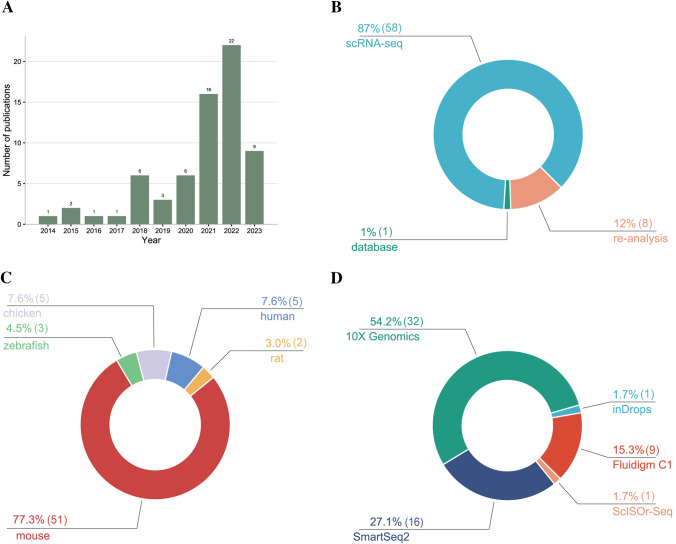
Fig. 1
Fig. 1
The summary of publications of scRNA-seq in auditory research. A A stack histogram shows that between 2014 and July 29, 2023, the number of publications related to single-cell transcriptomics in the field of auditory research has increased, and the number has increased dramatically in the last two years. B Number of publications by study types."scRNA-seq" indicates the original studies that generate scRNA-seq data."re-analysis refers to the re-analysis studies of the published scRNA-seg datasets."database" means the online database dedicated to the study of the inner ear. C Number of publications by type of source of sample species. D Number of publications by sequencing method types.
Fig. 2
Fig. 2
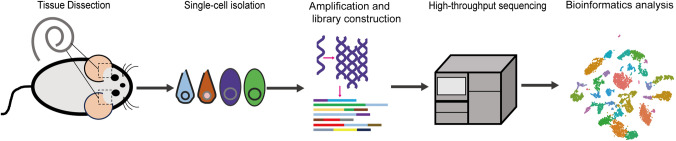
Basic process of scRNA-seq.
Fig. 3
Fig. 3
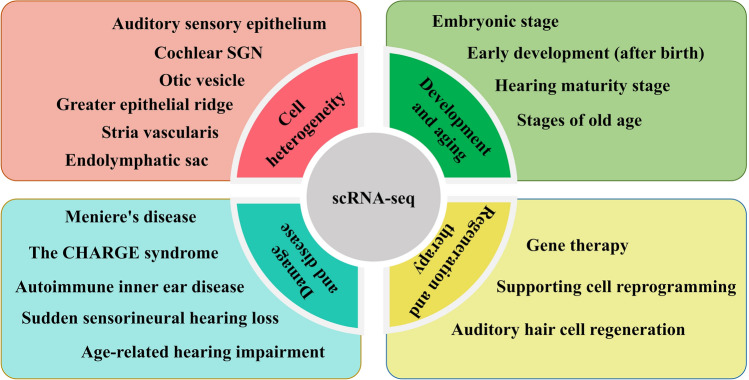
Hearing loss and deafness have been the subject of global concern as they are prevalent disabilities. Through the utilization of scRNA-seq, many aspects in the field of auditory research have been significantly advanced, including the heterogeneity, development, aging, and deafness-related diseases of auditory organ cells, as well as the regeneration and treatment of hair cells.

References

    1. Chadha S, Kamenov K, Cieza A. The world report on hearing, 2021. Bull World Health Organ. 2021;99:242–242A. doi: 10.2471/BLT.21.285643. - DOI - PMC - PubMed
    1. Basch ML, Brown RM, II, Jen HI, Groves AK. Where hearing starts: The development of the mammalian cochlea. J Anat. 2016;228:233–254. doi: 10.1111/joa.12314. - DOI - PMC - PubMed
    1. Müller U, Barr-Gillespie PG. New treatment options for hearing loss. Nat Rev Drug Discov. 2015;14:346–365. doi: 10.1038/nrd4533. - DOI - PubMed
    1. Driver EC, Kelley MW. Development of the cochlea. Development 2020, 147: dev162263. - PMC - PubMed
    1. Hedlund E, Deng Q. Single-cell RNA sequencing: Technical advancements and biological applications. Mol Aspects Med. 2018;59:36–46. doi: 10.1016/j.mam.2017.07.003. - DOI - PubMed

LinkOut - more resources