


Saccharomyces cerevisiae additions normalized hemocyte differential genes expression and regulated crayfish (Procambarus clarkii) oxidative damage under cadmium stress
- PMID: 38016989
- PMCID: PMC10684557
- DOI: 10.1038/s41598-023-47323-1
Saccharomyces cerevisiae additions normalized hemocyte differential genes expression and regulated crayfish (Procambarus clarkii) oxidative damage under cadmium stress
Erratum in
-
Author Correction: Saccharomyces cerevisiae additions normalized hemocyte differential genes expression and regulated crayfish (Procambarus clarkii) oxidative damage under cadmium stress.Sci Rep. 2023 Dec 15;13(1):22491. doi: 10.1038/s41598-023-48846-3. Sci Rep. 2023. PMID: 38110452 Free PMC article. No abstract available.
Abstract
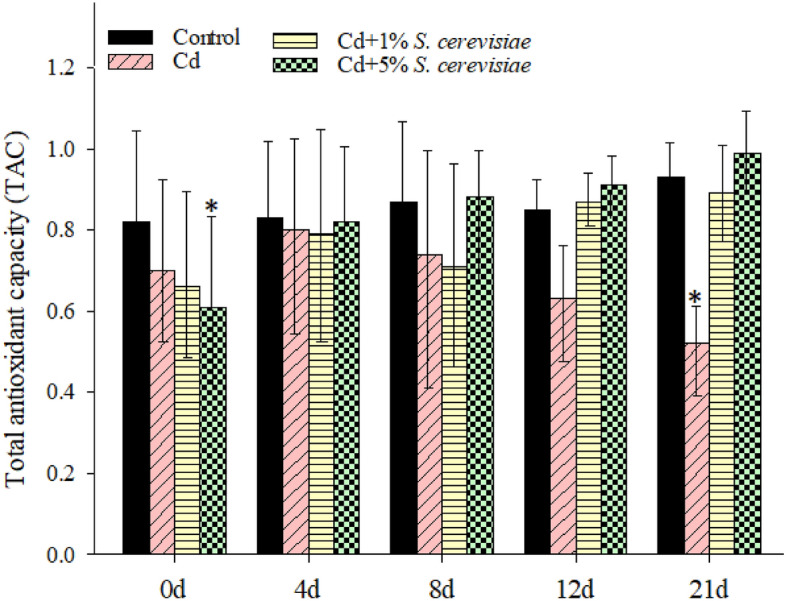
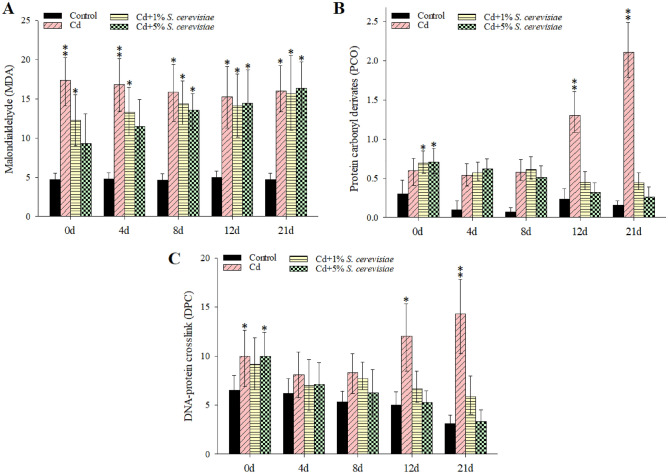
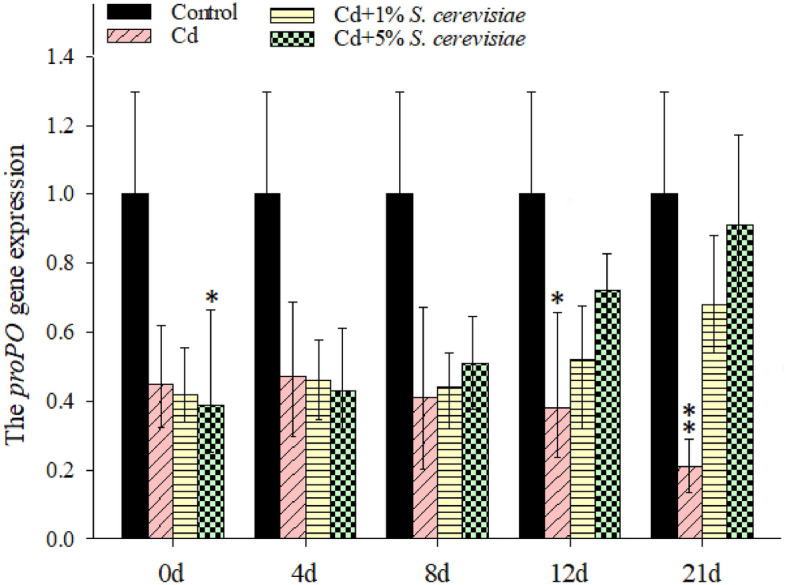
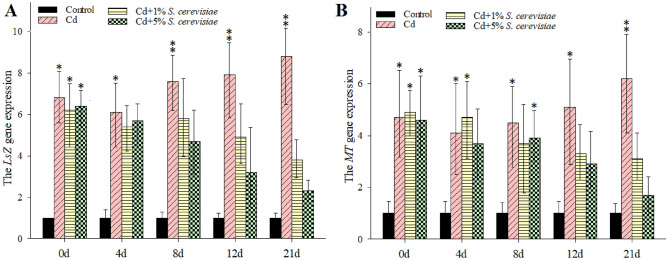
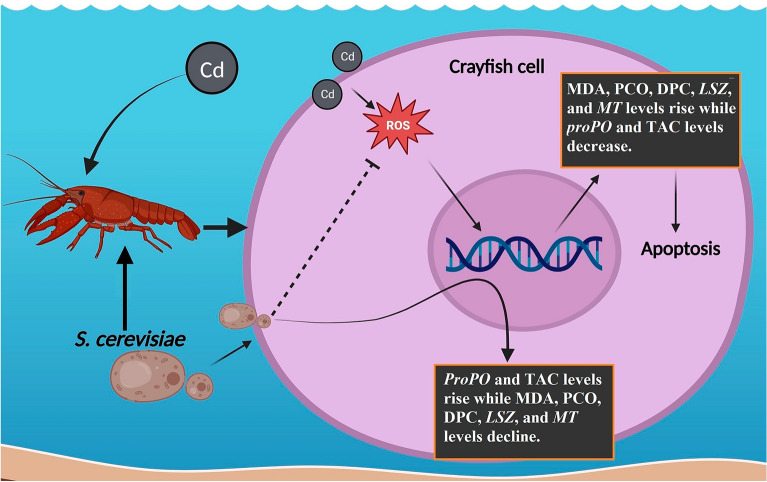
Because China produces the most crayfish in the world, safe solutions must be improved to mitigate the risks of ongoing heavy metal stressors accumulation. This study aimed to use Saccharomyces cerevisiae as a bioremediation agent to counteract the harmful effect of cadmium (Cd) on crayfish (Procambarus clarkia). Our study used three concentrations of S. cerevisiae on crayfish feed to assess their Cd toxicity remediation effect by measuring total antioxidant capacity (TAC) and the biomarkers related to oxidative stress like malondialdehyde (MDA), protein carbonyl derivates (PCO), and DNA-protein crosslink (DPC). A graphite furnace atomic absorption spectroscopy device was used to determine Cd contents in crayfish. Furthermore, the mRNA expression levels of lysozyme (LSZ), metallothionein (MT), and prophenoloxidase (proPO) were evaluated before and following the addition of S. cerevisiae. The results indicated that S. cerevisae at 5% supplemented in fundamental feed exhibited the best removal effect, and Cd removal rates at days 4th, 8th, 12th, and 21st were 12, 19, 29.7, and 66.45%, respectively, which were significantly higher than the basal diet of crayfish. The addition of S. cerevisiae increased TAC levels. On the other hand, it decreased MDA, PCO, and DPC, which had risen due to Cd exposure. Furthermore, it increased the expression of proPO, which was reduced by Cd exposure, and decreased the expression of LSZ and MT, acting in the opposite direction of Cd exposure alone. These findings demonstrated that feeding S. cerevisiae effectively reduces the Cd from crayfish and could be used to develop Cd-free crayfish-based foods.
© 2023. The Author(s).
Conflict of interest statement
The authors declare no competing interests.
Figures
References
-
- El-Sappah AH, Rather SA. Genomics approaches to study abiotic stress tolerance in plants. In: Aftab T, Hakeem R, editors. Plant Abiotic Stress Physiology: Molecular Advancements. Apple Academic Press; 2022. pp. 25–46.
-
- Sardar K, et al. Heavy metals contamination and what are the impacts on living organisms. Greener J. Environ. Manag. Public Saf. 2013;2:172–179. doi: 10.15580/GJEMPS.2013.4.060413652. - DOI
-
- Jawad S, Al-Taher Q, Shihab A. Melanoides tuberculate as Bioindicator of the Heavy Metal Contamination in Water and Sediment Pollution of Euphrates River at Thi-Qar province, Iraq. Health Educ. Health Promot. 2022;10:247–253.
-
- El-Demerdash FM, Yousef MI, Kedwany FS, Baghdadi HH. Cadmium-induced changes in lipid peroxidation, blood hematology, biochemical parameters and semen quality of male rats: Protective role of vitamin E and β-carotene. Food Chem. Toxicol. 2004;42:1563–1571. doi: 10.1016/j.fct.2004.05.001. - DOI - PubMed
MeSH terms
Substances
Grants and funding
LinkOut - more resources
Full Text Sources
