Randomized Controlled Trial
. 2023 Nov 28;13(1):20884.
doi: 10.1038/s41598-023-48063-y.

The effect of bodyweight exercise on 24-h glycemic responses determined by continuous glucose monitoring in healthy inactive adults: a randomized crossover study

Affiliations
Randomized Controlled Trial

The effect of bodyweight exercise on 24-h glycemic responses determined by continuous glucose monitoring in healthy inactive adults: a randomized crossover study

Fiona J Babir et al. Sci Rep. .

Abstract

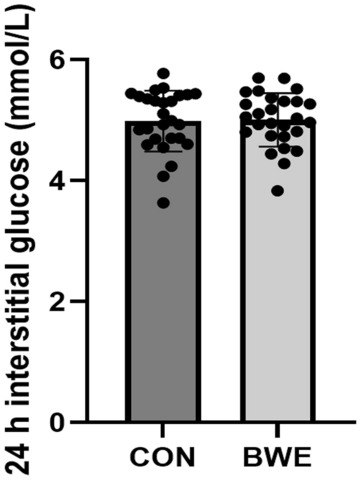
Vigorous intermittent exercise can improve indices of glycemia in the 24 h postexercise period in apparently healthy individuals. We examined the effect of a single session of bodyweight exercise (BWE) on glycemic responses using continuous glucose monitoring (CGM) under controlled dietary conditions. Healthy inactive adults (n = 27; 8 males, 19 females; age: 23 ± 3 years) completed 2 virtually supervised trials spaced ~ 1 week apart in a randomized, crossover manner. The trials involved an 11-min BWE protocol that consisted of 5 × 1-min bouts performed at a self-selected pace interspersed with 1-min active recovery periods or a non-exercise sitting control period (CON). Mean heart rate during the BWE protocol was 147 ± 14 beats per min (75% of age-predicted maximum). Mean 24 h glucose after BWE and CON was not different (5.0 ± 0.4 vs 5.0 ± 0.5 mM respectively; p = 0.39). There were also no differences between conditions for measures of glycemic variability or the postprandial glucose responses after ingestion of a 75 g glucose drink or lunch, dinner, and breakfast meals. This study demonstrates the feasibility of conducting a remotely supervised BWE intervention using CGM under free-living conditions. Future studies should investigate the effect of repeated sessions of BWE training or responses in people with impaired glycemic control.


Conflict of interest statement

MCR serves as a scientific advisor to Supersapiens. The other authors declare no competing interests.

Figures
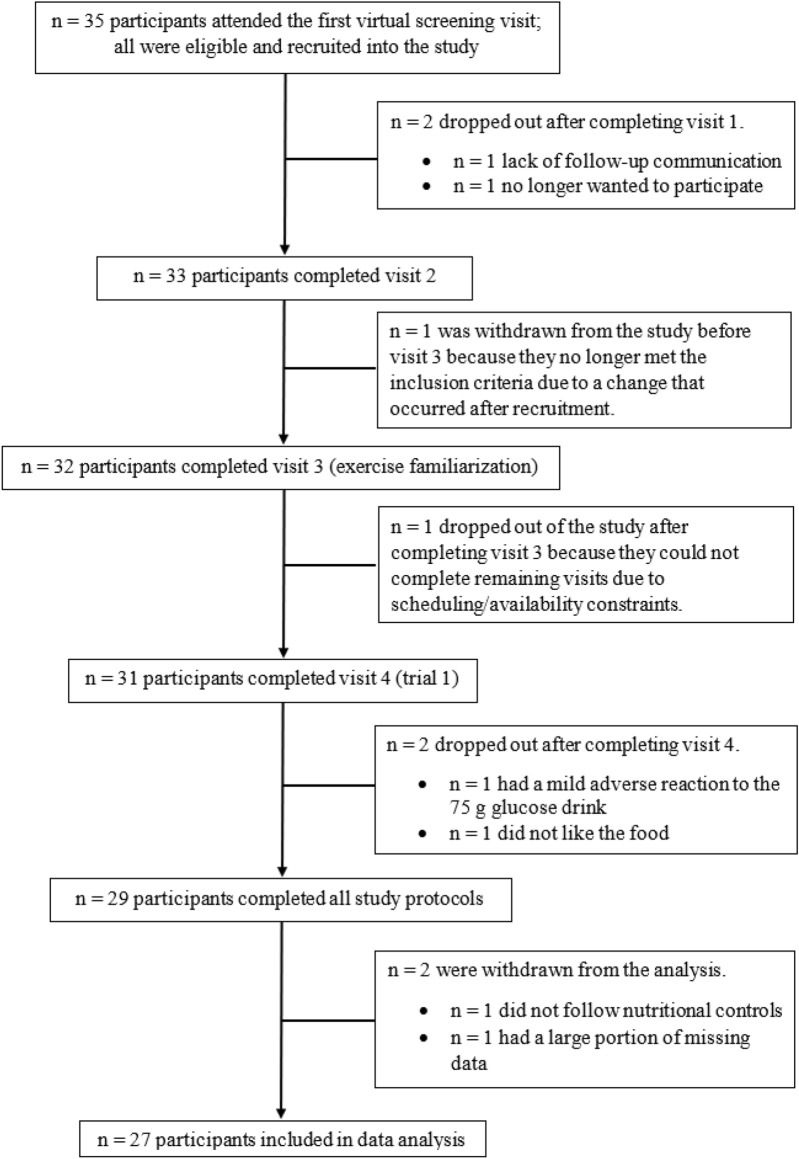
Figure 1
Figure 1
Study CONSORT diagram.
Figure 2
Figure 2
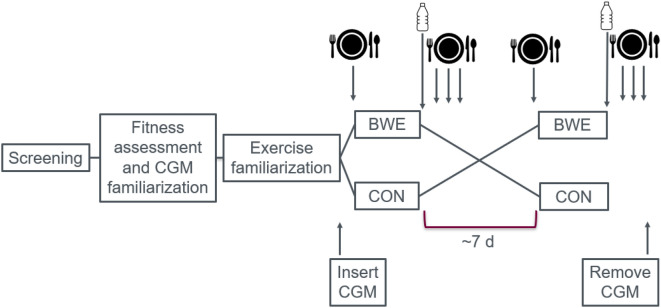
Overview of the acute within-subjects crossover design. Each participant completed a virtually supervised BWE and CON trial with the CGM device inserted to measure glycemic responses in the 24 h following each trial. Plate and cutlery = pre-packaged, individualized, controlled meals. Bottle = 75 g oral glucose drink. BWE bodyweight exercise, CGM continuous glucose monitoring, CON control, sitting.
Figure 3
Figure 3
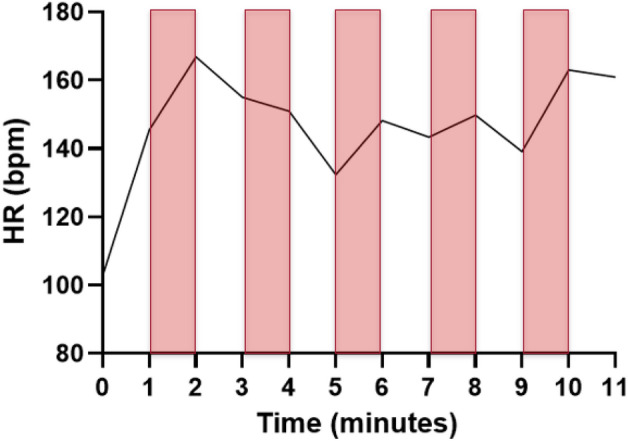
Representative heart rate tracing for 1 participant during the 11-min bodyweight exercise (BWE) protocol. The bars correspond to the 5, 1-min BWE intervals.
Figure 4
Figure 4
24 h mean glucose concentrations following bodyweight exercise (BWE) or control condition (CON).
Figure 5
Figure 5
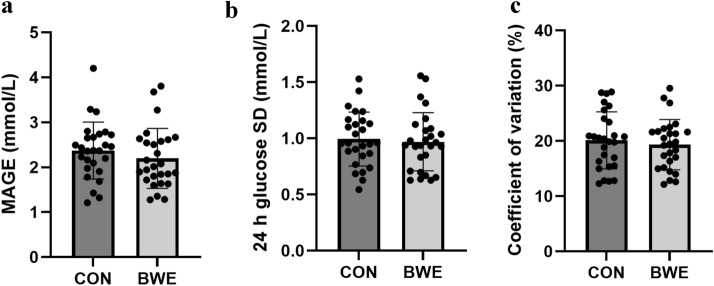
Measures of 24 h glycemic variability (p > 0.05). Mean amplitude of glycemic excursions (MAGE) (A), standard deviation (SD) (B), and coefficient of variation (CV) (C). BWE bodyweight exercise, CON control, sitting.
Figure 6
Figure 6
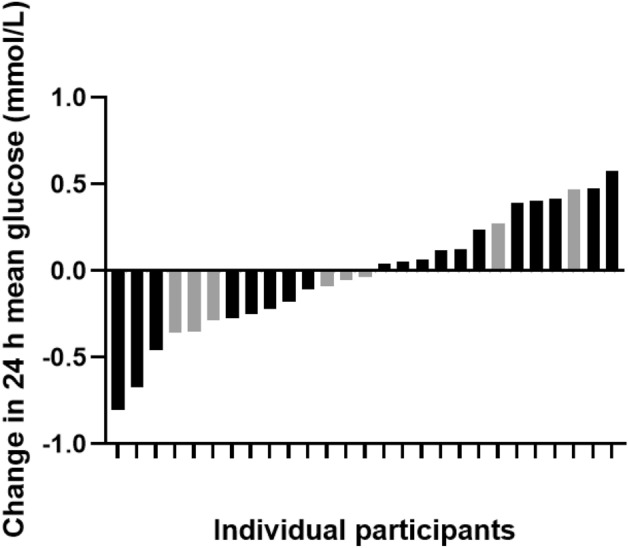
Individual responses of the change in 24 h mean glucose between the CON and BWE conditions. Each bar represents data for 1 participant where the change score = CON value minus BWE value. Positive net values represent participants whose 24 h mean glucose was greater in the CON condition whereas negative values coincide with the 24 h mean glucose being greater in the BWE condition. Gray bars represent male participants and darker bars represent female participants.

References

    1. Genuth S, et al. Follow-up report on the diagnosis of diabetes mellitus. Diabetes Care. 2003;26:3160–3167. doi: 10.2337/diacare.26.11.3160. - DOI - PubMed
    1. Roberts CK, Little JP, Thyfault JP. Modification of insulin sensitivity and glycemic control by activity and exercise. Med. Sci. Sports Exerc. 2013;45:1868–1877. doi: 10.1249/MSS.0b013e318295cdbb. - DOI - PubMed
    1. Little JP, Francois ME. High-intensity interval training for improving postprandial hyperglycemia. Res. Q. Exerc. Sport. 2014;85:451–456. doi: 10.1080/02701367.2014.963474. - DOI - PubMed
    1. Colberg SR, et al. Exercise and type 2 diabetes: The American College of Sports Medicine and the American Diabetes Association: Joint position statement. Diabetes Care. 2010;33:e147–e167. doi: 10.2337/dc10-9990. - DOI - PMC - PubMed
    1. Francois ME, Little JP. Effectiveness and safety of high-intensity interval training in patients with type 2 diabetes. Diabetes Spectr. 2015;28:39–44. doi: 10.2337/diaspect.28.1.39. - DOI - PMC - PubMed

Publication types