


Long-term follow-up of children with chronic non-bacterial osteomyelitis-assessment of disease activity, risk factors, and outcome
- PMID: 38017565
- PMCID: PMC10683360
- DOI: 10.1186/s13075-023-03195-4
Long-term follow-up of children with chronic non-bacterial osteomyelitis-assessment of disease activity, risk factors, and outcome
Abstract
Introduction: Chronic non-bacterial osteomyelitis (CNO) is an autoinflammatory bone-disease of unknown origin. The National Pediatric Rheumatologic Database (NPRD) collects long-term data of children and adolescents with rheumatic diseases including CNO.
Objective: To assess characteristics, courses, and outcomes of CNO with onset in childhood and adolescence and to identify outcome predictors.
Methods: From 2015 to 2021 patients with a confirmed diagnosis of CNO, who were registered in the NPRD during their first year of disease and at least one follow-up visit, were included in this analysis and observed for up to 4 years.
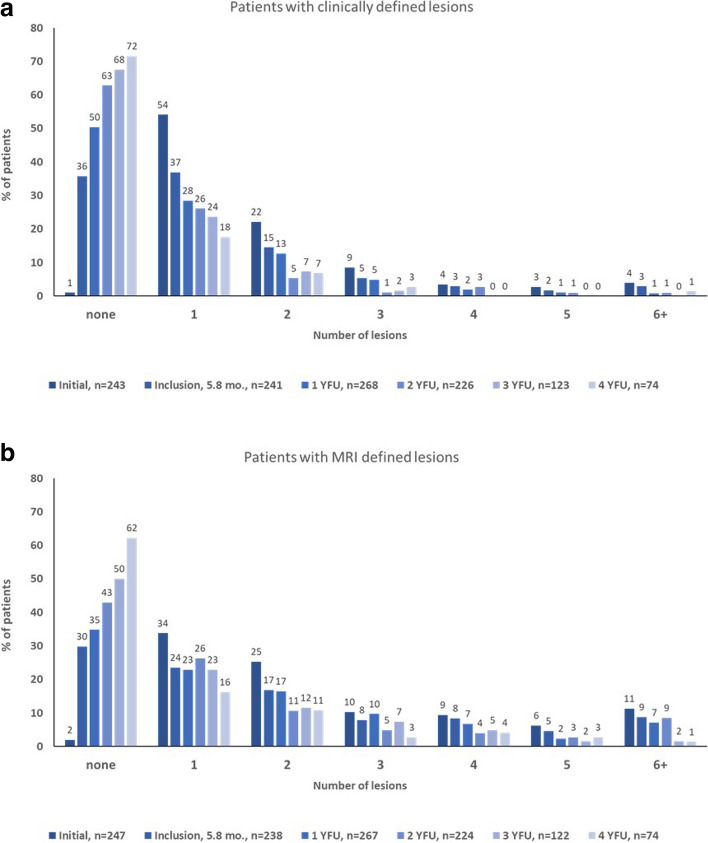
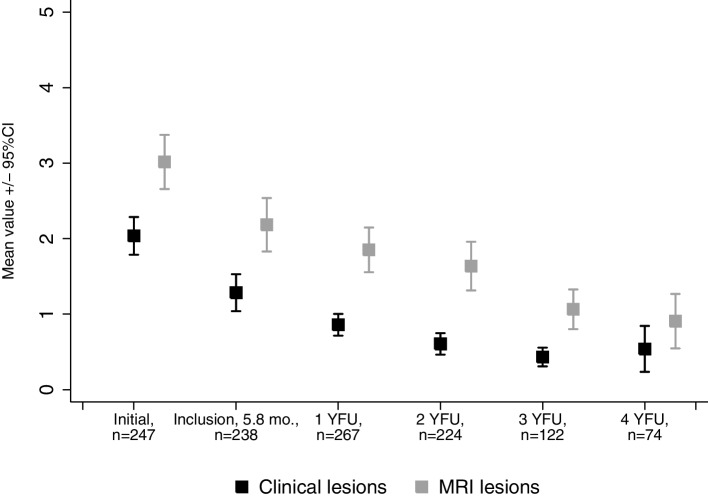
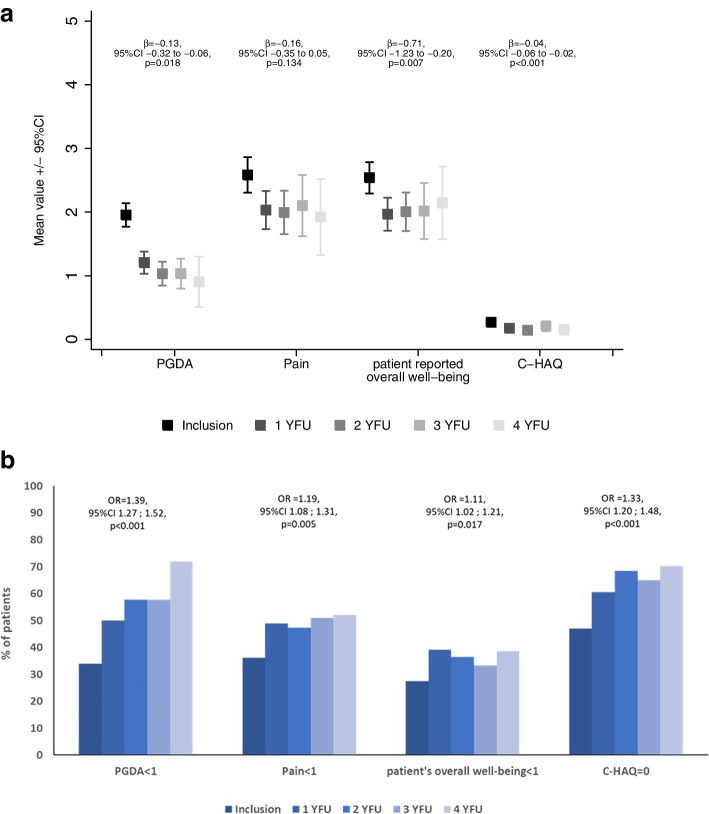
Results: Four hundred patients with recent diagnosis of CNO were enrolled in the NRPD during the study period. After 4 years, patient data documentation was sufficient to be analyzed in 81 patients. A significant decline of clinical and radiological lesions is reported: at inclusion in the registry, the mean number of clinical lesions was 2.0 and 3.0 MRI lesions per patient. A significant decrease of manifestations during 4 years of follow-up (mean clinical lesions 0.5, p < 0.001; mean MRI lesions 0.9 (p < 0.001)) was documented. A significant improvement of physician global disease activity (PGDA), patient-reported overall well-being, and childhood health assessment questionnaire (C-HAQ) was documented. Therapeutically, an increase of disease-modifying anti-rheumatic drugs over the years can be stated, while bisphosphonates rather seem to be considered as a therapeutic DMARD option in the first years of disease. Only 5-7% of the patients had a severe disease course as defined by a PGDA > = 4. Predictors associated with a severe disease course include the site of inflammation (pelvis, lower extremity, clavicle), increased erythrocyte sedimentation rate, and multifocal disease at first documentation. The previously published composite PedCNO disease activity score was analyzed revealing a PedCNO70 in 55% of the patients at 4YFU.
Conclusion: An improvement of physician global disease activity (PGDA), patient reported overall well-being and imaging-defined disease activity measures was documented, suggesting that inactivity of CNO disease can be reached. PedCNO score and especially PGDA, MRI-defined lesions and in a number of patients also the C-HAQ seem to be reliable parameters for describing disease activity. The identification of risk factors at the beginning of the disease might influence treatment decision in the future.
Keywords: Chronic nonbacterial osteomyelitis; Chronic recurrent multifocal osteomyelitis; Disease activity score; Long-term follow-up; Longitudinal registry; PedCNO score; Remission.
© 2023. The Author(s).
Conflict of interest statement
The authors declare no competing interests. CR received speaker honoraria from Novartis and Galapagos. Advisory boards: Pfizer, sobi.
Figures
References
-
- Giedion A, Holthusen W, Masel LF, Vischer D. Subacute and chronic “symmetrical” osteomyelitis. Ann Radiol (Paris) 1972;15:329–342. - PubMed
-
- Reiser C, Klotsche J, Hospach A, Berendes R, Schnabel A, Jansson AF, et al. First-year follow-up of children with chronic nonbacterial osteomyelitis-an analysis of the German National Pediatric Rheumatologic Database from 2009 to 2018. Arthritis Res Ther. 2021;23:281. doi: 10.1186/s13075-021-02658-w. - DOI - PMC - PubMed
-
- Minden K, Niewerth M, Listing J, Zink A. Health care provision in pediatric rheumatology in Germany — National Rheumatologic Database. J Rheumatol. 2002;29:622. - PubMed
Publication types
MeSH terms
Substances
Supplementary concepts
LinkOut - more resources
Full Text Sources
