Review
. 2023 Nov;13(11):230257.
doi: 10.1098/rsob.230257. Epub 2023 Nov 29.

Genome editing in East African cichlids and tilapias: state-of-the-art and future directions

Affiliations
Review

Genome editing in East African cichlids and tilapias: state-of-the-art and future directions

Bethan Clark et al. Open Biol. 2023 Nov.

Abstract

African cichlid fishes of the Cichlidae family are a group of teleosts important for aquaculture and research. A thriving research community is particularly interested in the cichlid radiations of the East African Great Lakes. One key goal is to pinpoint genetic variation underlying phenotypic diversification, but the lack of genetic tools has precluded thorough dissection of the genetic basis of relevant traits in cichlids. Genome editing technologies are well established in teleost models like zebrafish and medaka. However, this is not the case for emerging model organisms, such as East African cichlids, where these technologies remain inaccessible to most laboratories, due in part to limited exchange of knowledge and expertise. The Cichlid Science 2022 meeting (Cambridge, UK) hosted for the first time a Genome Editing Workshop, where the community discussed recent advances in genome editing, with an emphasis on CRISPR/Cas9 technologies. Based on the workshop findings and discussions, in this review we define the state-of-the-art of cichlid genome editing, share resources and protocols, and propose new possible avenues to further expand the cichlid genome editing toolkit.

Keywords: CRISPR/Cas9; East African cichlids; emerging model organisms; genome editing; tilapia.


Conflict of interest statement

We declare we have no competing interests.

Figures

Figure 1.
Figure 1.
Example uses of repair mechanisms following CRISPR/Cas9 cleavage. Repair by NHEJ can cause small indels leading to frameshift mutations (green) but note that mutations may be in-frame. Repair by HDR, using a template with homology arms (blue), can be used to generate large deletions, or knock-ins, such as allelic exchange and site-directed transgenesis (orange). Scissor symbols indicate Cas9 cut site.
Figure 2.
Figure 2.
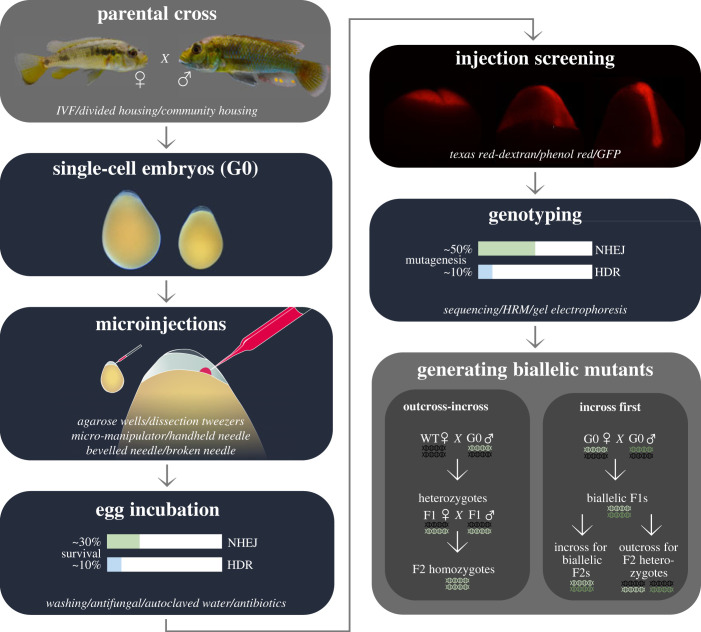
Generalized workflow for genome editing in cichlids. Words in italics indicate alternative options for each stage. Images in ‘single-cell embryos’ and ‘injection screening’ are adapted from Marconi et al. [75]. Note that rates of survival (indicating toxicity) and mutagenesis (indicating efficiency) in ‘egg incubation’ and ‘genotyping’ are only from a small number of reports [20,22,41,45]; future optimization will likely change this. In ‘generating biallelic mutants', black DNA symbols indicate WT alleles and green symbols indicate mutated alleles. Different shades of green symbolize different mutations. For simplicity, the genotype of only one cell per individual is represented, but in actuality only some cells in each G0 individual will contain mutations and different cells within the same G0 individual have different mutations.
Figure 3.
Figure 3.
Overview of the state-of-the-art and the emerging future of genome editing in cichlids. The key studies in genome editing of cichlids are shown in a chronological order. The top illustrates the progression of applying CRISPR/Cas9 and Tol2 system in the past decade to study diverse traits such as behaviour and pigmentation in cichlids. The bottom highlights the possible future directions of genome-editing and transgenic techniques to push the frontiers of uncovering evolutionary and developmental basis of phenotypic traits in a more comprehensive manner.

References

    1. Bone Q, Moore R. 2008. Biology of fishes. London, UK: Taylor & Francis.
    1. Salzburger W. 2018. Understanding explosive diversification through cichlid fish genomics. Nat. Rev. Genet. 19, 705-717. ( 10.1038/s41576-018-0043-9) - DOI - PubMed
    1. Santos ME, Lopes JF, Kratochwil CF. 2023. East African cichlid fishes. EvoDevo 14, 1. ( 10.1186/s13227-022-00205-5) - DOI - PMC - PubMed
    1. Ivory SJ, Blome MW, King JW, McGlue MM, Cole JE, Cohen AS. 2016. Environmental change explains cichlid adaptive radiation at Lake Malawi over the past 1.2 million years. Proc. Natl Acad. Sci. USA 113, 11 895-11 900. ( 10.1073/pnas.1611028113) - DOI - PMC - PubMed
    1. Meier JI, Marques DA, Mwaiko S, Wagner CE, Excoffier L, Seehausen O. 2017. Ancient hybridization fuels rapid cichlid fish adaptive radiations. Nat. Commun. 8, 14363. ( 10.1038/ncomms14363) - DOI - PMC - PubMed

Publication types