


Evaluation of risk factors for cytomegalovirus DNAemia after end of regular prophylaxis after heart transplantation
- PMID: 38018580
- PMCID: PMC10655632
- DOI: 10.1002/iid3.1075
Evaluation of risk factors for cytomegalovirus DNAemia after end of regular prophylaxis after heart transplantation
Abstract
Background: Cytomegalovirus (CMV) infections after heart transplantation (HTx) can cause cardiac allograft vasculopathy. Consequently, monitoring and prophylaxis for cytomegalovirus deoxyribonucleic acid (CMV-DNAemia) within the first weeks after HTx is recommended.
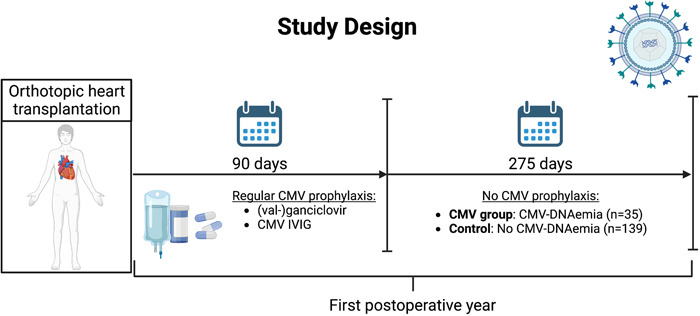
Methods: All patients who underwent HTx between September 2010 and 2021 surviving the first 90 days (n = 196) were retrospectively reviewed. The patients were divided on the prevalence of CMV-DNAemia during the first postoperative year after the end of the prophylaxis. A total of n = 35 (20.1%) developed CMV-DNAemia (CMV group) and were compared to patients without CMV-DNAemia (controls, n = 139). The remaining patients (n = 22) were excluded due to incomplete data.
Results: Positive donors and negative recipients (D+/R-) and negative donors and positive recipients (D-/R+) serology was significantly increased and D-/R- decreased in the CMV group (p < .01). Furthermore, the mean age was 57.7 ± 8.7 years but only 53.6 ± 10.0 years for controls (p = .03). Additionally, the intensive care unit (p = .02) and total hospital stay (p = .03) after HTx were approximately 50% longer. Interestingly, the incidence of CMV-DNAemia during prophylaxis was only numerically increased in the CMV group (5.7%, respectively, 0.7%, p = .10), the same effect was also observed for postoperative infections. Multivariate analyses confirmed that D+/R- and D-/R+ CMV immunoglobulin G match were independent risk factors for postprophylaxis CMV-DNAemia.
Conclusion: Our data should raise awareness of CMV-DNAemia after the termination of regular prophylaxis, as this affects one in five HTx patients. Especially old recipients as well as D+/R- and D-/R+ serology share an elevated risk of late CMV-DNAemia. For these patients, prolongation, or repetition of CMV prophylaxis, including antiviral drugs and CMV immunoglobulins, may be considered.
Keywords: cardiac allograft vasculopathy; cytomegalovirus; heart transplantation; prophylaxis.
© 2023 The Authors. Immunity, Inflammation and Disease published by John Wiley & Sons Ltd.
Conflict of interest statement
The authors declare no conflict of interest.
Figures
References
-
- Hsich E, Singh TP, Cherikh WS, et al. The International Thoracic Organ Transplant Registry of the International Society for Heart and Lung Transplantation: thirty‐ninth adult heart transplantation report‐2022; focus on transplant for restrictive heart disease. J Heart Lung Transplant. 2022;41(10):1366‐1375. - PMC - PubMed
-
- Chih S, Chong AY, Mielniczuk LM, Bhatt DL, Beanlands RSB. Allograft vasculopathy. JACC. 2016;68(1):80‐91. - PubMed
-
- Spartalis M, Spartalis E, Siasos G. Cardiac allograft vasculopathy after heart transplantation: pathophysiology, detection approaches, prevention, and treatment management. Trends Cardiovascul Med. 2022;32(6):333‐338. - PubMed
-
- Ljungman P, Boeckh M, Hirsch HH, et al. Definitions of cytomegalovirus infection and disease in transplant patients for use in clinical trials. Clin Infect Dis. 2017;64(1):87‐91. - PubMed
