


Personality predictors of dementia diagnosis and neuropathological burden: An individual participant data meta-analysis
- PMID: 38018701
- PMCID: PMC10947984
- DOI: 10.1002/alz.13523
Personality predictors of dementia diagnosis and neuropathological burden: An individual participant data meta-analysis
Abstract
Introduction: The extent to which the Big Five personality traits and subjective well-being (SWB) are discriminatory predictors of clinical manifestation of dementia versus dementia-related neuropathology is unclear.
Methods: Using data from eight independent studies (Ntotal = 44,531; Ndementia = 1703; baseline Mage = 49 to 81 years, 26 to 61% female; Mfollow-up range = 3.53 to 21.00 years), Bayesian multilevel models tested whether personality traits and SWB differentially predicted neuropsychological and neuropathological characteristics of dementia.
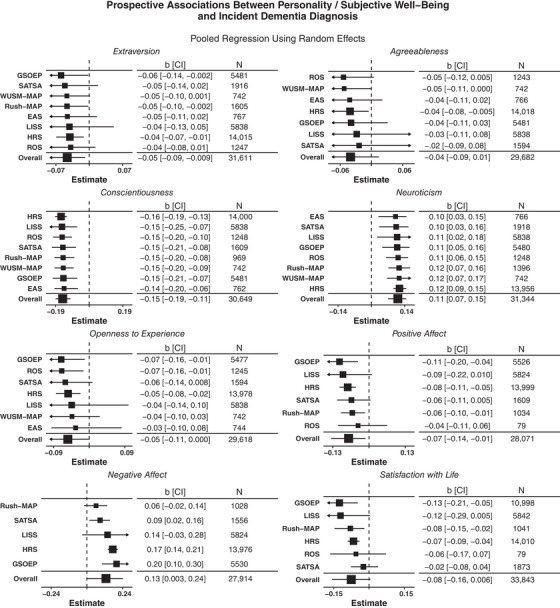
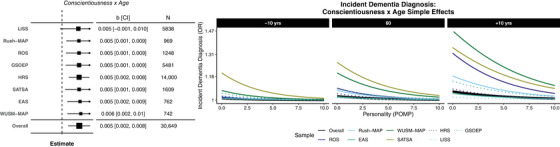
Results: Synthesized and individual study results indicate that high neuroticism and negative affect and low conscientiousness, extraversion, and positive affect were associated with increased risk of long-term dementia diagnosis. There were no consistent associations with neuropathology.
Discussion: This multistudy project provides robust, conceptually replicated and extended evidence that psychosocial factors are strong predictors of dementia diagnosis but not consistently associated with neuropathology at autopsy.
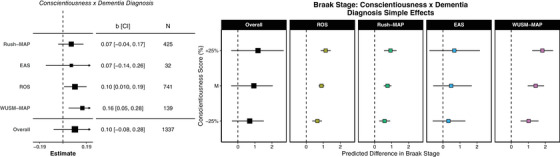
Highlights: N(+), C(-), E(-), PA(-), and NA(+) were associated with incident diagnosis. Results were consistent despite self-report versus clinical diagnosis of dementia. Psychological factors were not associated with neuropathology at autopsy. Individuals with higher conscientiousness and no diagnosis had less neuropathology. High C individuals may withstand neuropathology for longer before death.
Keywords: Braak stage; CERAD; Lewy body disease; TDP-43; agreeableness; arteriosclerosis; cerebral amyloid angiopathy; cerebral atherosclerosis; extraversion; gross cerebral infarcts; gross cerebral microinfarcts; hippocampal sclerosis; individual participant data meta-analysis; openness; positive affect; satisfaction with life.
© 2023 The Authors. Alzheimer's & Dementia published by Wiley Periodicals LLC on behalf of Alzheimer's Association.
Conflict of interest statement
The content is solely the responsibility of the authors and does not necessarily represent the official views of the funding agencies. There are no conflicts of interest to disclose among any of the contributing authors. Author disclosures are available in the supporting information.
Figures
References
-
- Abd‐Allah F, Abate KH, Abbafati C, et al. Global, regional, and national incidence, prevalence, and years lived with disability for 328 diseases and injuries for 195 countries, 1990–2016: a systematic analysis for the Global Burden of Disease Study 2016. Lancet Br Ed. 2017;390(10100):1211‐1259. doi: 10.1016/S0140-6736(17)32154-2 - DOI - PMC - PubMed
-
- Prince MJ, Wimo A, Guerchet MM, Ali GC, Wu YT, Prina M, World Alzheimer Report 2015‐The Global Impact of Dementia: an analysis of prevalence, incidence, cost and trends. 2015.
Publication types
MeSH terms
Grants and funding
- P30AG010161/NH/NIH HHS/United States
- R01 AG018436/AG/NIA NIH HHS/United States
- P01 AG003991/AG/NIA NIH HHS/United States
- R01AG072559/NH/NIH HHS/United States
- P30AG72975/NH/NIH HHS/United States
- P30 AG010161/AG/NIA NIH HHS/United States
- P01AG043362/NH/NIH HHS/United States
- R01 AG067622/AG/NIA NIH HHS/United States
- R01AG018436/NH/NIH HHS/United States
- P01 AG003949/AG/NIA NIH HHS/United States
- P01AG03949/NH/NIH HHS/United States
- RF1 AG067622/AG/NIA NIH HHS/United States
- P01 AG043362/AG/NIA NIH HHS/United States
- R01AG017917/NH/NIH HHS/United States
- P30 AG072975/AG/NIA NIH HHS/United States
- P30 AG066444/AG/NIA NIH HHS/United States
- R01 AG017917/AG/NIA NIH HHS/United States
- R01AG067622/NH/NIH HHS/United States
- R01AG15819/NH/NIH HHS/United States
- R01 AG072559/AG/NIA NIH HHS/United States
- R01 AG082954/AG/NIA NIH HHS/United States
- R01 AG015819/AG/NIA NIH HHS/United States
