. 2023 Sep 20;13(6):588-599.
doi: 10.1016/j.jtcme.2023.09.003. eCollection 2023 Nov.

Effect of electrode configuration in electroacupuncture on ischemic stroke treatment in rats

Affiliations

Effect of electrode configuration in electroacupuncture on ischemic stroke treatment in rats

Chung-Hsiang Liu et al. J Tradit Complement Med. .

Abstract

Background and aim: This study investigated the effect of the electrode configuration on EA treating ischemic stroke.

Experimental procedure: An ischemic stroke rat model was established. In the EA-P group, the anodes of EA were placed on the BL7 and BL8 acupoints of the lesioned, and the cathodes were placed on the BL7 and BL8 acupoints of the nonlesioned hemispheres; by contrast, in the EA-N group.

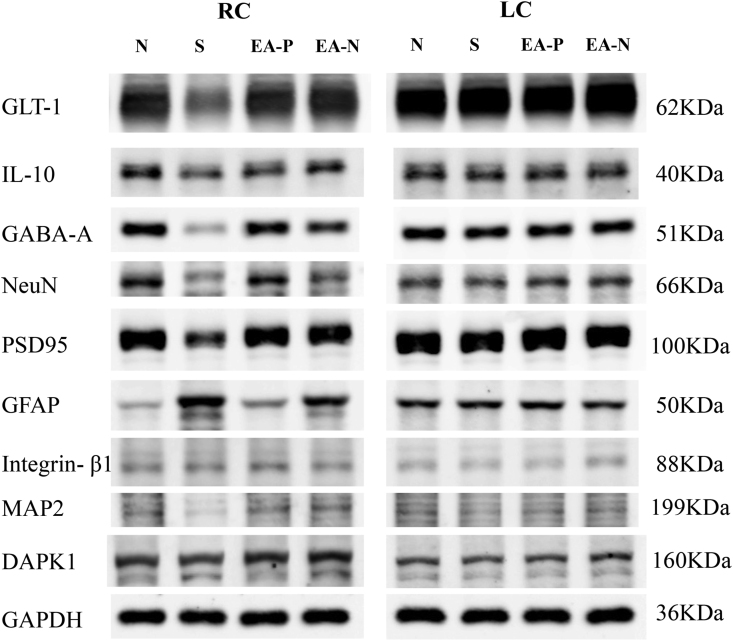
Results: The difference in neurological deficit scores between the first and fourth days and the difference in Rotarod test time between the fourth and first days after reperfusion were greater in the EA-P and EA-N groups than in the sham group (all p < 0.001). In the lesioned hemisphere, neuronal nuclei (NeuN), γ-aminobutyric acid-A (GABA)-A, postsynaptic density 95 (PSD95), and astrocyte glutamate transporter 1 (GLT-1) expression and microtubule-associated protein 2 (MAP2)/glyceraldehyde 3-phosphate dehydrogenase (GADPH) ratios were greater and the glial fibrillary acid protein (GFAP)/GADPH ratios were smaller in the EA-P than in the sham group (all p < 0.05), but these ratios in the EA-N group were similar to those in the sham group (all p > 0.05); serum adrenaline and serotonin levels in the sham group were lower than those in the normal and EA-P groups (both p < 0.05), and cerebrospinal fluid (CSF) glutamate levels were higher in the EA-P group than in the sham group (p < 0.05).

Conclusion: EA improved neurological function through multiple pathways. However, placing the anode on the lesioned hemisphere can provide more neuroprotection.

Keywords: Electroacupuncture; Electrode configuration; Ischemic stroke; Neuroprotection.


Conflict of interest statement

The authors declare that there are no conflicts of interest associated with this manuscript, and no significant financial support was received that would influence the findings.

Figures

Image 1
Graphical abstract
Fig. 1
Fig. 1
Effect of electroacupuncture on infarction volume in rats with ischemic stroke. Normal: normal group; Sham: sham group; EA-P: EA-P group, EA-N: EA-N group; red-purple color: normal brain tissue; white color: cerebral infarction area. ∗p < 0.05, ∗∗p < 0.01, and ∗∗∗p < 0.001 compared with normal; ##p < 0.01 and ###p < 0.001 compared with sham; n = 6.
Fig. 2
Fig. 2
Effect of electroacupuncture on levels of astrocyte glutamate transporter-1(GLT-1), interleukin-10 (IL-10), γ-aminobutyric acid-A (GABA-A), NeuN, postsynaptic density95 (PSD95), glial fibrillary acid protein (GFAP), Integrin-β1, microtubule-associated protein2 (MAP2), and death-associated protein kinase1 (DAPK1) in rats with ischemic stroke: Western blot analysis. RC: right cerebral hemisphere; LC: left cerebral hemisphere; N: normal group; S: sham group; EA-P: EA-P group; EA-N: EA-N group; n = 6.
Fig. 3
Fig. 3
Effect of electroacupuncture on levels of astrocyte glutamate transporter-1(GLT-1), interleukin-10 (IL-10), γ-aminobutyric acid-A (GABA-A), NeuN, postsynaptic density95 (PSD95), glial fibrillary acid protein (GFAP), Integrin-β1, microtubule-associated protein2 (MAP2), and death-associated protein kinase1 (DAPK1) in rats with ischemic stroke: right cerebral hemisphere. Normal: normal group; sham: sham group; EA-P: EA-P group; EA-N: EA-N group; ∗p < 0.05, ∗∗p < 0.01, and ∗∗∗p < 0.001 compared with normal; #p < 0.05, ##p < 0.01, and ###p < 0.001 compared with sham; n = 6.
Fig. 4
Fig. 4
Effect of electroacupuncture on levels of astrocyte glutamate transporter-1(GLT-1), interleukin-10 (IL-10), γ-aminobutyric acid-A (GABA-A), NeuN, postsynaptic density95 (PSD95), glial fibrillary acid protein (GFAP), Integrin-β1, microtubule-associated protein2 (MAP2), and death-associated protein kinase1 (DAPK1) in rats with ischemic stroke: left cerebral hemisphere. Normal: normal group; sham: sham group; EA-P: EA-P group; EA-N: EA-N group; n = 6.
Fig. 5
Fig. 5
Effect of electroacupuncture on serum dopamine, adrenaline, noradrenaline, glutamate, γ-aminobutyric acid (GABA), and serotonin in rats with ischemic stroke: metabolomic analysis. Normal: normal group; sham: sham group; EA-P: EA-P group; EA-N: EA-N group; ∗p < 0.05 compared with normal; #p < 0.05 compared with sham, n = 12.
Fig. 6
Fig. 6
Effect of electroacupuncture on cerebrospinal fluid (CSF) dopamine, adrenaline, noradrenaline, glutamate, γ-aminobutyric acid (GABA), and serotonin in rats with ischemic stroke: metabolomic analysis. Normal: normal group; sham: sham group; EA-P: EA-P group; EA-N: EA-N group; #p < 0.05 compared with sham, n = 12.

References

    1. Saini V., Guada L., Yavagal D.R. Global epidemiology of stroke and access to acute ischemic stroke interventions. Neurology. 2021;97(20 Supplement 2):S6–S16. - PubMed
    1. European Society of Cardiology . European Society of Cardiology; 2018. Stroke Incidence Rising in Taiwan Contrary to Falls in Western Countries.
    1. Lee M., Wu Y.-L., Ovbiagele B. Trends in incident and recurrent rates of first-ever ischemic stroke in Taiwan between 2000 and 2011. J Stroke. 2016;18(1):60. - PMC - PubMed
    1. Hasan T.F., Hasan H., Kelley R.E. Overview of acute ischemic stroke evaluation and management. Biomedicines. 2021;9(10):1486. - PMC - PubMed
    1. Boddington L., Reynolds J. Targeting interhemispheric inhibition with neuromodulation to enhance stroke rehabilitation. Brain Stimul. 2017;10(2):214–222. - PubMed