


The effect of balance and gait training on specific balance abilities of survivors with stroke: a systematic review and network meta-analysis
- PMID: 38020595
- PMCID: PMC10653323
- DOI: 10.3389/fneur.2023.1234017
The effect of balance and gait training on specific balance abilities of survivors with stroke: a systematic review and network meta-analysis
Abstract
Background: Stroke, which is a common clinical cerebrovascular disease, causes approximately 83% of survivors to suffer from balance impairments. Balance and gait training (BGT) is widely used to restore balance in patients with stroke. However, its wide variety presents clinicians with a dilemma when selecting interventions. This study aimed to compare and rank BGT interventions by quantifying information based on randomized controlled trials (RCTs).
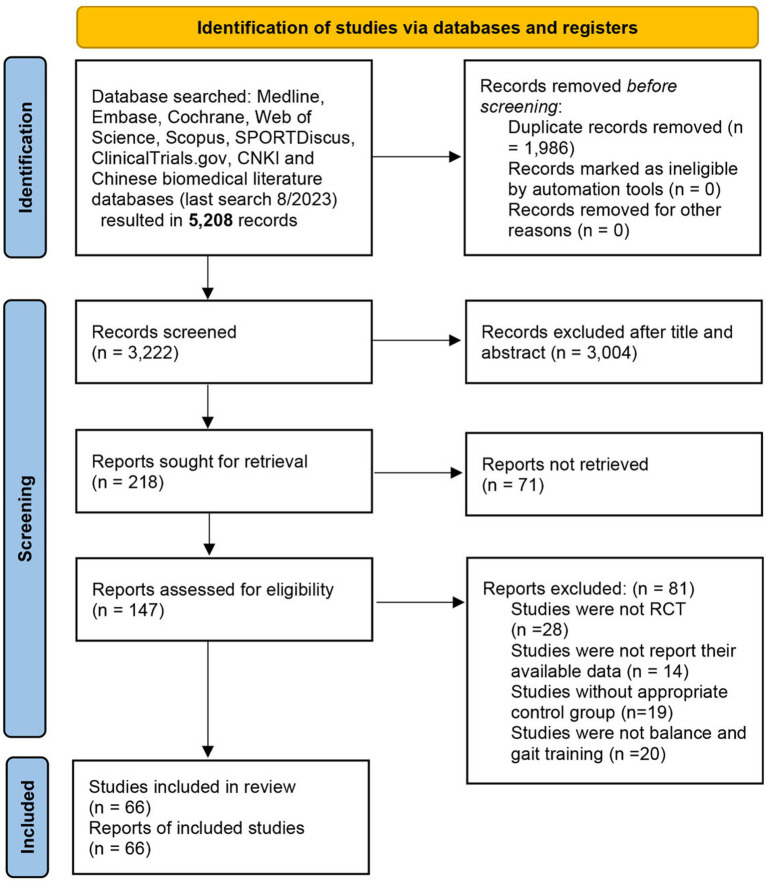
Methods: We conducted a network meta-analysis (NMA) of non-gait-trained controls and head-to-head RCTs and compared the effects of 12 BGT interventions. A total of nine literature databases, including Medline, Embase, Cochrane Library, Web of Science, Scopus, SPORTDiscus, ClinicalTrials.gov, CNKI, and Chinese biomedical literature databases, were searched from their database inception to August 2023. Two authors independently selected studies and extracted data. The difference in outcomes, which were expressed as standardized mean differences and confidence intervals (CIs) of 95%, were explored in this meta-analysis.
Results: A total of 66 studies with 1,933 participants were included. Effect size estimates showed that not all BGT interventions were more effective than controls, with treadmill training as the least effective for balance test batteries (SMD = -0.41, 95% CI [-1.09, 0.27]) and proactive balance (SMD = -0.50, 95% CI [-1.14, 0.14]). Body-weight-supported treadmill training with external stimulation was most effective for proactive balance and dynamic steady-state balance (SMD = 1.57, 95% CI [-0.03, 3.16]); SMD = 1.18, 95% CI [0.67, 1.68]. Virtual reality gait training (SMD = 1.37, 95% CI [0.62, 2.11]) had the best effect on improving balance test batteries, while dual-task BGT (SMD = 1.64, 95% CI [0.50, 2.78]) had the best effect on static steady-state balance. After analyses for possible impact covariates, the findings through the outcomes did not change substantially. Confidence in the evidence was generally low or very low.
Conclusion: This NMA suggested that virtual reality gait training was the most effective BGT modality for improving balance test batteries. Body-weight support treadmill training with external stimulation was the most effective for improving active and dynamic balance. In addition, dual-task BGT was the best choice for improving static balance. However, balance is a multidimensional concept, and patients' different needs should be considered when selecting BGT.
Systematic review registration: https://www.crd.york.ac.uk/prospero/display_record.php?ID=CRD42022316057, ID: CRD42022316057.
Keywords: balance; gait; network meta-analysis; rehabilitation; stroke.
Copyright © 2023 Zhang, Liang, Li, Meng, Jiang, Xu, Li and Liu.
Conflict of interest statement
The authors declare that the research was conducted in the absence of any commercial or financial relationships that could be construed as a potential conflict of interest.
Figures

References
-
- Dicker D, Nguyen G, Abate D, Abate KH, Abay SM, Abbafati C, et al. . Global, regional, and national age-sex-specific mortality and life expectancy, 1950-2017: a systematic analysis for the global burden of disease study 2017. Lancet. (2018) 392:1684–735. doi: 10.1016/s0140-6736(18)31891-9, PMID: - DOI - PMC - PubMed
-
- Roth GA, Abate D, Abate KH, Abay SM, Abbafati C, Abbasi N, et al. . Global, regional, and national age-sex-specific mortality for 282 causes of death in 195 countries and territories, 1980-2017: a systematic analysis for the global burden of disease study 2017. Lancet. (2018) 392:1736–88. doi: 10.1016/s0140-6736(18)32203-7, PMID: - DOI - PMC - PubMed
-
- James SL, Abate D, Abate KH, Abay SM, Abbafati C, Abbasi N, et al. . Global, regional, and national incidence, prevalence, and years lived with disability for 354 diseases and injuries for 195 countries and territories, 1990-2017: a systematic analysis for the global burden of disease study 2017. Lancet. (2018) 392:1789–858. doi: 10.1016/s0140-6736(18)32279-7, PMID: - DOI - PMC - PubMed
-
- Feigin VL, Stark BA, Johnson CO, Roth GA, Bisignano C, Abady GG, et al. . Global, regional, and national burden of stroke and its risk factors, 1990-2019: a systematic analysis for the global burden of disease study 2019. Lancet Neurol. (2021) 20:795–820. doi: 10.1016/s1474-4422(21)00252-0, PMID: - DOI - PMC - PubMed
Publication types
LinkOut - more resources
Full Text Sources
