


Advancing Universal Health Coverage in the WHO South-East Asia Region with a focus on Human Resources for Health
- PMID: 38028168
- PMCID: PMC10667288
- DOI: 10.1016/j.lansea.2023.100313
Advancing Universal Health Coverage in the WHO South-East Asia Region with a focus on Human Resources for Health
Abstract
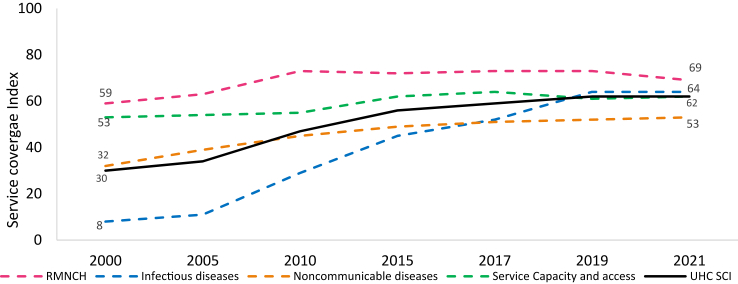
The identification in 2014 of Universal Health Coverage, including focus on human resources for health, as a flagship priority for the WHO South-East Asia Region marked critical departure from the prior period of the Millennium Development Goals. The last decade witnessed strong political commitment and action to advance UHC across the Region. At regional level, UHC service coverage index improved from 47 in 2010 to 62 in 2021. Improved availability of human resources for health has been an important contributor, with the regional average of doctors, nurses and midwives increasing by approximately a third between 2014 and 2020. Progress on financial protection has been mixed: proportion of population impoverished declined significantly but catastrophic expenditure did not reduce. Despite important gains, progress is insufficient to achieve UHC targets by 2030. Covid-19 pandemic and subsequent economic challenges have created further urgency to accelerate progress towards UHC, with attention to strengthening primary health care.
Keywords: HRH; Health systems; Human Resources for Health; PHC; Primary Health Care; UHC; Universal Health Coverage.
© 2023 Published by Elsevier Ltd.
Conflict of interest statement
The authors declare they have no conflict of interest. All authors are WHO SEARO employees. The views expressed are of the authors and not an officila position of the WHO or any institutions to which they are affiliated. The authors declare no conflict of interest.
Figures



References
-
- Tracking Universal Health Coverage . World Health Organization and International Bank for Reconstruction and Development/The World Bank; Geneva: 2021. 2021 global monitoring report.
-
- United National Department of Economic and Social Affairs, Goal 3: ensure health lives and promote well-being for all at all ages. See Goal 3 | Department of Economic and Social Affairs (un.org).
-
- Karl E. Vol. 3-6. 1949. p. 217. (Chronicle of the World Health Organization, 1949). Geneva, Switzerland.
-
- Amrith S. Palgrave Macmillan; London: 2006. Decolonizing International Health: India and South-East Asia, 1930-1965.
Publication types
Grants and funding
LinkOut - more resources
Full Text Sources
