. 2023 Nov 30;11(1):259.
doi: 10.1186/s40168-023-01692-x.

Integrating compositional and functional content to describe vaginal microbiomes in health and disease

Affiliations

Integrating compositional and functional content to describe vaginal microbiomes in health and disease

Johanna B Holm et al. Microbiome. .

Erratum in

Abstract

Background: A Lactobacillus-dominated vaginal microbiome provides the first line of defense against adverse genital tract health outcomes. However, there is limited understanding of the mechanisms by which the vaginal microbiome modulates protection, as prior work mostly described its composition through morphologic assessment and marker gene sequencing methods that do not capture functional information. To address this gap, we developed metagenomic community state types (mgCSTs) which use metagenomic sequences to describe and define vaginal microbiomes based on both composition and functional potential.

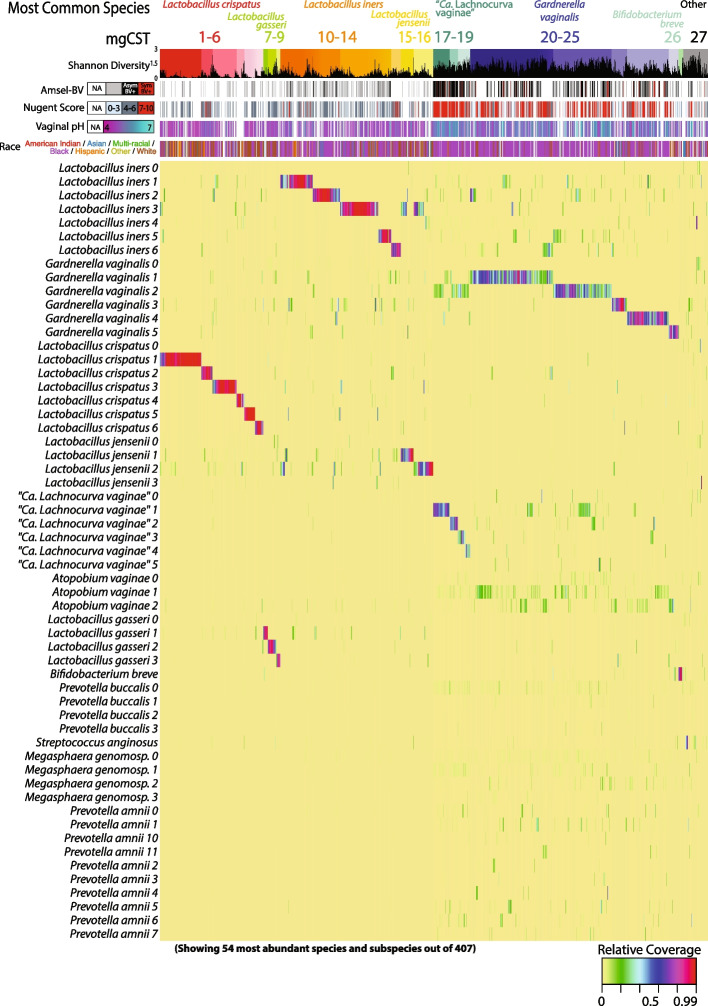
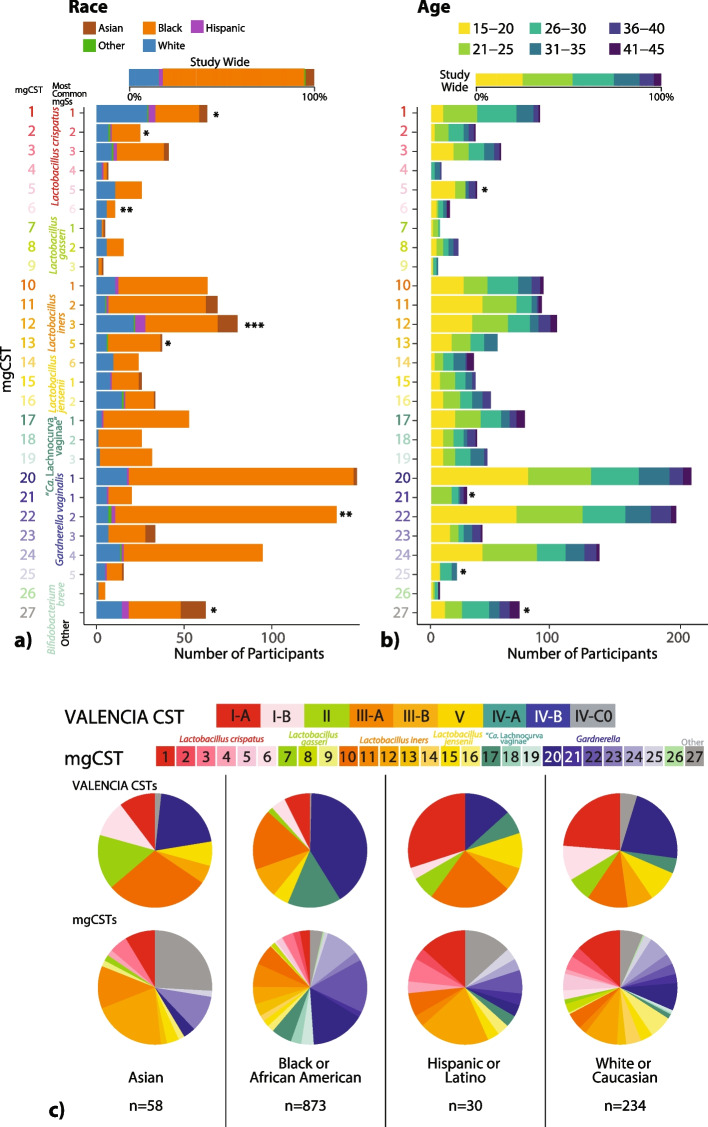
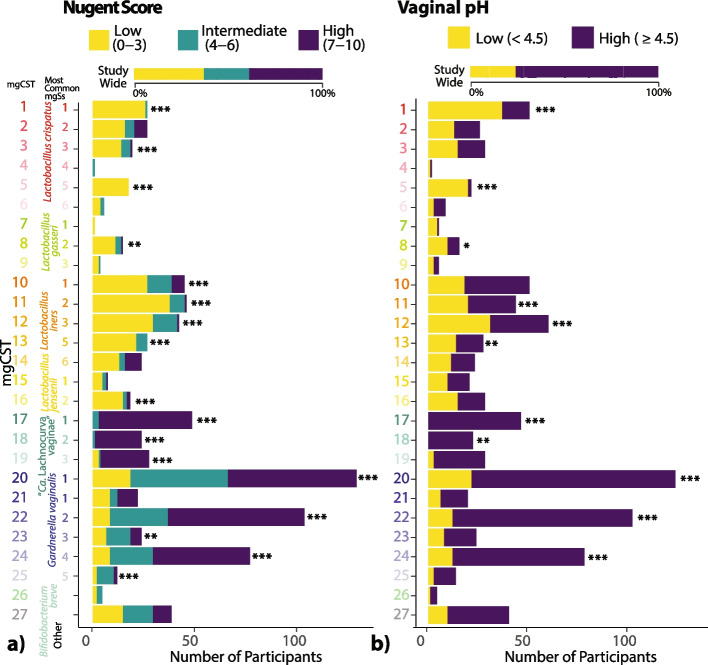
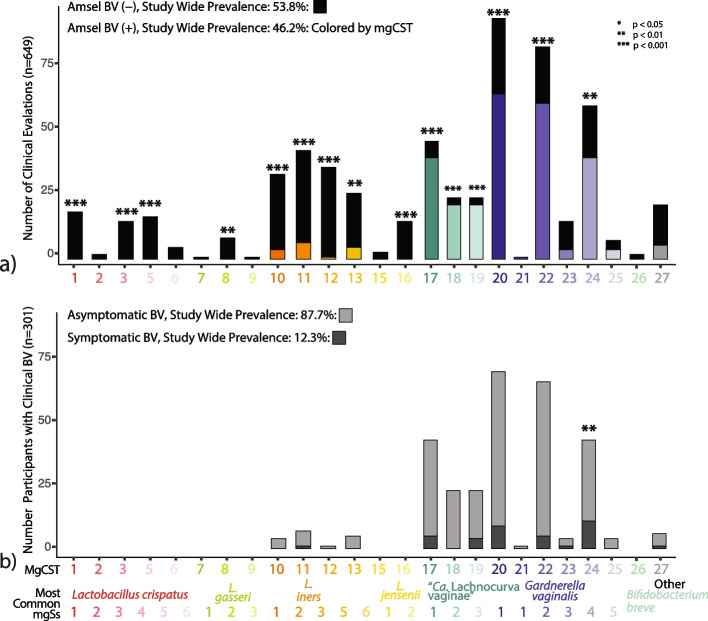
Results: MgCSTs are categories of microbiomes classified using taxonomy and the functional potential encoded in their metagenomes. MgCSTs reflect unique combinations of metagenomic subspecies (mgSs), which are assemblages of bacterial strains of the same species, within a microbiome. We demonstrate that mgCSTs are associated with demographics such as age and race, as well as vaginal pH and Gram stain assessment of vaginal smears. Importantly, these associations varied between mgCSTs predominated by the same bacterial species. A subset of mgCSTs, including three of the six predominated by Gardnerella vaginalis mgSs, as well as mgSs of L. iners, were associated with a greater likelihood of bacterial vaginosis diagnosed by Amsel clinical criteria. This L. iners mgSs, among other functional features, encoded enhanced genetic capabilities for epithelial cell attachment that could facilitate cytotoxin-mediated cell lysis. Finally, we report a mgSs and mgCST classifier for which source code is provided and may be adapted for use by the microbiome research community.

Conclusions: MgCSTs are a novel and easily implemented approach to reduce the dimension of complex metagenomic datasets while maintaining their functional uniqueness. MgCSTs enable the investigation of multiple strains of the same species and the functional diversity in that species. Future investigations of functional diversity may be key to unraveling the pathways by which the vaginal microbiome modulates the protection of the genital tract. Importantly, our findings support the hypothesis that functional differences between vaginal microbiomes, including those that may look compositionally similar, are critical considerations in vaginal health. Ultimately, mgCSTs may lead to novel hypotheses concerning the role of the vaginal microbiome in promoting health and disease, and identify targets for novel prognostic, diagnostic, and therapeutic strategies to improve women's genital health. Video Abstract.

Keywords: Bacterial vaginosis; Genital health; Metagenome; Sequencing; Vaginal microbiome.


Conflict of interest statement

JR is co-founder of LUCA Biologics, a biotechnology company focusing on translating microbiome research into live biotherapeutics drugs for women’s health. JR is Editor-in-Chief at Microbiome. All other authors declare that they have no competing interests.

Figures

Fig. 1
Fig. 1
Vaginal Metagenomic Community State Types (mgCSTs). Using 1890 metagenomic samples, 27 vaginal metagenomic Community State Types (mgCSTs) were identified: mgCSTs 1–16 are predominated by metagenomic subspecies of Lactobacillus spp., mgCSTs 17–19 by metagenomic subspecies of “Ca. Lachnocurva vaginae”, mgCSTs 20–25 by metagenomic subspecies of the genus Gardnerella, and mgCST 27 contains samples without a predominant metagenomic subspecies
Fig. 2
Fig. 2
MgCSTs were associated with self-reported race (a, n = 1441) and age categories (b, n = 1623) Within-mgCST distributions were compared to study-wide distributions (*p < 0.05, **p < 0.01, ***p < 0.001). c The distribution of mgCSTs differs by race. Vaginal microbiomes from black women have the smallest proportion of L. crispatus mgCSTs. “Ca. Lachnocurva vaginae” mgCSTs 17–19 were absent from Asian vaginal microbiomes in this study, as were L. iners mgCST 10 and 14
Fig. 3
Fig. 3
MgCSTs are associated with Nugent Scores (a, n = 968) and vaginal pH categories (b, n = 979). Within-mgCST distributions were compared to study-wide distributions (*p < 0.05, **p < 0.01, ***p < 0.001)
Fig. 4
Fig. 4
Clinically diagnosed Amsel bacterial vaginosis (a) and symptomatic Amsel bacterial vaginosis (b) associated with mgCSTs. a Within each mgCST, the total number of clinical evaluations per mgCST is indicated. The black bars indicate the proportion of negative Amsel-BV diagnoses, and the colored bars indicate the positive Amsel-BV diagnoses. Within-mgCST proportions were statistically compared to the study-wide proportions of Amsel-BV diagnoses. b Of positive Amsel-BV diagnoses in a, the proportions of asymptomatic (light gray) and symptomatic (dark gray) Amsel-BV diagnoses are shown within each mgCST. Within-mgCST proportions were statistically compared to the study-wide proportions of asymptomatic to symptomatic Amsel-BV diagnoses. (*p < 0.05, **p < 0.01, ***p < 0.001)
Fig. 5
Fig. 5
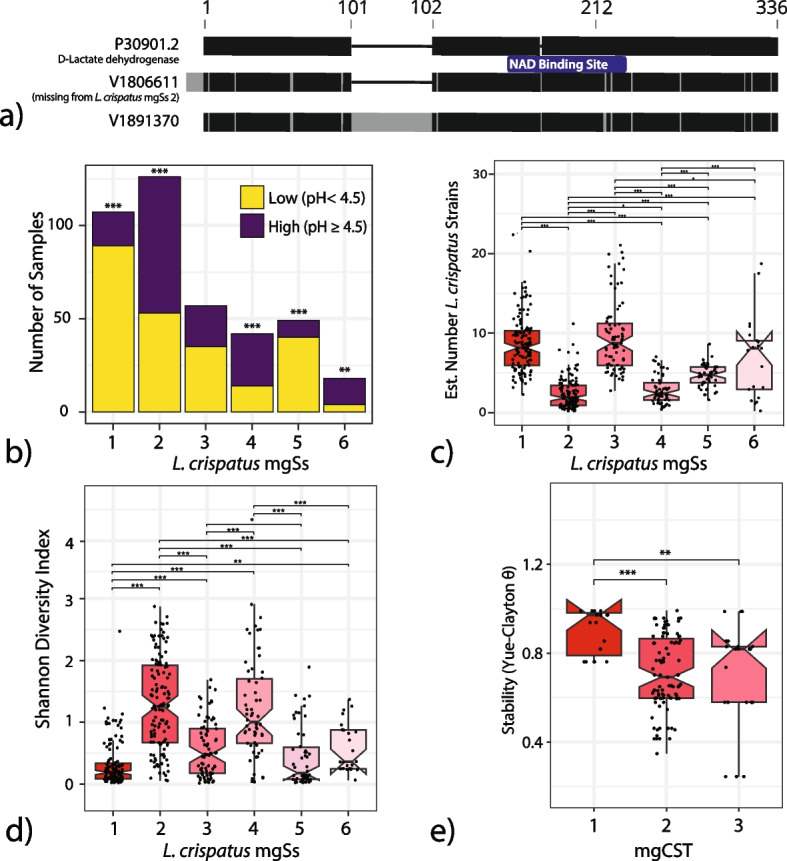
a D-lactate dehydrogenase orthologs in VIRGO compared to functionally validated reference, P30901.2. The presence of D-lactate dehydrogenase orthologs differs by L. crispatus mgSs with mgSs 2 missing V1806611 which is 96% identical to the functionally validated ortholog P30901.2. b The proportion of samples with low vs. high vaginal pH differed by the L. crispatus mgSs present (reference was based on the proportions among samples containing any L. crispatus mgSs: 40.7% low and 59.4% high). c The estimated number of L. crispatus strains differed by the L. crispatus mgSs present. d Shannon diversity of the vaginal microbiome differed by the L. crispatus mgSs present. e Microbiome stability differed by L. crispatus mgCST
Fig. 6
Fig. 6
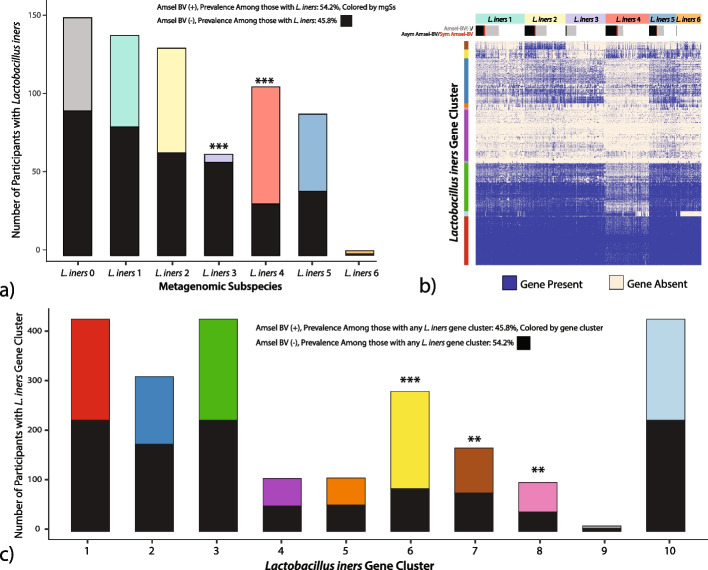
a The total number of clinical evaluations per L. iners mgSs are indicated. The black bars indicate the proportion of negative Amsel-BV diagnoses, and the colored bars indicate the positive Amsel-BV diagnoses. b Gene presence map represents gene content of L. iners mgSs (columns) and L. iners gene clusters (rows). c The total number of clinical evaluations per L. iners gene cluster is indicated. The black bars indicate the proportion of negative Amsel-BV diagnoses, and the colored bars indicate the positive Amsel-BV diagnoses. Within-gene group proportions were statistically compared to the study-wide proportions of Amsel-BV for any samples containing a L. iners gene cluster. (*p < 0.05, **p < 0.01, ***p < 0.001)
Fig. 7
Fig. 7
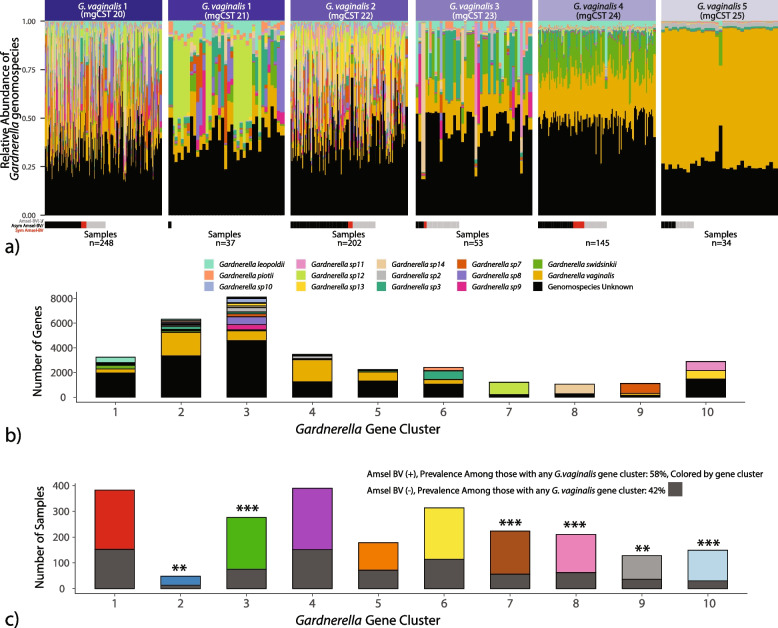
The proportions of Gardnerella genomospecies in a sample differ by Gardnerella mgSs (a). For samples with Amsel-BV evaluations, Amsel-BV status is indicated below each sample (column). b Gene clusters of Gardnerella contain genes attributed to a variety of Gardnerella genomospecies (as indicated by colored bars, black bars indicate unknown genomospecies). c The total number of clinical evaluations per Gardnerella gene cluster is indicated. The dark gray bars indicate the proportion of negative Amsel-BV diagnoses, and the colored bars indicate the positive Amsel-BV diagnoses. Within-gene group proportions were statistically compared to the study-wide proportions of Amsel-BV for any samples containing a Gardnerella gene cluster. (*p < 0.05, **p < 0.01, ***p < 0.001)
Fig. 8
Fig. 8
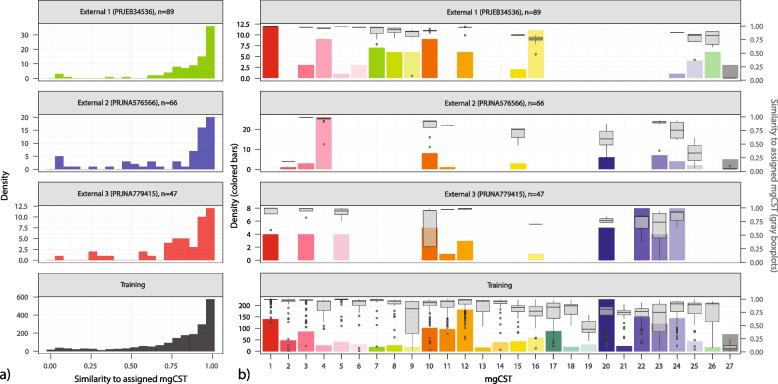
Three external metagenomic datasets were processed with VIRGO [29] and assigned mgCSTs using the mgCST classifier. a Most samples were statistically similar to the reference centroid of the assigned mgCST. b Samples in each dataset were distributed across mgCSTs. In all cases, the lowest similarity scores were observed in mgCST 27

Update of

References

    1. Ravel J, Gajer P, Abdo Z, Schneider GM, Koenig SSK, McCulle SL, et al. Vaginal microbiome of reproductive-age women. Proc Natl Acad Sci USA. 2011;108(Suppl 1):4680–7. doi: 10.1073/pnas.1002611107. - DOI - PMC - PubMed
    1. O'Hanlon DE, Come RA, Moench TR. Vaginal pH measured in vivo: lactobacilli determine pH and lactic acid concentration. BMC Microbiol. 2019;19(1):13. doi: 10.1186/s12866-019-1388-8. - DOI - PMC - PubMed
    1. Gong Z, Luna Y, Yu P, Fan H. Lactobacilli inactivate Chlamydia trachomatis through lactic acid but not H2O2. PLoS One. 2014;9(9):e107758. doi: 10.1371/journal.pone.0107758. - DOI - PMC - PubMed
    1. Witkin SS, Mendes-Soares H, Linhares IM, Jayaram A, Ledger WJ, Forney LJ. Influence of vaginal bacteria and D- and L-lactic acid isomers on vaginal extracellular matrix metalloproteinase inducer: implications for protection against upper genital tract infections. mBio. 2013;4(4); 10.1128/mBio.00460-13. - PMC - PubMed
    1. Ravel J, Brotman RM. Translating the vaginal microbiome: gaps and challenges. Genome Med. 2016;8(1):35. doi: 10.1186/s13073-016-0291-2. - DOI - PMC - PubMed

Publication types

LinkOut - more resources