. 2023 Jul 14:8:306.
doi: 10.12688/wellcomeopenres.19463.1. eCollection 2023.

The Sanitation Hygiene Infant Nutrition Efficacy (SHINE) Trial: Protocol for school-age follow-up

Affiliations

The Sanitation Hygiene Infant Nutrition Efficacy (SHINE) Trial: Protocol for school-age follow-up

Joseph D Piper et al. Wellcome Open Res. .

Abstract

Background: There is a need for follow-up of early-life stunting intervention trials into childhood to determine their long-term impact. A holistic school-age assessment of health, growth, physical and cognitive function will help to comprehensively characterise the sustained effects of early-life interventions. Methods: The Sanitation Hygiene Infant Nutrition Efficacy (SHINE) trial in rural Zimbabwe assessed the effects of improved infant and young child feeding (IYCF) and/or improved water, sanitation and hygiene (WASH) on stunting and anaemia at 18 months. Among children enrolled to SHINE, 1,275 have been followed up at 7-8 years of age (1,000 children who have not been exposed to HIV, 268 exposed to HIV antenatally who remain HIV negative and 7 HIV positive children). Children were assessed using the School-Age Health, Activity, Resilience, Anthropometry and Neurocognitive (SAHARAN) toolbox, to measure their growth, body composition, cognitive and physical function. In parallel, a caregiver questionnaire assessed household demographics, socioeconomic status, adversity, nurturing, caregiver support, food and water insecurity. A monthly morbidity questionnaire is currently being administered by community health workers to evaluate school-age rates of infection and healthcare-seeking. The impact of the SHINE IYCF and WASH interventions, the early-life 'exposome', maternal HIV, and contemporary exposures on each school-age outcome will be assessed. We will also undertake an exploratory factor analysis to generate new, simpler metrics for assessment of cognition (COG-SAHARAN), growth (GROW-SAHARAN) and combined growth, cognitive and physical function (SUB-SAHARAN). The SUB-SAHARAN toolbox will be used to conduct annual assessments within the SHINE cohort from ages 8-12 years. Ethics and dissemination: Approval was obtained from Medical Research Council of Zimbabwe (08/02/21) and registered with Pan-African Clinical Trials Registry (PACTR202201828512110, 24/01/22). Primary caregivers provided written informed consent and children written assent. Findings will be disseminated through community sensitisation, peer-reviewed journals and stakeholders including the Zimbabwean Ministry of Health and Child Care.

Keywords: Child; HIV; IYCF; WASH; body composition; cognition; fitness; nutrition.


Conflict of interest statement

No competing interests were disclosed.

Figures
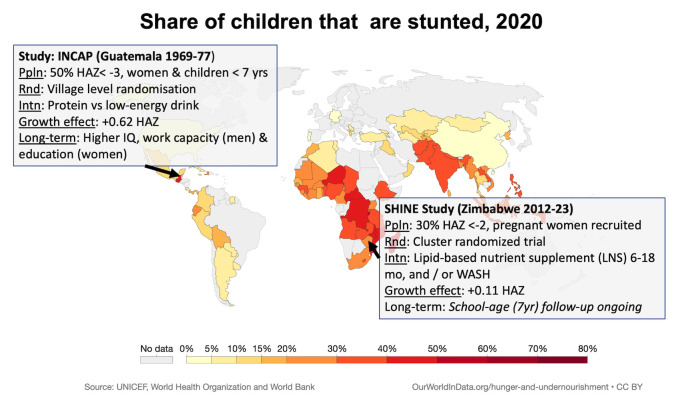
Figure 1.
Figure 1.. Proportion of children that are stunted (UNICEF, WHO and World Bank, kindly reproduced from ‘Our World in Data’).
Inset details describe the landmark INCAP study and the proposed SHINE study, both of which provide long-term follow-up of a nutrition intervention. Data from the landmark INCAP study in Guatemala 50 years ago indicate that early-life improvements in nutrition can confer long-term benefits for cognition. Children receiving additional nutrition by age 2 years initially had only modest effects on neurodevelopmental scores; however, in long-term follow-up, those who had received the nutrition intervention had higher IQ scores, greater work capacity and earnings (among men) and greater schooling (among women) . The INCAP study was conducted at a time when global stunting prevalence was much higher (1969–1977): 50% of the study population had HAZ<-3.0, while currently worldwide 22% children have HAZ <-2.0. Furthermore, the impact of the intervention on linear growth was much greater than that seen in trials of complementary feeding interventions over the past 20 years (+0.62 HAZ compared to +0.11 HAZ). Thus, although the Guatemala trial suggests that complementary feeding interventions can have substantial long-term physical and neurodevelopmental benefits, it does not reflect today’s situation in which Africa has the highest stunting prevalence, severe stunting is relatively rare but moderate stunting is 20–40%, and the average impact of interventions on HAZ is only 0.1-0.2. UNICEF, United Nations Children's Fund; WHO, World Health Organization; INCAP, Institute of Nutrition of Central America and Panama; SHINE, Sanitation Hygiene Infant Nutrition Efficacy; HAZ, height-for-age Z-score; Ppln, population; Rnd, randomisation technique; Intn, Intervention; WASH, water, sanitation and hygiene.
Figure 2.
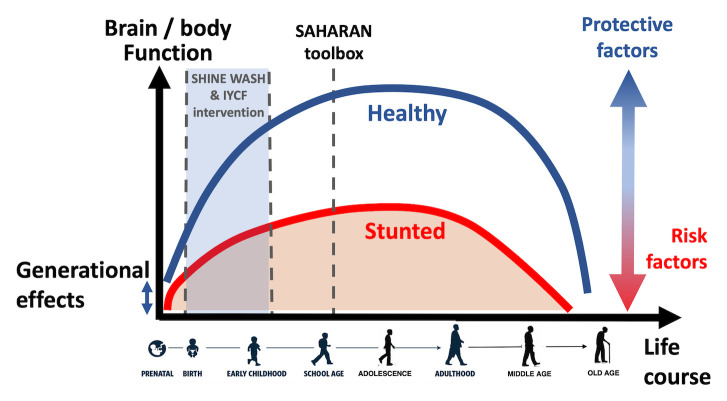
Figure 2.. The life course approach to child growth and development (reproduced from Child Health for all, 6 th Edition with permission from Oxford University Press).
Healthy (blue) and stunted (red) trajectories are shown, illustrating that lifelong health and function are particularly affected by early-life conditions, as well as risk and protective factors throughout life. This applies to linear growth, physical function and health as well as cognitive function and mental health. IYCF, infant and young child feeding.
Figure 3.
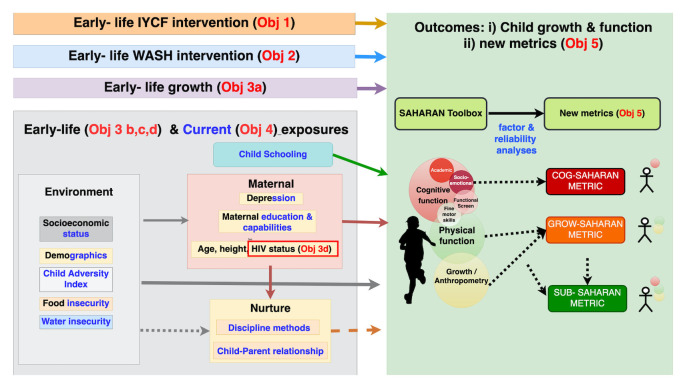
Figure 3.. Conceptual framework of objectives with exposure and outcome variables.
Exposures are split into environmental, schooling, maternal and nurturing domains. Early-life exposures are described in black and contemporary exposures in blue text. Those exposures that were measured in both early-life and contemporary are written in black and blue text. Outcomes are based on the SAHARAN toolbox to provide school-age child growth, health and function. These outcomes will also be analysed in the standard of care arm to provide new cognitive (COG-SAHARAN), Growth (GRO-SAHARAN) and overall (SUB-SAHARAN) metrics. SAHARAN, School-Age Health, Activity, Resilience, Anthropometry and Neurocognitive; IYCF, infant and young child feeding; WASH, water, sanitation and hygiene.

References

    1. Perumal N, Bassani DG, Roth DE: Use and Misuse of Stunting as a Measure of Child Health. J Nutr. 2018;148(3):311–15. 10.1093/jn/nxx064 - DOI - PubMed
    1. Martorell R: Improved Nutrition in the First 1000 Days and Adult Human Capital and Health. Am J Hum Biol. 2017;29(2). 10.1002/ajhb.22952 - DOI - PMC - PubMed
    1. UNICEF, WHO, World Bank Group: Levels and Trends in Child Malnutrition. In: edition JCME, ed.,2017. Reference Source
    1. Black MM, Walker SP, Fernald LCH, et al. : Early childhood development coming of age: science through the life course. Lancet. 2017;389(10064):77–90. 10.1016/S0140-6736(16)31389-7 - DOI - PMC - PubMed
    1. Das JK, Salam RA, Hadi YB, et al. : Preventive lipid-based nutrient supplements given with complementary foods to infants and young children 6 to 23 months of age for health, nutrition, and developmental outcomes. Cochrane Database Syst Rev. 2019;5(5): CD012611. 10.1002/14651858.CD012611.pub3 - DOI - PMC - PubMed

LinkOut - more resources