


Home delivery among women who had optimal ANC follow-up in Sub-Saharan Africa: A multilevel analysis
- PMID: 38033152
- PMCID: PMC10688839
- DOI: 10.1371/journal.pone.0295289
Home delivery among women who had optimal ANC follow-up in Sub-Saharan Africa: A multilevel analysis
Abstract
Background: Home deliveries, where most births take place, are significantly responsible for the majority of maternal mortality. In order to develop appropriate policies and methods that could aid in addressing the issue, it is important to understand the scope of home delivery and its determinants in developing countries. Therefore, this study aims to ascertain the prevalence and factors associated with home delivery among women who had optimal ANC follow up in the Sub-Saharan Africa countries.
Methods: A population based cross-sectional study was conducted. Data from the most recent Demographic and Health Surveys, which covered 23 Sub-Saharan Africa countries from 2014 to 2020, were used. The study used a total of 180,551 women who had optimal ANC follow up weighted sample. Stata 14 was used to analyze the data. The determinants of home delivery were determined using a multilevel mixed-effects logistic regression model. Factors associated with home delivery in the multilevel logistic regression model were declared significant at p-values <0.05. The adjusted odds ratio and confidence interval were used to interpret the results.
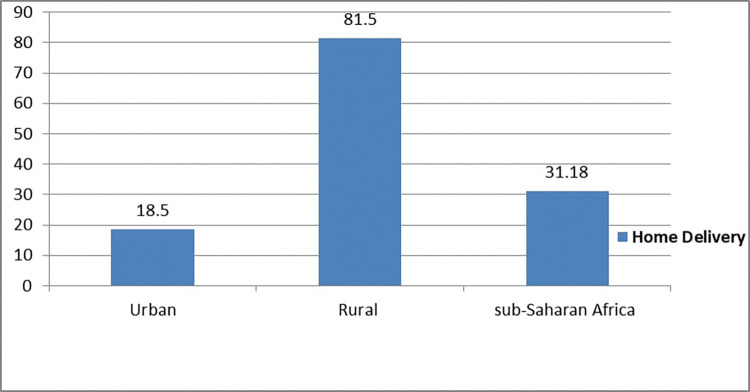
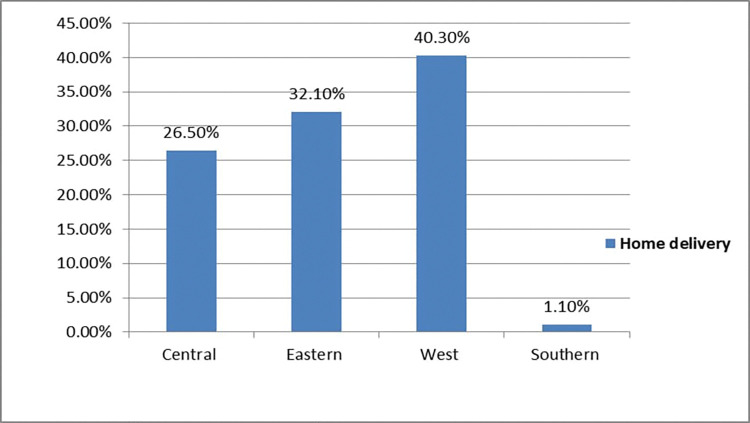
Results: In Sub-Saharan Africa, three in ten (30%) women who had optimal ANC follow-up gave birth at home. Individual-level variables such as maternal age (20 to 35 years) (AOR = 1.27, 95% CI: 1.10, 1.46), no formal education (AOR = 3.10, 95% CI: 2.68, 3.59), pregnancy complications (AOR = 0.74, 95% CI: 0.67, 0.82), distance to a health facility (AOR = 1.43, 95% CI: 1.30, 1.58), and poor wealth status (AOR = 2.71, 95% CI: 2.37, 3.10) had higher odds of home delivery. Community-level variables such as rural residence (AOR = 2.83, 95% CI: 2.48, 3.22), living in central Sub-Saharan Africa (AOR = 7.95, 95% CI: 5.81, 10.9), and eastern Sub-Saharan Africa (AOR = 2.74, 95% CI: 2.09, 3.59), were significantly associated with home delivery.
Conclusions and recommendation: This study concludes that home delivery in sub-Saharan Africa among women who had optimal ANC follow-up were high. The study identified that both individual and community-level variables were determinants of home delivery. Therefore, the Government and ministries of health in Sub-Saharan Africa countries should give attention to those women who reported distance as a big problem to health facilities and for rural resident women while designing policies and strategies targeting reducing home delivery in sub-Saharan Africa.
Copyright: © 2023 Zegeye et al. This is an open access article distributed under the terms of the Creative Commons Attribution License, which permits unrestricted use, distribution, and reproduction in any medium, provided the original author and source are credited.
Conflict of interest statement
The authors declared that there is no competing interest.
Figures
References
-
- Tariku M., Enyew D. B., Tusa B. S., Weldesenbet A. B., and Bahiru N., “Home delivery among pregnant women with ANC follow-up in Ethiopia; Evidence from the 2019 Ethiopia mini demographic and health survey,” Frontiers in Public Health, vol. 10, pp. 862616, 2022. doi: 10.3389/fpubh.2022.862616 - DOI - PMC - PubMed
-
- W. H. Organization, “Trend in maternal mortality: 1990 to 2010: WHO, UNICEF, UNFPA and The World Bank estimates,” 2012.
MeSH terms
LinkOut - more resources
Full Text Sources
