. 2023 Dec 1;9(1):91.
doi: 10.1038/s41522-023-00457-6.

Survey of the infant male urobiome and genomic analysis of Actinotignum spp

Affiliations

Survey of the infant male urobiome and genomic analysis of Actinotignum spp

Seth A Reasoner et al. NPJ Biofilms Microbiomes. .

Abstract

The urinary bladder harbors a community of microbes termed the urobiome, which remains understudied. In this study, we present the urobiome of healthy infant males from samples collected by transurethral catheterization. Using a combination of enhanced culture and amplicon sequencing, we identify several common bacterial genera that can be further investigated for their effects on urinary health across the lifespan. Many genera were shared between all samples suggesting a consistent urobiome composition among this cohort. We note that, for this cohort, early life exposures including mode of birth (vaginal vs. Cesarean section), or prior antibiotic exposure did not influence urobiome composition. In addition, we report the isolation of culturable bacteria from the bladders of these infant males, including Actinotignum spp., a bacterial genus that has been associated with urinary tract infections in older male adults. Herein, we isolate and sequence 9 distinct strains of Actinotignum spp. enhancing the genomic knowledge surrounding this genus and opening avenues for delineating the microbiology of this urobiome constituent. Furthermore, we present a framework for using the combination of culture-dependent and sequencing methodologies for uncovering mechanisms in the urobiome.


Conflict of interest statement

The authors declare no competing interests.

Figures
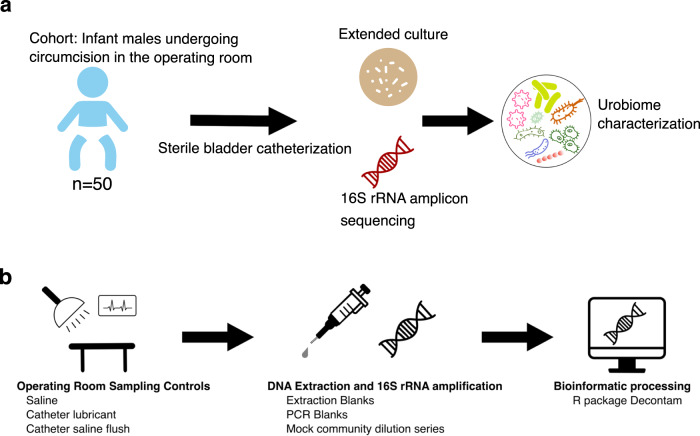
Fig. 1
Fig. 1. Study schematic and analysis workflow.
a Illustration of study design. Fifty male infants were sterilely catheterized in the operating theater prior to undergoing circumcision. Urine was immediately plated for enhanced urine culture. DNA was extracted from urine samples, amplified with V4 16S rRNA primers, and sequenced using Illumina paired-end chemistry. The combination of urine culture and sequencing results was used to describe the urobiome composition. b Illustration of analysis workflow and evaluation of potential contaminant sources. Sampling controls were collected contemporaneously with urine samples in the operating theater. Extraction blanks and a mock microbial community dilution series were used to benchmark DNA extraction. No template blanks were subjected to 16S rRNA PCR amplification to benchmark PCR amplification. All controls mentioned were subjected to Illumina paired-end sequencing. The Decontam package in R was used to filter potential contaminant sequences.
Fig. 2
Fig. 2. 16S rRNA amplicon sequencing reveals a consistent urobiome composition.
a Beta diversity between infant urine samples and sampling controls. Beta diversity was calculated by the phyloseq “ordinate” function using Bray–Curtis distances. Urine samples were significantly different than sampling controls by permutational multivariate analysis of variance (PERMANOVA, p = 0.001). PERMANOVA was calculated using the vegan function “adonis2”. Ellipse depicts a 95% confidence level. b ASV-level profiles of urine samples from 50 infants. Urine samples are depicted along the vertical axis and relative abundance is on the x-axis. Plot created with the microViz function “comp_barplot”. c Alpha diversity metrics (Shannon index and Chao1) between urine from infants born by vaginal delivery vs. Cesarean section (left); and between urine from infants previously exposed to antibiotics vs. antibiotic naïve (right). Alpha diversity was calculated within the phyloseq package using the “plot_richness” function. Alpha diversity was not significantly different between groups by Wilcoxon rank sum test (p > 0.05). Box-plot graphs are defined as center line—median; box limits—upper and lower quartiles; whiskers—1.5× interquartile range. d Relative abundance of Lactobacillus ASVs in urine samples between infants born by vaginal delivery vs. Cesarean section. MaAsLin2 differential abundance P values and multiple-testing corrected FDR are depicted. Box-plot graphs are defined as center line—median; box limits—upper and lower quartiles; whiskers—1.5× interquartile range.
Fig. 3
Fig. 3. Concordance between enhanced culture and amplicon sequencing results.
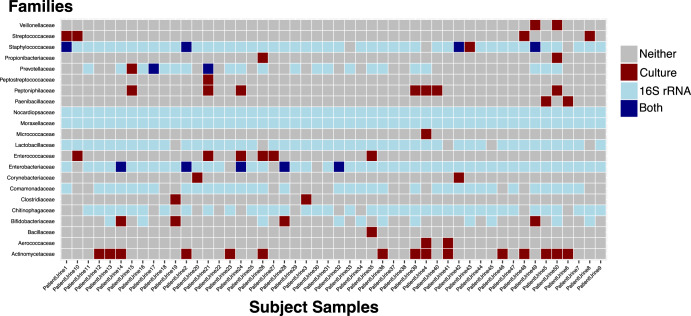
Co-occurrence detection patterns of taxonomic families between enhanced culture and amplicon sequencing methodologies. Taxonomic families are arranged vertically and patient samples are horizontally. The rectangles indicate the detection of the family by enhanced culture (maroon), 16S rRNA amplicon sequencing (light blue), both methodologies (dark blue), or neither methodology (gray).
Fig. 4
Fig. 4. Genomic characterization of Actinotignum spp. isolates.
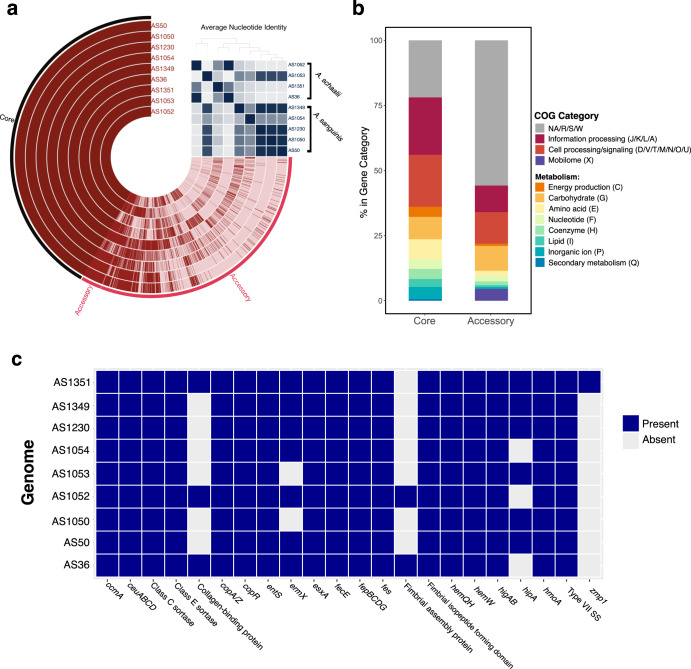
a Nine Actinotignum spp. genomes isolated by enhanced culture from distinct subjects were subjected to whole genome sequencing. Actinotignum spp. pangenome of the nine isolates visualized using anvi’o. Core genes were present in 100% of isolates (9/9) while the accessory genome consists of genes present in <9 of the genomes. Clustering of the genomes is based on average nucleotide identity (ANI), shown in the upper right matrix. b Relative abundance of COG categories represented in the core and accessory genomes. c Presence–absence matrix of fitness factors and antimicrobial resistance genes. ABRicate was used to screen contigs using the MegaRes, ResFinder, and Virulence Factor databases.

Update of

References

    1. Wolfe AJ, et al. Evidence of uncultivated bacteria in the adult female bladder. J. Clin. Microbiol. 2012;50:1376–1383. doi: 10.1128/JCM.05852-11. - DOI - PMC - PubMed
    1. Hilt EE, et al. Urine is not sterile: Use of enhanced urine culture techniques to detect resident bacterial flora in the adult female bladder. J. Clin. Microbiol. 2014;52:871–876. doi: 10.1128/JCM.02876-13. - DOI - PMC - PubMed
    1. Lewis DA, et al. The human urinary microbiome; bacterial DNA in voided urine of asymptomatic adults. Front. Cell. Infect. Microbiol. 2013;3:00041. doi: 10.3389/fcimb.2013.00041. - DOI - PMC - PubMed
    1. Dornbier RA, et al. The microbiome of calcium-based urinary stones. Urolithiasis. 2020;48:191–199. doi: 10.1007/s00240-019-01146-w. - DOI - PubMed
    1. Liu F, et al. The pelvis urinary microbiome in patients with kidney stones and clinical associations. BMC Microbiol. 2020;20:336. doi: 10.1186/s12866-020-01992-4. - DOI - PMC - PubMed