


Impact of dementia special care units for short-stay nursing home patients
- PMID: 38041834
- PMCID: PMC10947952
- DOI: 10.1111/jgs.18708
Impact of dementia special care units for short-stay nursing home patients
Abstract
Background: Improving quality of care provided to short-stay patients with dementia in nursing homes is a policy priority. However, it is unknown whether dementia-focused care strategies are associated with improved clinical outcomes or lower utilization and costs for short-stay dementia patients.
Methods: We performed a national survey of nursing home administrators in 2020-2021, asking about the presence of three dementia-focused care services used for their short-stay patients: (1) a dementia care unit, (2) cognitive deficiency training for staff, and (3) dementia-specific occupational therapy. Using Medicare claims, we identified short-stay episodes for beneficiaries residing in surveyed skilled nursing facilities (SNFs) with and without dementia. We compared clinical, cost, and utilization outcomes for dementia patients in SNFs, which did and did not offer dementia-focused care services. As a counterfactual control, we compared these differences to those for non-dementia patients in the same facilities. Our primary quantity of interest was an interaction term between a patients' dementia status and the presence of a dementia-focused care tool.
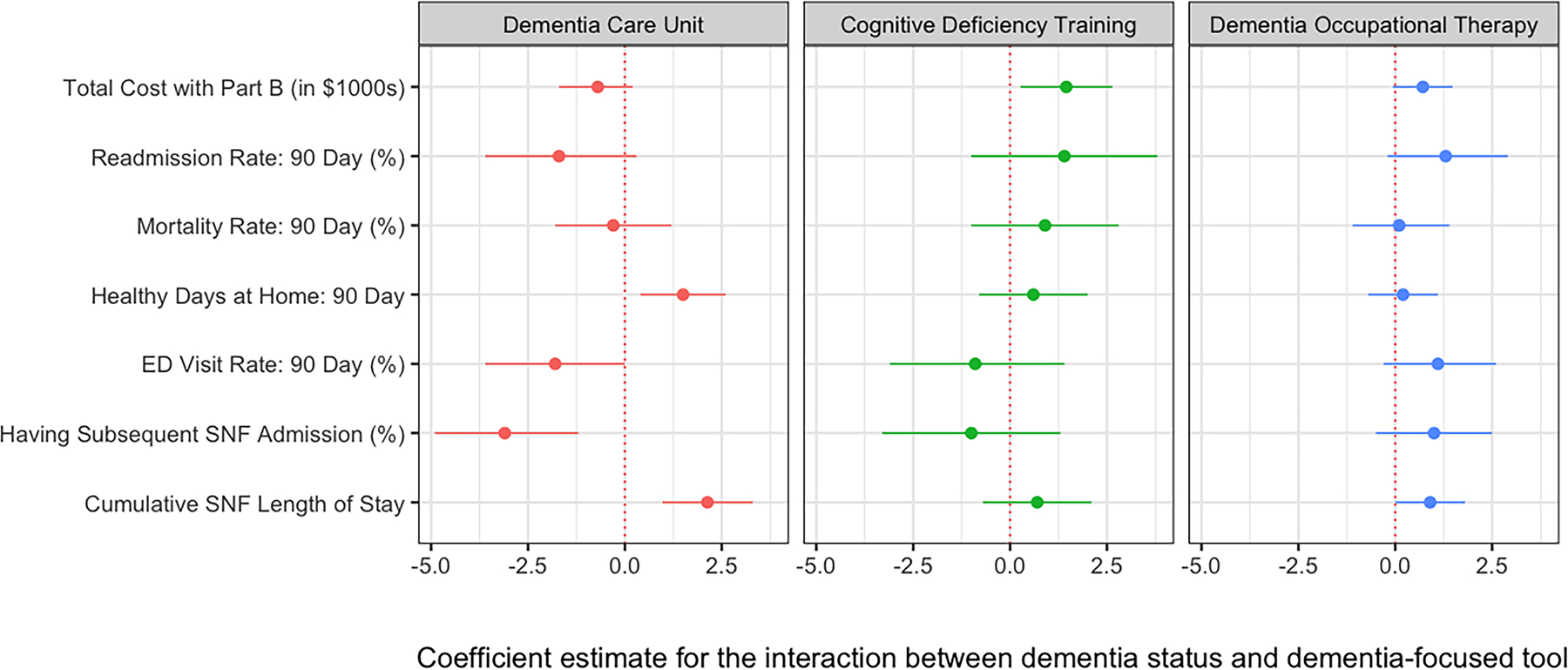
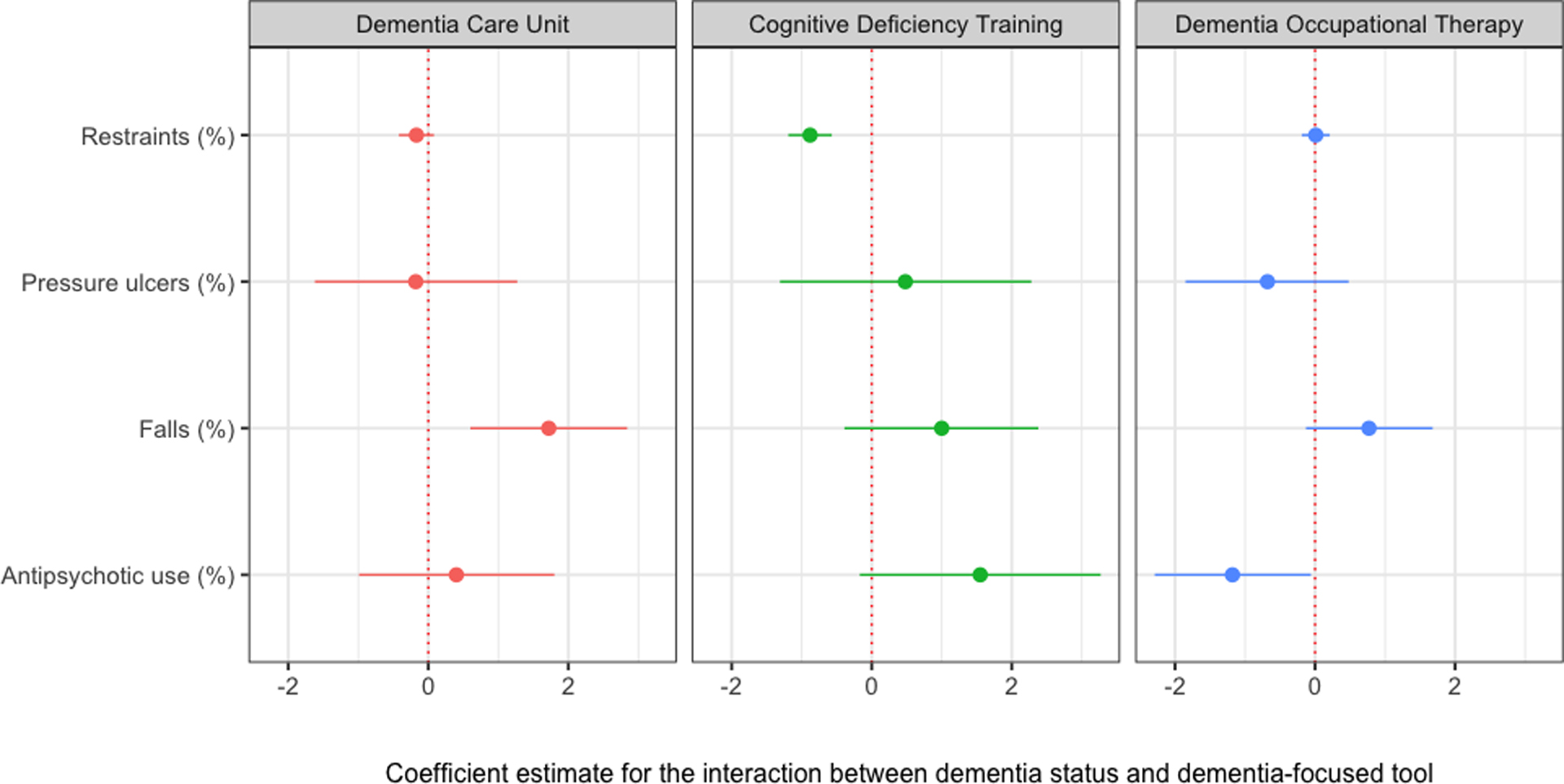
Results: The study population included 102,860 Medicare episodes of care from 377 SNF survey respondents in 2018-2019. In adjusted comparisons of the interaction between dementia status and the presence of each dementia-focused care tool, dementia care units were associated with a 1.5-day increase in healthy days at home in the 90 days following discharge (p = 0.01) and a 3.1% decrease in the likelihood of a subsequent SNF admission (p = 0.001). Cognitive deficiency training was also associated with a 2.0% increase in antipsychotics (p = 0.03), whereas dementia-specific occupational therapy was associated with a 1.2% increase in falls (p = 0.01) per patient episode.
Conclusions: Self-reported use of dementia care units for short-stay patients was associated with modestly better performance in some, but not all, outcome measures. This provides hypothesis-generating evidence that dementia care units could be a promising mechanism to improve care delivery in nursing homes.
Keywords: dementia; nursing home; short-stay patients.
© 2023 The American Geriatrics Society.
Conflict of interest statement
This work was supported by grants K23 AG058806 (Barnett) and R01 AG060935 from the National Institute on Aging of the National Institutes of Health (Epstein, Grabowski, Orav, and Joynt Maddox). Dr. Epstein receives compensation from the New England Journal of Medicine. Dr. Joynt Maddox receives or has received compensation from the Journal of the American Medical Association, Centene Corporation, and Humana Inc. Dr. Grabowski receives compensation from AARP, Analysis Group, GRAIL, and the Medicare Payment Advisory Commission. Dr. Barnett receives compensation as an expert witness through Greylock McKinnon Associates.
Figures
References
-
- Alzheimer’s Association. 2022 Alzheimer’s Disease Facts and Figures.; 2022.
-
- Centers for Medicare & Medicaid Services. CMS ANNOUNCES PARTNERSHIP TO IMPROVE DEMENTIA CARE IN NURSING HOMES. Centers for Medicare & Medicaid Services. Published 2012. Accessed February 28, 2023. https://www.cms.gov/newsroom/press-releases/cms-announces-partnership-im...
Publication types
MeSH terms
Grants and funding
LinkOut - more resources
Full Text Sources
Medical
Research Materials
