


The Effect of a Balance Training Program on the Balance and Technical Skills of Adolescent Soccer Players
- PMID: 38045735
- PMCID: PMC10690516
- DOI: 10.52082/jssm.2023.645
The Effect of a Balance Training Program on the Balance and Technical Skills of Adolescent Soccer Players
Abstract
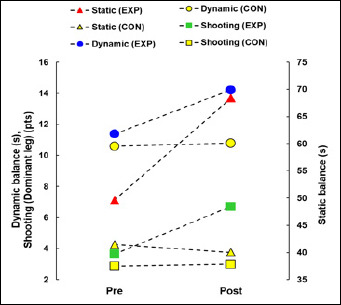
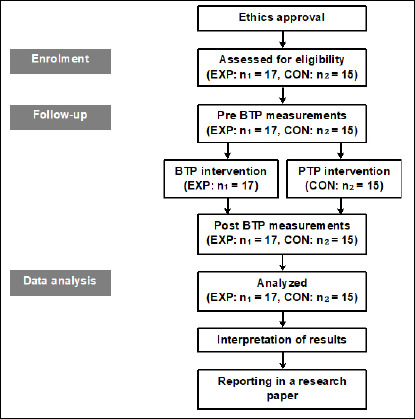
Soccer is a complex sport, and balance appears to play a crucial role in the quality execution of technical skills, which are mostly performed while standing on one foot. Nevertheless, in younger ages, when learning still affects soccer performance, the effect of a balance-training program on the player's balance and technical skills remains unexplored. This research examined the effect of a balance-training program (BTP) on balance and technical skills of adolescent soccer players. Τhe participating volunteers were thirty-two soccer players (12-13 years old with 3.84 ± 0.95 years of practice), randomly separated into two groups: an experimental (EXP, n1 = 17) and a control group (CON, n2 = 15). Both groups were evaluated in static and dynamic balance and in technical skills (dribbling, passing, juggling, and shooting with dominant and non-dominant legs) before (Pre-condition) and after the intervention (Post-condition) which was an eight-week BTP for the EXP group and a placebo-training program for the CON group. Α 2 by 2 (groups×condition) mixed analysis of variance (ANOVA) with repeated measures on the condition factor was used to assess possible differences between groups. A significant groups × condition interaction effect was found in dynamic balance (p = 0.008), static (p = 0.042), and shooting (p = 0.022) with dominant leg performance. The EXP group improved (p = 0.007) its static balance by 37.82% and also significantly improved its dynamic balance and shooting accuracy with dominant leg in Post condition by 24.98% (p = 0.006) and 83.84% (p = 0.006) respectively. No significant improvement of other variables was detected in the EXP group Post condition. Dynamic and static balance, and shooting with dominant leg skills can be improved in adolescent soccer players through a specialized 8-week BTP. Balance-training program may contribute to technical skill improvement in soccer training.
Keywords: Soccer technique; adolescence; dominant leg; performance; proprioception; steadiness.
© Journal of Sports Science and Medicine.
Figures
References
-
- Bailey R., Collins D., Ford P., Macnamara Á., Toms M., Pearce G. (2010) Participant Developmentin Sport: An Academic Review. 1st edition. (ed A Masha). Sports Coach; UK.
-
- Bangsbo J. (1994) The physiology of soccer with special reference to intense intermittent exercise. Acta physiologica Scandinavica 619, 1-155. - PubMed
-
- Bekris E., Bourdas D.I., Mylonis E., Ispirlidis I., Zacharakis E.D., Katis A. (2022) Effect of 3 vs. 3 Soccer Small-Sided Game on Various Performance, Inflammatory, Muscle Damage and Hormonal Indicators in Semi-Professional Players. Sports 10, 1-15. https://doi.org/10.3390/sports10070102 10.3390/sports10070102 - DOI - PMC - PubMed
-
- Bekris E., Gioldasis A. (2016) Juggling Test Battery. The Swedish Journal of Scientific Research 3, 2001–9211.
-
- Bekris E., Kahrimanis G., Anagnostakos K., Gissis I., Papadopoulos C., Sotiropoulos A. (2012) Proprioception and balance training can improve amateur soccer players’ technical skills. Journal of Physical Education and Sport 12, 81-89.
MeSH terms
LinkOut - more resources
Full Text Sources