Review
. 2022 Aug 17;1(4):23.
doi: 10.20517/mrr.2022.11. eCollection 2022.

The gut-immune-brain axis in neurodevelopment and neurological disorders

Affiliations
Review

The gut-immune-brain axis in neurodevelopment and neurological disorders

John Chulhoon Park et al. Microbiome Res Rep. .

Abstract

The gut-brain axis is gaining momentum as an interdisciplinary field addressing how intestinal microbes influence the central nervous system (CNS). Studies using powerful tools, including germ-free, antibiotic-fed, and fecal microbiota transplanted mice, demonstrate how gut microbiota perturbations alter the fate of neurodevelopment. Probiotics are also becoming more recognized as potentially effective therapeutic agents in alleviating symptoms of neurological disorders. While gut microbes may directly communicate with the CNS through their effector molecules, including metabolites, their influence on neuroimmune populations, including newly discovered brain-resident T cells, underscore the host immunity as a potent mediator of the gut-brain axis. In this review, we examine the unique immune populations within the brain, the effects of the gut microbiota on the CNS, and the efficacy of specific probiotic strains to propose the novel concept of the gut-immune-brain axis.

Keywords: Alzheimer’s disease; Gut-brain axis; autism spectrum disorder; blood-brain barrier; microbiota; neuroimmunology; neuroinflammation; probiotics.


Conflict of interest statement

Im SH is the CEO of the ImmunoBiome but declares no conflicts of interest for this paper. The other author declares that the research was conducted without any commercial or financial relationships that could be construed as a potential conflict of interest.

Figures

Figure 1
Figure 1
Immune populations of the brain microenvironment. The blood-brain barrier regulates the influx of peripheral immune populations into the brain. However, recent findings have also identified brain-resident lymphocyte populations in diseased and homeostatic brain parenchyma.
Figure 2
Figure 2
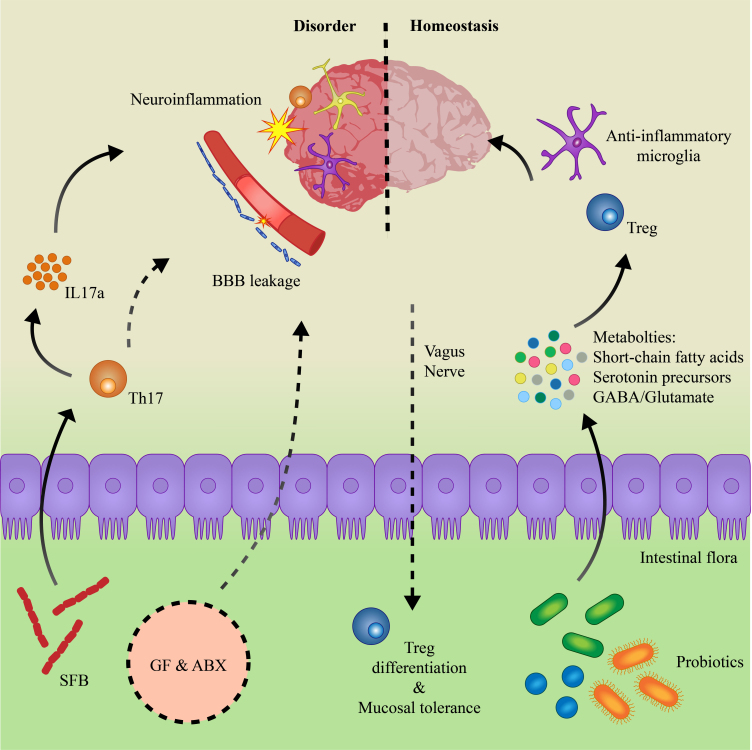
Model of the gut-immune-brain axis. Microbes can directly shape the brain microenvironment through their metabolites or indirectly through modulation of the host immune system. The absence of microflora in germ-free (GF) or antibiotics-treated (ABX) mice have been demonstrated to induce blood-brain barrier (BBB) leakage[85,86]. Segmented filamentous bacteria (SFB) can stimulate the production of IL17a by Th17 cells, which drives neuroinflammation[105,108-110]. On the other hand, beneficial probiotics such as L. reuteri ATCC PTA 6475 or B. longum subsp. infantis DSM 24737 can protect from neurological disorders through metabolic pathways and the induction of immune homeostasis. Brain-to-gut signals through the vagus nerve control colonic regulator T cell (Treg) populations to regulate gastrointestinal homeostasis.

References

    1. Sudo N, Chida Y, Aiba Y, et al. Postnatal microbial colonization programs the hypothalamic-pituitary-adrenal system for stress response in mice. J Physiol. 2004;558:263–75. doi: 10.1113/jphysiol.2004.063388. - DOI - PMC - PubMed
    1. Wang X, Sun G, Feng T, et al. Sodium oligomannate therapeutically remodels gut microbiota and suppresses gut bacterial amino acids-shaped neuroinflammation to inhibit Alzheimer's disease progression. Cell Res. 2019;29:787–803. doi: 10.1038/s41422-019-0216-x. - DOI - PMC - PubMed
    1. Olson CA, Vuong HE, Yano JM, Liang QY, Nusbaum DJ, Hsiao EY. The gut microbiota mediates the anti-seizure effects of the ketogenic diet. Cell. 2018;174:497. doi: 10.1016/j.cell.2018.06.051. - DOI - PMC - PubMed
    1. Wu WL, Adame MD, Liou CW, et al. Microbiota regulate social behaviour via stress response neurons in the brain. Nature. 2021;595:409–14. doi: 10.1038/s41586-021-03669-y. - DOI - PMC - PubMed
    1. Chu C, Murdock MH, Jing D, et al. The microbiota regulate neuronal function and fear extinction learning. Nature. 2019;574:543–8. doi: 10.1038/s41586-019-1644-y. - DOI - PMC - PubMed

LinkOut - more resources