. 2024 Apr;18(2):292-301.
doi: 10.1007/s11682-023-00825-y. Epub 2023 Dec 5.

Altered functional brain networks in problematic smartphone and social media use: resting-state fMRI study

Affiliations

Altered functional brain networks in problematic smartphone and social media use: resting-state fMRI study

Eszter Áfra et al. Brain Imaging Behav. 2024 Apr.

Abstract

Nowadays, the limitless availability to the World Wide Web can lead to general Internet misuse and dependence. Currently, smartphone and social media use belong to the most prevalent Internet-related behavioral addiction forms. However, the neurobiological background of these Internet-related behavioral addictions is not sufficiently explored. In this study, these addiction forms were assessed with self-reported questionnaires. Resting-state functional magnetic resonance imaging was acquired for all participants (n = 59, 29 males) to examine functional brain networks. The resting-state networks that were discovered using independent component analysis were analyzed to estimate within network differences. Significant negative associations with social media addiction and smartphone addiction were found in the language network, the lateral visual networks, the auditory network, the sensorimotor network, the executive network and the frontoparietal network. These results suggest that problematic smartphone and social media use are associated with sensory processing and higher cognitive functioning.

Keywords: Functional brain networks; Functional magnetic resonance imaging; Language network; Resting-state; Visual network.


Conflict of interest statement

This manuscript has not been published and is not under consideration for publication elsewhere. We have no conflicts of interest to disclose. We do hope that the manuscript is suitable for your journal.

Figures
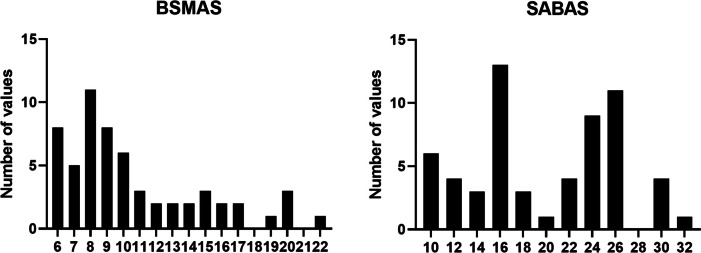
Fig. 1
Fig. 1
Histograms showing the distribution of the questionnaires’ data. BSMAS: Bergen Social Media Addiction Scale; SABAS: Smartphone Application-Based Addiction Scale
Fig. 2.
Fig. 2.
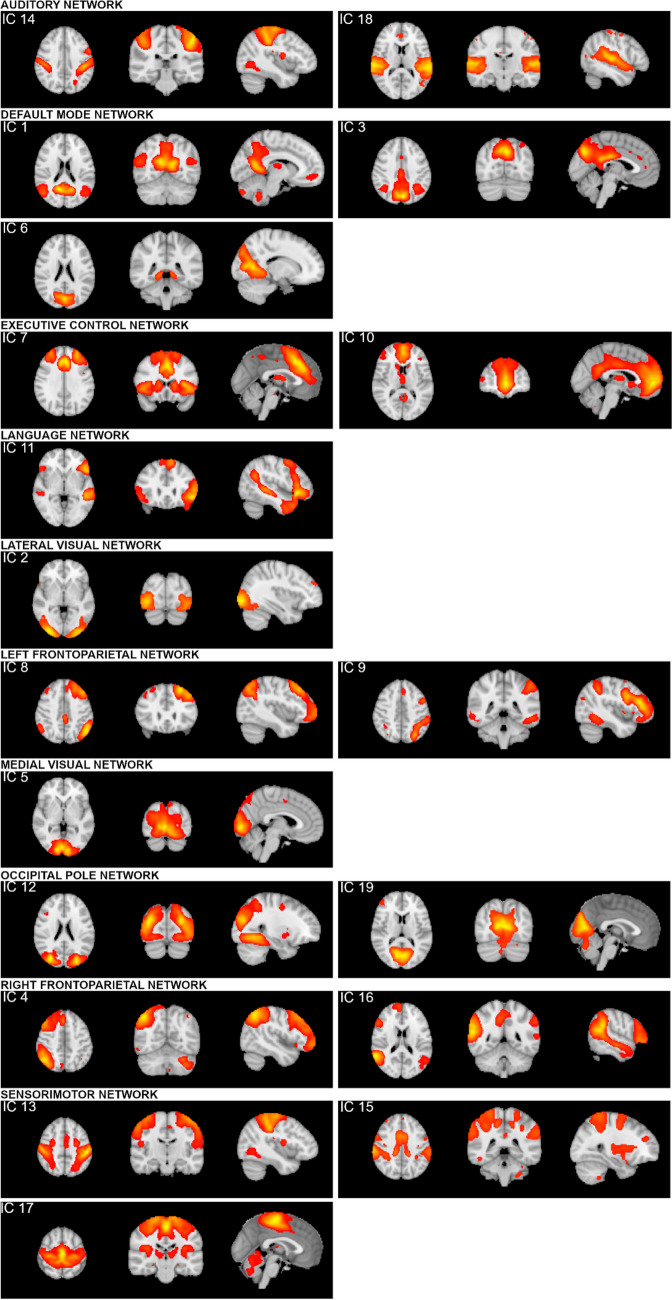
19 components revealed by the independent component analysis. Auditory network: IC 14, IC 18; Default mode network: IC 1, IC 3, IC 6; Executive control network: IC 7, IC 10; Language network: IC 11; Lateral visual network: IC 2; Left frontoparietal network: IC 8, IC 9; Medial visual network: IC 5; Occipital pole: IC 12, IC 19; Right frontoparietal network: IC 4, IC 16; Sensorimotor network: IC 13, IC 15, IC 17. Red-yellow color bars depict Z scores ranging from 3.0 to 32.27
Fig. 3
Fig. 3
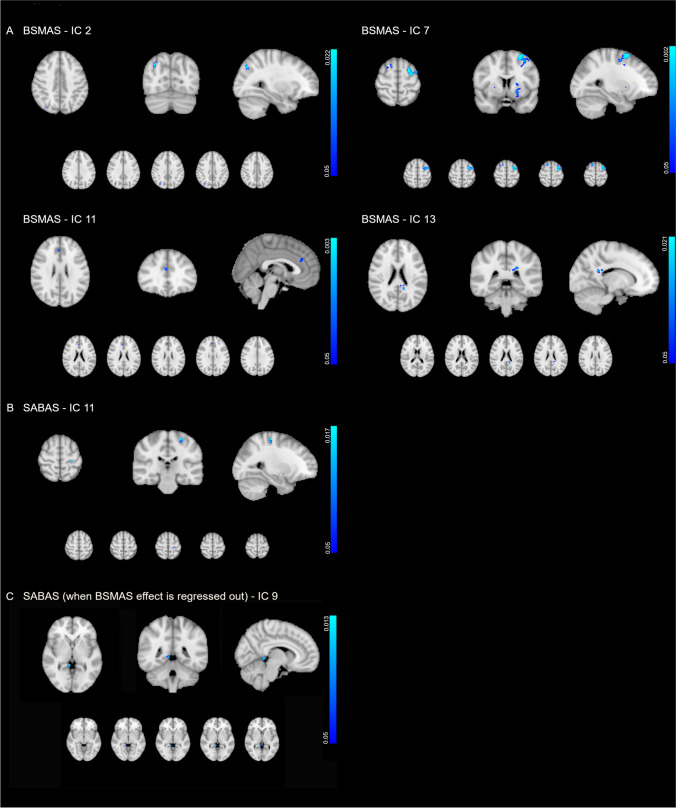
Group-level negative associations between A) BSMAS and FC within the IC 2 (lateral visual network), IC 7 (executive control network), IC 11 (language network), IC 13 (sensorimotor network; B) SABAS and FC within the IC 11 (language network) and C) SABAS (when BSMAS effect is regressed out and FC within the IC 9 (left frontoparietal network). SABAS: Smartphone Application-Based Addiction Scale; BSMAS: Bergen Social Media Addiction Scale; Blue-light blue color bars depict FWE corrected P-values. Axial slices are shown in radiological convention

References

    1. Ahn J, Lee D, Namkoong K, Jung YC. Altered functional connectivity of the salience network in problematic smartphone users. Frontiers in Psychiatry. 2021;12:636730. doi: 10.3389/fpsyt.2021.636730. - DOI - PMC - PubMed
    1. Bányai F, Zsila Á, Király O, Maraz A, Elekes Z, Griffiths MD, Andreassen CS, Demetrovics Z. Problematic Social Media Use: Results from a Large-Scale Nationally Representative Adolescent Sample. PLoS ONE. 2017;12(1):e016983910. doi: 10.1371/JOURNAL.PONE.0169839. - DOI - PMC - PubMed
    1. Beck AT, Ward CH, Mendelson M, Mock J, Erbaugh J. An inventory for measuring depression. Archives of General Psychiatry. 1961;4(6):561–571. doi: 10.1001/ARCHPSYC.1961.01710120031004. - DOI - PubMed
    1. Csibi S, Griffiths MD, Cook B, Demetrovics Z, Szabo A. The Psychometric Properties of the Smartphone Application-Based Addiction Scale (SABAS) International Journal of Mental Health and Addiction. 2018;16:393–403. doi: 10.1007/s11469-017-9787-2. - DOI - PMC - PubMed
    1. Damoiseaux JS, Rombouts SARB, Barkhof F, Scheltens P, Stam CJ, Smith SM, Beckmann CF. Consistent resting-state networks across healthy subjects. Proceedings of the National Academy of Sciences of the United States of America. 2006;103(37):13848–13853. doi: 10.1073/PNAS.0601417103. - DOI - PMC - PubMed

MeSH terms