. 2023 Dec 5;14(1):348.
doi: 10.1186/s13287-023-03591-2.

Neural cell engraftment therapy for sporadic Creutzfeldt-Jakob disease restores neuroelectrophysiological parameters in a cerebral organoid model

Affiliations

Neural cell engraftment therapy for sporadic Creutzfeldt-Jakob disease restores neuroelectrophysiological parameters in a cerebral organoid model

Katie Williams et al. Stem Cell Res Ther. .

Abstract

Background: Sporadic Creutzfeldt-Jakob disease (sCJD), the most common human prion disease, is a fatal neurodegenerative disease with currently no treatment options. Stem cell therapy for neurodegenerative diseases is emerging as a possible treatment option. However, while there are a few clinical trials for other neurodegenerative disorders such as Parkinson's disease, prion disease cell therapy research has so far been confined to animal models.

Methods: Here, we use a novel approach to study cell therapies in sCJD using a human cerebral organoid model. Cerebral organoids can be infected with sCJD prions allowing us to assess how neural precursor cell (NPC) therapy impacts the progression of sCJD. After 90 days of sCJD or mock infection, organoids were either seeded with NPCs or left unseeded and monitored for cellular composition changes, prion infection parameters and neuroelectrophysiological function at 180 days post-infection.

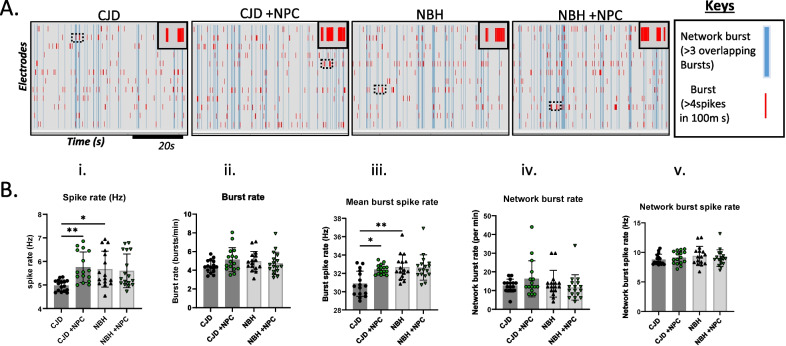
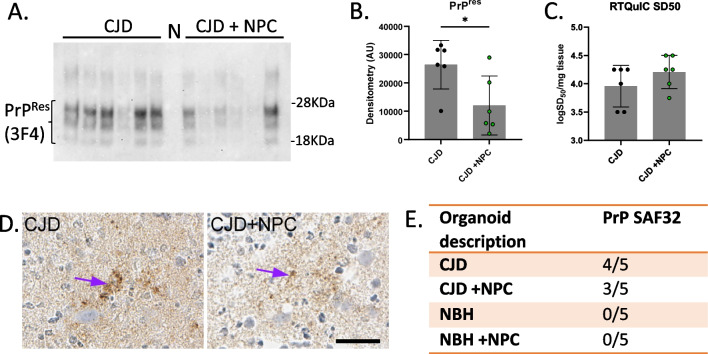
Results: Our results showed NPCs integrated into organoids leading to an increase in neuronal markers and changes in cell signaling irrespective of sCJD infection. Although a small, but significant, decrease in protease-resistant PrP deposition was observed in the CJD-infected organoids that received the NPCs, other disease-associated parameters showed minimal changes. However, the NPCs had a beneficial impact on organoid function following infection. sCJD infection caused reduction in neuronal spike rate and mean burst spike rate, indicative of reduced action potentials. NPC seeding restored these electrophysiological parameters to the uninfected control level.

Conclusions: Together with the previous animal studies, our results support that cell therapy may have some functional benefit for the treatment of human prion diseases.

Keywords: Cell therapy; Cerebral organoid; Electrophysiology; Neural progenitor; Prion; Sporadic CJD.


Conflict of interest statement

The authors declare that they have no competing interests.

Figures
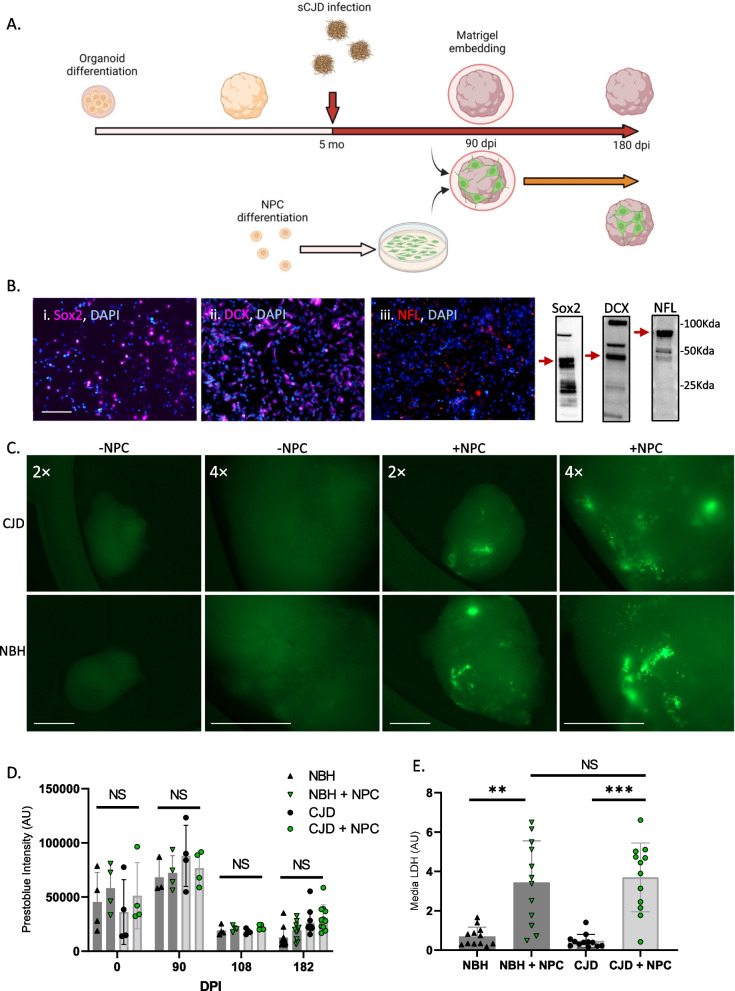
Fig. 1
Fig. 1
Input NPC characterization and organoid health. A Schematic of the experimental approach (created with Biorender). B Immunofluorescent staining (left) and western blot (right, uncropped blots are shown in Additional file 1: Fig. S3) of input NPCs with Sox2 (i.), DCX (ii.), and NFL (iii.). Scale bar = 100 µm. C GFP fluorescence of live organoids with and without NPCs at 184 dpi (94 days post-seeding). Scale bar = 1000 µm for both magnifications. Prestoblue viability assay and E media LDH analysis of representative organoids. Prestoblue measurements were taken at various time points throughout infection (n = 4 at 0–108 dpi, n = 12 at 182dpi), and LDH measurements are 182dpi (n = 12). Each dot represents an individual organoid with shaded bars showing the mean and error bars showing the SD. Statistics were performed at each dpi using Kruskal–Wallis test with Dunn’s correction for multiple comparisons. **p < 0.01, ***p < 0.001, NS = Not significant
Fig. 2
Fig. 2
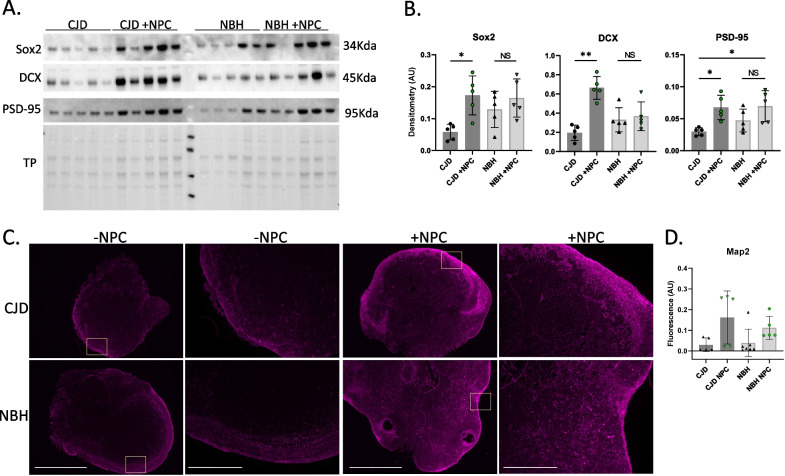
CJD-infected COs seeded with NPCs have higher neuronal linage markers than unseeded CJD-infected organoids. A Western blotting for neuronal markers, Sox2, DCX and PSD-95 of CJD-infected unseeded (lanes 1–5) and unseeded (lanes 6–10) and NBH ‘mock’ infected unseeded (lanes 12–16) and seeded (lanes 17–21) organoid lysates after harvest at 182 dpi (un-cropped blot images can be found in Additional file 1: Fig. S4). B Quantification of western bolts normalized to total protein (n = 5). C Immunofluorescence staining for neuronal marker MAP2 with yellow boxes indicating where higher magnification image was taken. Representative scale bars are shown in CJD without NPC and are 1000 µm and 400 µm, respectively. D Fluorescent intensity quantification of Map2 staining, with each dot representing an individual organoid (n = 5–7). Statistics were preformed using Kruskal–Wallis test with Dunn’s correction for multiple comparisons. *p < 0.05, **p < 0.01, NS Not significant
Fig. 3
Fig. 3
Neuronal network activity in NPC-seeded or unseeded COs following ~ 180 days of inoculation with normal brain homogenate (NBH) or CJD brain homogenate. A Raster plots displaying bursts (each red line indicates a burst) and network bursts (each blue line indicates overlapping bursts between > 3 electrodes) over a ~ 60 s recording. The top-right corner inset displays a zoom-in of the bursts within the dotted rectangular box. Keys are displayed on the right panel. B Parameters can be calculated from the raster plots that broadly translate to the functioning of neurons in the brain. Neuronal population network activity is measured as (i) spike rate (action potentials), (ii) burst rate (periods of rapid action potential spiking), (iii) spike rate in bursts (average number of spikes per burst), (iv) network burst count (burst occurring in synchrony on multiple electrodes indicating wider neuronal network communication), and v) spike rate in network burst (average action potential spiking in synchronized bursts on multiple electrodes). B Average means were compared between groups by the Kruskal–Wallis test with Dunn’s correction for multiple comparisons. Each dot is an “n” representing an organoid (n = 15–17). Data are presented as mean ± SD. *p < 0.05, **p < 0.01
Fig. 4
Fig. 4
Effect of NPC seeding on CO infection parameters. A Western blot of proteinase K (PK) digested PrP from the CJD infections using 3F4 anti-PrP antibody (uncropped blots are shown in Additional file 1: Fig. S6). Samples were PK treated with 10 µg/ml. Lane N is NBH + NPC. B Quantification of PrPRes western blot intensities. C RT-QuIC 50% seeding dose (SD50) for CJD samples with or without NPC (n = 6). D Example PrP histochemistry of the NPC unseeded and seeded organoids with SAF32 antibody. Purple arrows show deposits. Scale bar is 25 µm E IHC summary of abnormal PrP deposits. With number scoring positive over total number of organoids per group examined
Fig. 5
Fig. 5
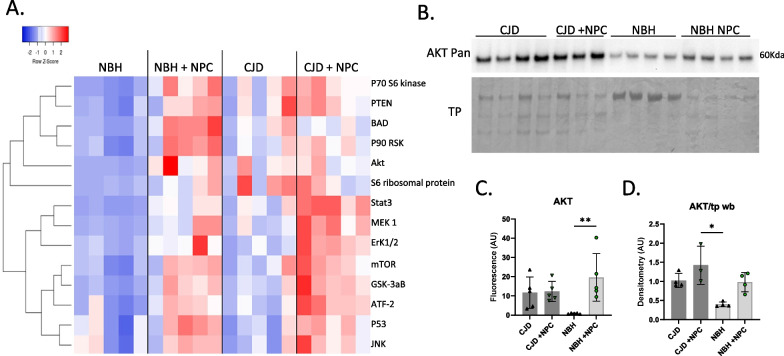
Analysis of cell signaling intermediates changed as a result of infection and NPC seeding. A Heat map of multiplex immunoassay data for signal transduction intermediates showing Z-scores of 5 organoids per treatment. B Western blotting of pan AKT for validation of the Bioplex signaling array data (un-cropped blot images can be found in Additional file 1: Fig. S8). C Bioplex AKT quantification (mean fluorescence normalized to total protein). D Quantification of western blot AKT (Pan) normalized to total protein (Coomassie). Markers on graphs represent individual organoids with shaded bars showing the mean and error bars showing the SD. Statistics were preformed using Kruskal–Wallis test with Dunn’s correction for multiple comparisons. **p < 0.01, *p < 0.05

References

    1. Miranda LHL, Oliveira A, Carvalho DM, Souza GMF, Magalhães JGM, Júnior JAC, et al. Systematic review of pharmacological management in Creutzfeldt-Jakob disease: no options so far? Arq Neuropsiquiatr. 2022;80(8):837–844. doi: 10.1055/s-0042-1755341. - DOI - PMC - PubMed
    1. Varges D, Manthey H, Heinemann U, Ponto C, Schmitz M, Schulz-Schaeffer WJ, et al. Doxycycline in early CJD: a double-blinded randomised phase II and observational study. J Neurol Neurosurg Psychiatry. 2017;88(2):119–125. doi: 10.1136/jnnp-2016-313541. - DOI - PMC - PubMed
    1. Newman PK, Todd NV, Scoones D, Mead S, Knight RS, Will RG, et al. Postmortem findings in a case of variant Creutzfeldt-Jakob disease treated with intraventricular pentosan polysulfate. J Neurol Neurosurg Psychiatry. 2014;85(8):921–924. doi: 10.1136/jnnp-2013-305590. - DOI - PMC - PubMed
    1. Bone I, Belton L, Walker AS, Darbyshire J. Intraventricular pentosan polysulphate in human prion diseases: an observational study in the UK. Eur J Neurol. 2008;15(5):458–464. doi: 10.1111/j.1468-1331.2008.02108.x. - DOI - PubMed
    1. Whittle IR, Knight RS, Will RG. Unsuccessful intraventricular pentosan polysulphate treatment of variant Creutzfeldt-Jakob disease. Acta Neurochir (Wien). 2006;148(6):677–679. doi: 10.1007/s00701-006-0772-y. - DOI - PubMed

Supplementary concepts