Review
. 2024 Jan 22;53(2):566-585.
doi: 10.1039/d2cs00706a.

Cyclic voltammetry and chronoamperometry: mechanistic tools for organic electrosynthesis

Affiliations
Review

Cyclic voltammetry and chronoamperometry: mechanistic tools for organic electrosynthesis

Mohammad Rafiee et al. Chem Soc Rev. .

Abstract

Electrochemical methods offer unique advantages for chemical synthesis, as the reaction selectivity may be controlled by tuning the applied potential or current. Similarly, measuring the current or potential during the reaction can provide valuable mechanistic insights into these reactions. The aim of this tutorial review is to explain the use of cyclic voltammetry and chronoamperometry to interrogate reaction mechanisms, optimize electrochemical reactions, or design new reactions. Fundamental principles of cyclic voltammetry and chronoamperometry experiments are presented together with the application of these techniques to probe (electro)chemical reactions. Several diagnostic criteria are noted for the use of cyclic voltammetry and chronoamperometry to analyze coupled electrochemical-chemical (EC) reactions, and a series of individual mechanistic studies are presented. Steady state voltammetric and amperometric measurements, using microelectrodes (ME) or rotating disk electrodes (RDE) provide a means to analyze concentrations of redox active species in bulk solution and offer a versatile strategy to conduct kinetic analysis or determine the species present during (electro)synthetic chemical reactions.


Conflict of interest statement

Conflicts of interest

There are no conflicts to declare.

Figures

Fig. 1
Fig. 1
(a) Wave form showing the time-dependent applied potentials during a cyclic voltammetry (CV) experiment with an electroactive compound that has an E°' value of 0.5 V. (b) The cyclic voltammograms obtained from the experiment defined in (a). (c) The normalized cyclic voltammograms that account for scan-rate dependence of the current response in a CV experiment. The CV data recorded at 25 (blue) and 100 (red) mV s–1 directly overlay in these plots.
Fig. 2
Fig. 2
(a) Time-dependent applied potential of a chronoamperometry experiment, (b) resulted chronoamperograms, and (c) chronocoulogram for oxidation of a redox-active compound with standard potential (E°') of 0.5 V. (d) Time-dependent applied potential for a double step chronoamperometry and (e) resulted chronoamperograms for oxidation and reduction of a redox-active compound with standard potential (E°') of 0.5 V.
Fig. 3
Fig. 3
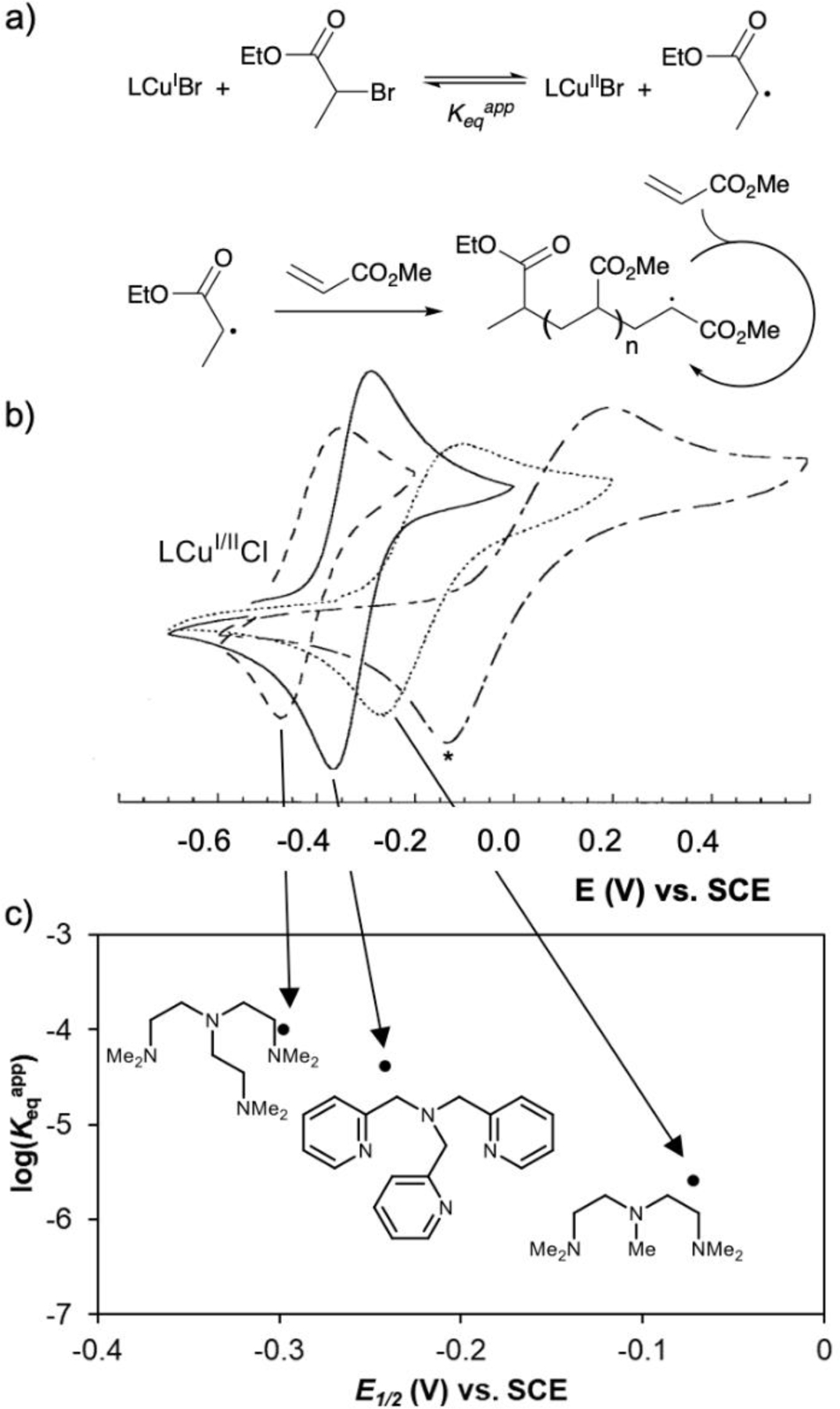
(a) General scheme of atom transfer radical polymerization reactions. (b) Cyclic voltammograms of four ligands with copper chloride (1:1 except in the case of bipyridine*) at 10 mM in acetonitrile (100 mM NBu4PF6). (c) Correlation between the halide abstraction equilibrium constant (derived from ATRP kinetic data) and the redox potential of the associated copper bromide/ligand catalyst complex. Reproduced from ref. with permission from John Wiley and Sons, copyright 2000.
Fig. 4
Fig. 4
(a) Reaction scheme and mechanism of electrochemical glycosylation. (b) Correlation between observed irreversible oxidation potential of various chalcogenoglycosides and the ionization potential of the associated chalcogen atom. Reproduced from ref. with permission from American Chemical Society, copyright 2002.
Fig. 5
Fig. 5
Correlation between the first oxidation potential of triarylimidazoles and the sum of the Hammett parameters of the para-substituents. Reproduced from ref. with permission from American Chemical Society, copyright 2013.
Fig. 6
Fig. 6
(a) Cyclic voltammetry showing that direct oxidation of the aryl tosylamide substrate correlates with oxidation of an aromatic analogue and not an analogous tosylamide. (b) The mechanism of cyclization, relying on 2e, 1H+ oxidation of the benzylic C-H bond. Reproduced from ref. with permission from the Royal Society of Chemistry, copyright 2018.
Fig. 7
Fig. 7
Correlation between redox potential and structural features in oxoammonium electrocatalysts and the classifications of oxoammonium mediators based on their catalytic activity and redox potential. Reproduced from ref. with permission from American Chemical Society, copyright 2015.
Fig. 8
Fig. 8
Cyclic voltammograms of electrocatalyst, substrate, and two of the additives used for the study of the robustness and functional group tolerance. Reproduced from ref. with permission from John Wiley and Sons, copyright 2018.
Fig. 9
Fig. 9
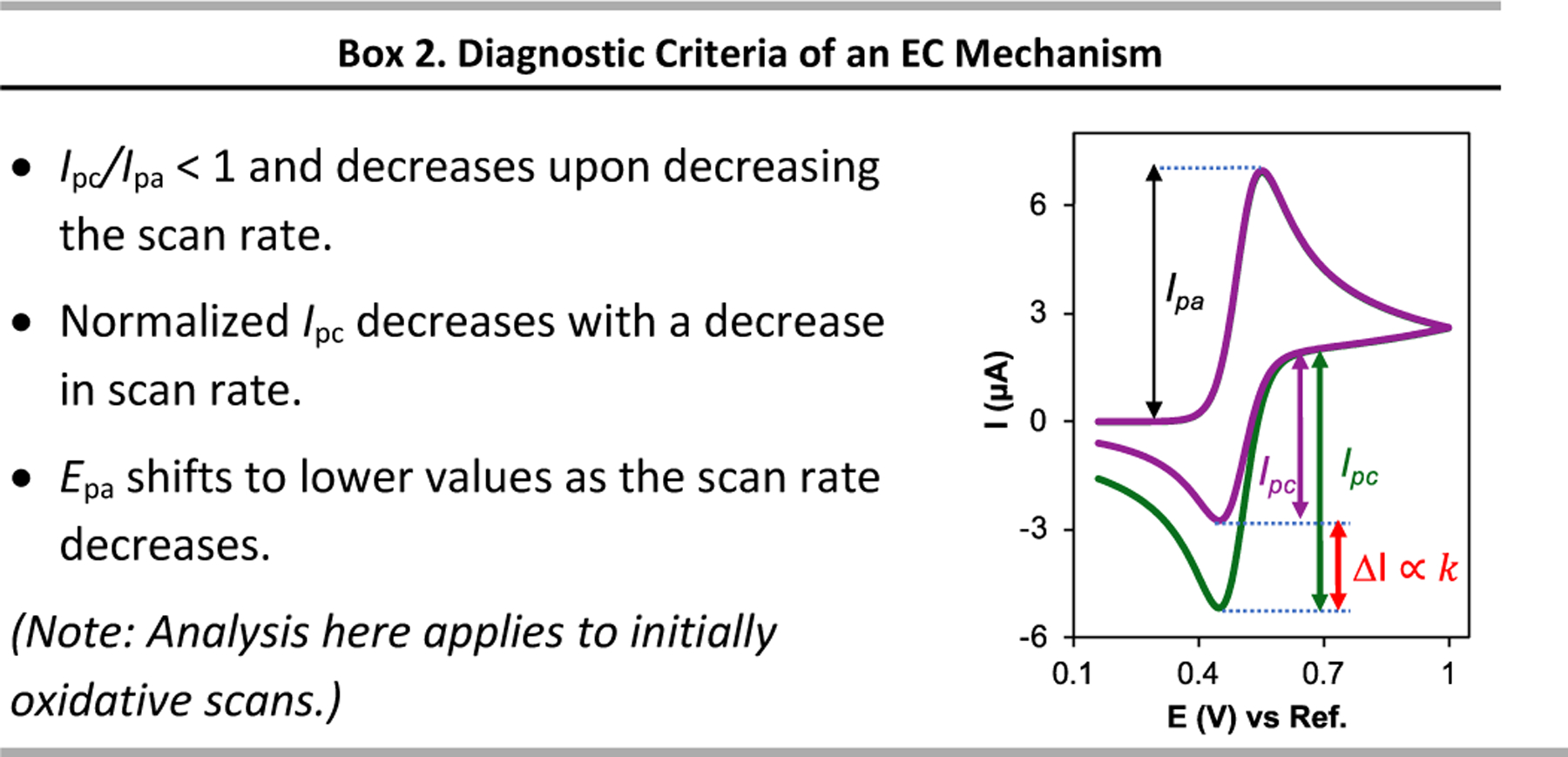
(a) Simulated cyclic voltammograms for the oxidation of 1 mM Red with E1/2 = 0.5 V, in the absence (dotted line) and presence of a chemical reaction with k value = 0.2 M–1 s–1, scan rate 100 mV s–1. (b) Cyclic voltammograms of EC mechanism with k = 0.2 M–1 s–1 at different scan rates, (c) plot showing how the cathodic-to-anodic peak-current ratio varies as a function of k, the rate constant of the C step in the EC mechanism, and 𝜏, the time to scan the potential between the switching potential and E1/2, and (d) plot of the normalized cyclic voltammograms in panel (b).
Fig. 10
Fig. 10
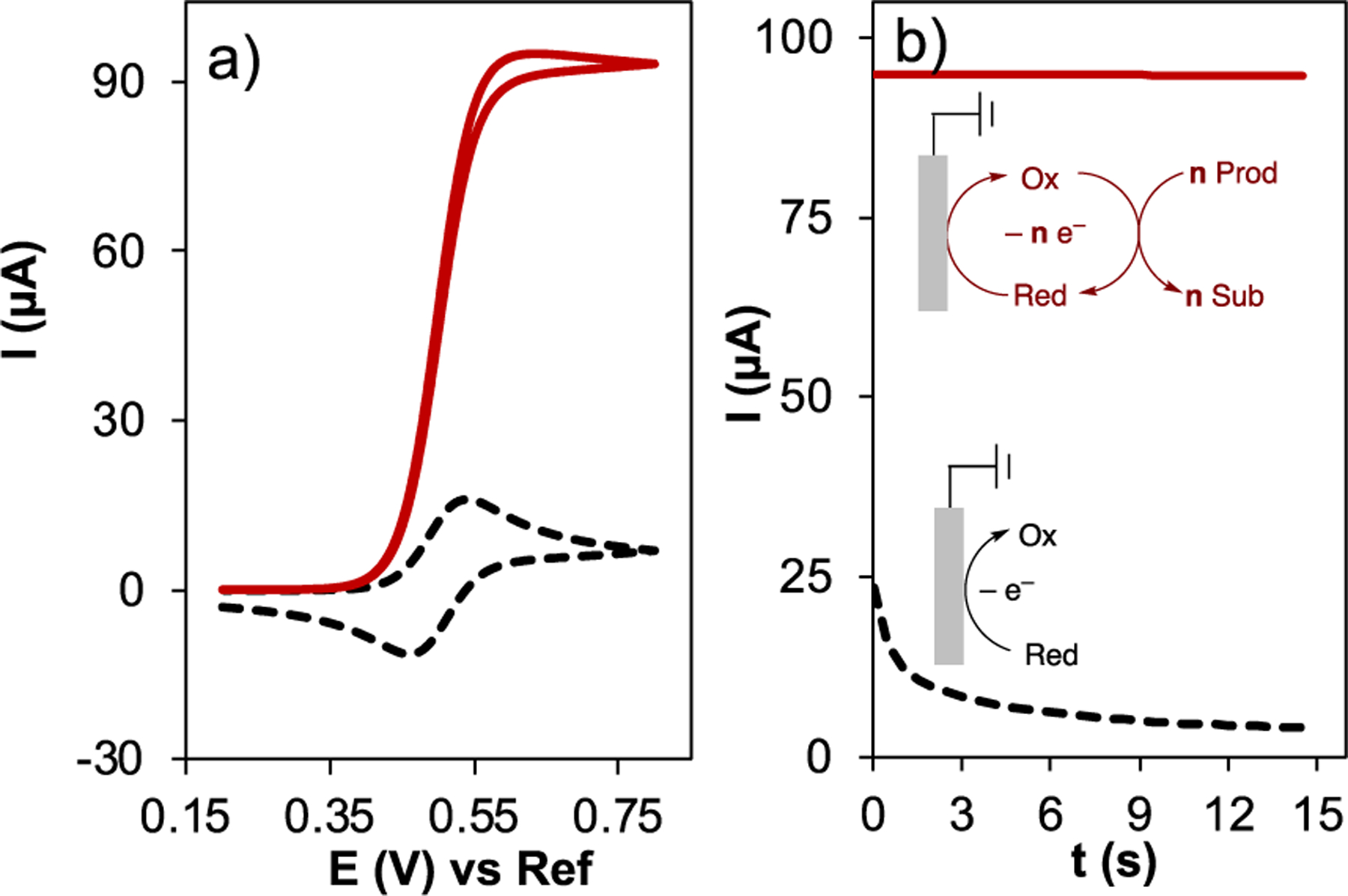
(a) Simulated cyclic voltammograms for electrode reaction of 1 mM Red with E1/2 = 0.5 V, in the absence (dashed black trace) and presence (solid red trace) of a catalytic reaction with k = 20 M–1s–1, scan rate 100 mV s–1. (b) Chronoamperometry of the same electrode reaction (dashed black trace) and electrocatalytic reaction (solid red trace), with an applied potential for chronoamperometry of 0.62 V vs Ref electrode.
Fig. 11
Fig. 11
(a) Proposed mechanism for reaction of allyl acetate with a NiBr2/Mebpy complex. (b) Cyclic voltammetry traces at two scan rates using a solution of 1.0 mM NiBr2∙DME, 1.0 mM Mebpy ligand, 5.0 mM allyl acetate in a solution of acetonitrile containing 100 mM NBu4PF6 at 25 °C. (c) Equations used in the study to obtain kinetic data from cyclic voltammetry data in (b). (d) A second order kinetic plot using CV data to obtain rate constants for oxidative addition. Reproduced from ref. with permission from American Chemical Society, copyright 2022.
Fig. 12
Fig. 12
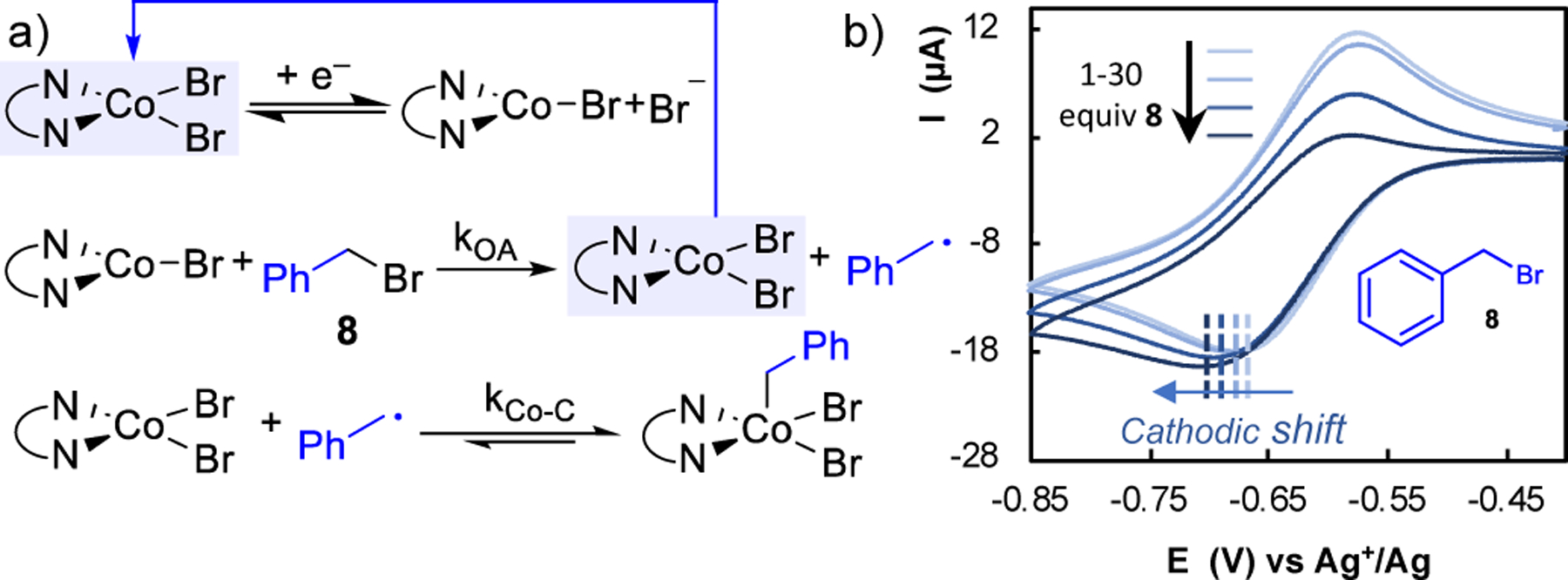
(a) Proposed mechanism for activation of benzyl bromide by Co/pyrox system. (b) Cathodic shift of peak cathodic potential for the CoII/CoI couple ligated by 5CN-pyrox ((S)-6-(4-(tert-butyl)-4,5-dihydrooxazol-2-yl)nicotinonitrile) with successive increases in benzyl bromide 8 concentration. Reproduced from ref. with permission from American Chemical Society, copyright 2019.
Fig. 13
Fig. 13
(a) Proposed mechanism for the formation of Co-H complex. (b) Cyclic voltammograms of [(dppe)(CH3CN)Co(Cp)](PF6)2 0.5 mM in CH3CN (blue trace) and CH2Cl2 (red trace). (c) Cyclic voltammograms of the same complex in the absence of a proton source (blue) and as 4-cyano-anilinium (pKa = 7) is titrated into an CH3CN solution (traces grey to red). Cyclic voltammograms were recorded in 0.25 M NBu4PF6 at 100 mV s–1. (d) Rate constants for protonation of CoI (kPT) on a logarithmic scale as a function of acid pKa in CH3CN and selected examples of acids included in the study. Reproduced from ref. with permission from American Chemical Society, copyright 2017.
Fig. 14
Fig. 14
(a) Cyclic voltammogram of (dppe)NiCl2 (2 mM) in HMPA/THF (1/2) mixture (0.1 M NBu4BF4) at 20 ºC. Voltammogram at a stationary gold microelectrode (d = 125 µm, ν = 500 V s−1). (b) Variations of current peak ratio Ip(R2)/Ip(R1) with the scan rate and the (dppe)NiCl2 concentration, C0: ( ○ ) 1.0, ( ) 1.5, and ( ● ) 2.0 mM. Solid line: theoretical variations for a NiI dimerization mechanism. (ν in V s–1, C0 in M, ΔEp in V; k in M−1 s−1; Z = 0.034(FΔEp/RT); 20 ºC). Reproduced from ref. with permission from American Chemical Society, copyright 1988.
Fig. 15
Fig. 15
(a) General reaction scheme. (b) Cyclic voltammogram at a glassy carbon electrode (A = 2.5 mm2) of 2 mM catechol 9 alone (red) in the presence of 2 mM acetylacetone 11 (blue) and 2 mM 11 alone (green). (c) Cyclic voltammogram as in (b) but at pH = 9 in buffered solutions with same ionic strength. ν = 100 mV s−1, T = 25 °C. (d) Curve I: Variation of peak current ratio Ipc/Ipa in the absence of acetylacetone; curve II: variation of peak current ratio Ipc/Ipa in the presence of acetyl acetone; curve III: difference between peak current ratio Ipc/Ipa in the presence and absence of acetylacetone. Reproduced from ref. with permission from Elsevier B.V., copyright 2003.
Fig. 16
Fig. 16
(a) Cyclic voltammogram of 15 and glucose in the absence and presence of GO. (b) Reaction scheme for electrocatalytic reaction (c) plotting kinetic parameter kf/(nFνR−1T−1) as a function of ν−1 for various glucose concentrations. Reproduced from ref. with permission from American Chemical Society, copyright 1984.
Fig. 17
Fig. 17
(a) Scheme of single electron reduction of 16. (b) Cyclic voltammograms of 16 at −60 °C (blue trace) and room temperature (green trace), both with ν = 500 mV s–1. The enhancement in current seen at room temperature is due to the increase in diffusion; this effect is accounted for in the Randles-Ševčík equation. The second peak, at more positive potentials, was assigned to the oxidation of (bpy)NiI(Mes), formed via Br dissociation from 16’. (c) Plot of Ipa/Ipc ratio against scan rate conducted at −60 °C, showing the peak to peak ratio remains approximately unity at different scan rates. Reproduced from ref. with permission from American Chemical Society, copyright 2021.
Fig. 18
Fig. 18
(a) Cyclic voltammograms of 16 in the absence and presence of 1-Br propane substrate. (b) Normalized voltammograms of 16 in the presence of substrate at 5 mV s−1 and 15 mV s−1 scan rates. All CVs performed at −60 °C. Reproduced from ref. with permission from American Chemical Society, copyright 2021.
Fig. 19
Fig. 19
(a) Cyclic voltammograms corresponding to an EC’ mechanism, with increasing degrees of substrate consumption. The blue trace is the ideal case with no consumption (Icurrent and Ip 0=peak current in the absence of substrate). (b) Corresponding Foot-of-the-wave analysis plots. (Note: left plot is shown in the US convention, with negative potentials on the right, while the rest of our paper is in IUPAC convention). Reproduced from ref. with permission from American Chemical Society, copyright 2012.
Fig. 20
Fig. 20
Cyclic voltammograms of 1.0 mM 16 in a 100 mM solution of NBu4BF4 in DMF at 22 °C in the absence (green trace) and presence (violet trace) of 100 equiv. of BnBr, with the region used for foot-of-the-wave analysis highlighted (red trace). Reproduced from ref. with permission from American Chemical Society, copyright 2021.
Fig. 21
Fig. 21
(a) Cyclic voltammograms of Co/salen complex 17 in the presence and absence of HFIP and alkene 18. (b) Proposed mechanism for the electrochemical isomerization of alkenes catalyzed by Co. Note: Only one of the possible mechanisms for H2 generation is shown in cycle B. Reproduced from ref. with permission from Springer Nature, copyright 2022.
Fig. 22
Fig. 22
(a) Visualization of the effect of increasing alcohol concentration on the chronoamperogram of (b) mediated alcohol oxidation and (c) the trends of initial turnover frequency for various alcohols with different nitroxyl electrocatalysts. Reproduced from ref. with permission from American Chemical Society, copyright 2021.
Fig. 23
Fig. 23
(a) Mechanistic cycle of mediated electrochemical oxidation of alcohols or aldehyde hydrates to aldehydes and acids. (b) Mediated oxidation of a stereoenriched alcohol (19), demonstrating that the relatively fast oxidation of the aldehyde outcompetes base-induced epimerization, providing stereoenriched product. (c) Relative turnover frequency of mediated alcohol or aldehyde oxidation with ACT, showing a clear structure reactivity dependence.
Fig. 24
Fig. 24
(a) General reaction equation. (b) Cyclic voltammetry trace performed with a gold disk electrode (d = 1 mm) in DMF containing 0.3 M NBu4BF4 at a scan rate of 0.5 V s−1 at r.t. on a solution containing (PPh3)2Pd(pCNC6H4)Br, PhB(OH)2, 10 eq. OH- and 2 eq. of PPh3 after 400 s from the addition of the base. (c left) Evolution of the oxidation current of [(PPh3)3Pd0] vs time. The current was determined by chronoamperometry performed at a RDE (d = 2 mm) polarized at + 0.05 V (c right) plot of ln(x) vs time where x = (Ilim-It)/Ilim; Ilim defined as the final oxidation current of [(PPh3)3Pd0] and It as the oxidation current of [(PPh3)3Pd0] at a given time t. Reproduced from ref. with permission from John Wiley and Sons, copyright 2011.
Fig. 25
Fig. 25
(a) General reaction scheme. (b) Linear sweep voltammograms recorded in the oxidative direction for a solution containing increasing concentration of (PPh3)4Pd in toluene, n-hex4NBF4 (0.06 M) using a gold microelectrode (10 μm), 200 mV s−1 scan rate (C1 is the highest concentration = 1.5 mM). (c) Concentration profile of (PPh3)4Pd0 vs time in presence of excess p-Iodotoluene obtained from cyclic step chronoamperometry (CSCA) at a ME (10 μm) scanned between +0.2 V and −2.7 V vs Ag/AgBF4 over 600 s, the reductive step at −2.7 V was used to regenerate the ME surface after each oxidation step but is not considered for the concentration determination. Reproduced from ref. with permission from American Chemical Society, copyright 1990.
Fig. 26
Fig. 26
(a) Linear sweep voltammograms of TEMPO in the oxidative (blue) and reductive (red) directions at a RDE. (b) Representative cyclic chronoamperometric data for the oxidation of TEMPO by bleach. (c) Expansion of the oxidation and reduction currents from a single cycle in plot b, obtained from potential steps at 0.71 and 0.35 V vs Ag/AgCl. (d) Plots of the Faradaic anodic (positive) and cathodic (negative) currents at each step in plot b. Pulse width = 3 s, RDE rotation rate = 2000 rpm. Initial concentrations: 5.0 mM TEMPO, 0.2 M NaOCl, 0.12 M NaHCO3. Reproduced from ref. with permission from American Chemical Society, copyright 2015.
Fig. 27
Fig. 27
[TEMPO] (blue trace) and [TEMPO+] (red trace) obtained using cyclic step chronoamperometry at a rotating disk electrode upon mixing CH3CN solutions of 3 mM TEMPO and 3 mM Fe(NO3)3·9H2O in 0.1 M NBu4PF6 in CH3CN at 1000 rpm. Reproduced from ref. with permission from American Chemical Society, copyright 2021
Fig. 28
Fig. 28
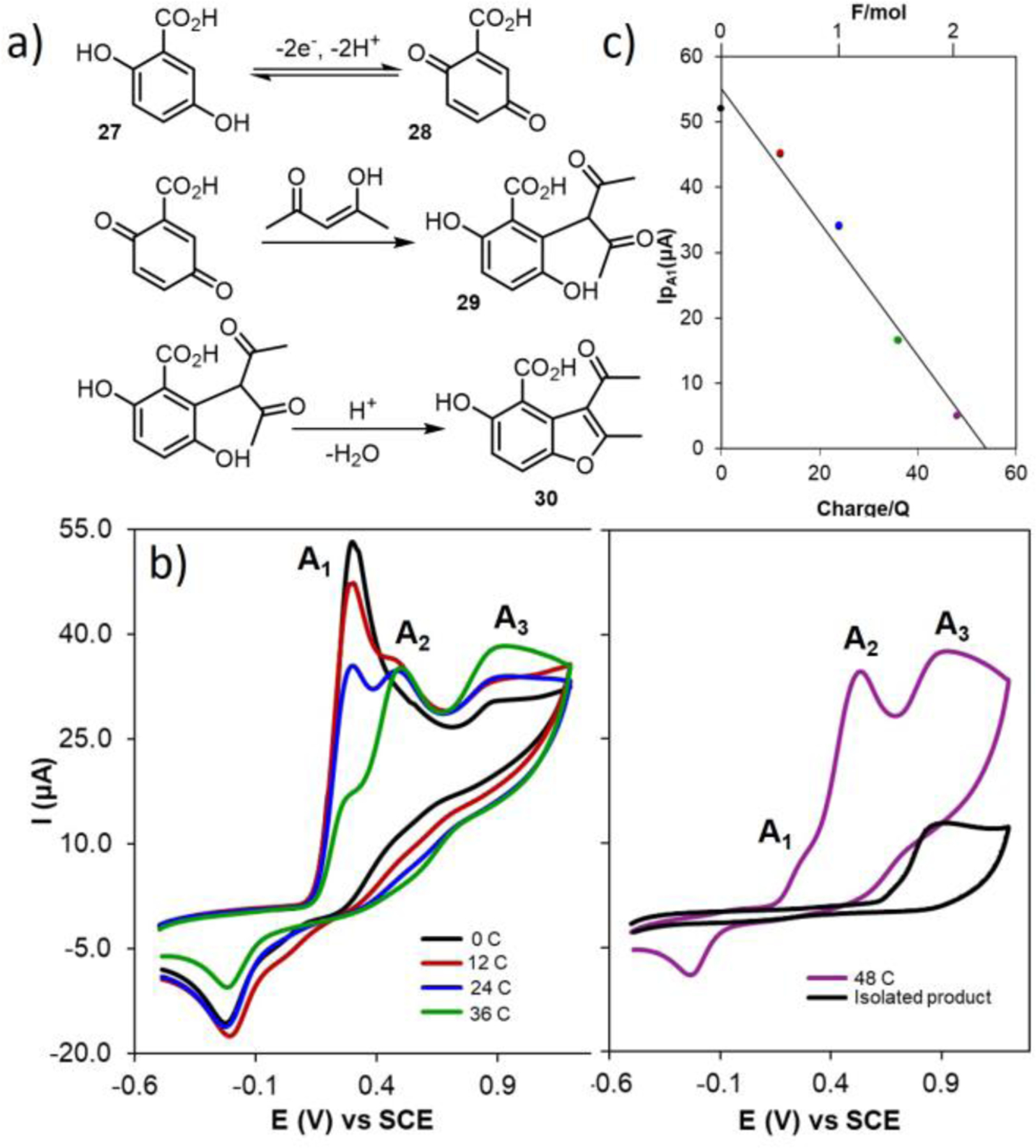
(a) General reaction scheme. (b) Cyclic voltammograms of 0.25 mmol 2,5-dihydroxybenzoic acid in the presence of 0.25 mmol acetylacetone in 0.2 M NaOAc solution at a glassy carbon electrode during controlled potential coulometry at 0.27 V versus SCE; after consumption of: 0 (black), 12 (red), 24 (blue), 36 (green), and 48 C (purple). Compared with the cyclic voltammogram of a saturated solution of final product 30 after separation and purification (black). (c) Variation of peak current Ip,o1 versus charge consumed. Scan rate 100 mV s−1. Reproduced from ref. with permission from the Royal Society of Chemistry, copyright 2005.
None
None
None
None

References

    1. Costentin C and Savéant JM, Proc. Natl. Acad. Sci. U. S. A, 2019, 166, 11147–11152. - PMC - PubMed
    1. Barek J and Zima J, Electroanalysis, 2003, 15, 467–472.
    1. McKenzie ECR, Hosseini S, Petro AGC, Rudman KK, Gerroll BHR, Mubarak MS, Baker LA and Little RD, Chem. Rev, 2022, 122, 3292–3335. - PubMed
    1. Sandford C, Edwards MA, Klunder KJ, Hickey DP, Li M, Barman K, Sigman MS, White HS and Minteer SD, Chem. Sci, 2019, 10, 6404–6422. - PMC - PubMed
    1. Jing Q and Moeller KD, Acc. Chem. Res, 2020, 53, 135–143. - PMC - PubMed

LinkOut - more resources