Review
. 2024 Dec;15(1):2289769.
doi: 10.1080/21505594.2023.2289769. Epub 2023 Dec 6.

Pathogenicity and virulence of Acinetobacter baumannii: Factors contributing to the fitness in healthcare settings and the infected host

Affiliations
Review

Pathogenicity and virulence of Acinetobacter baumannii: Factors contributing to the fitness in healthcare settings and the infected host

Massimiliano Lucidi et al. Virulence. 2024 Dec.

Abstract

Acinetobacter baumannii is a common cause of healthcare-associated infections and hospital outbreaks, particularly in intensive care units. Much of the success of A. baumannii relies on its genomic plasticity, which allows rapid adaptation to adversity and stress. The capacity to acquire novel antibiotic resistance determinants and the tolerance to stresses encountered in the hospital environment promote A. baumannii spread among patients and long-term contamination of the healthcare setting. This review explores virulence factors and physiological traits contributing to A. baumannii infection and adaptation to the hospital environment. Several cell-associated and secreted virulence factors involved in A. baumannii biofilm formation, cell adhesion, invasion, and persistence in the host, as well as resistance to xeric stress imposed by the healthcare settings, are illustrated to give reasons for the success of A. baumannii as a hospital pathogen.

Keywords: Acinetobacter baumannii; desiccation; metals uptake; secretion systems; tolerance; virulence factors.


Conflict of interest statement

No potential conflict of interest was reported by the author(s).

Figures
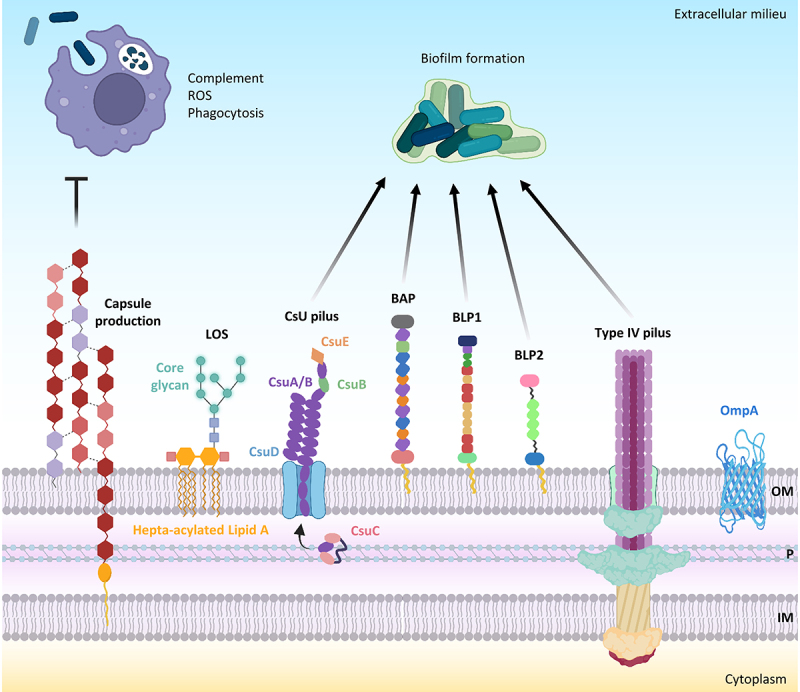
Figure 1.
Figure 1.
A. baumannii cell-associated virulence factors. negatively charged capsular polysaccharides hinder interactions with negatively charged surfaces of neutrophils and macrophages and protect against complement-mediated killing, peptidoglycan degradation by lysozyme, and ROS. Hepta-acylation of lipid A in LOS strengthens the outer membrane (OM) and protects A. baumannii from cationic antimicrobial peptides (CAMPs) and lysozyme. Csu pilus, BAP, BLP1, BLP2, and type IV pilus are the main proteins involved in biofilm formation. The OM protein A (OmpA) inhibits complement-mediated killing. Other abbreviations: P, periplasm; IM, inner membrane. Figure created with Biorender.
Figure 2.
Figure 2.
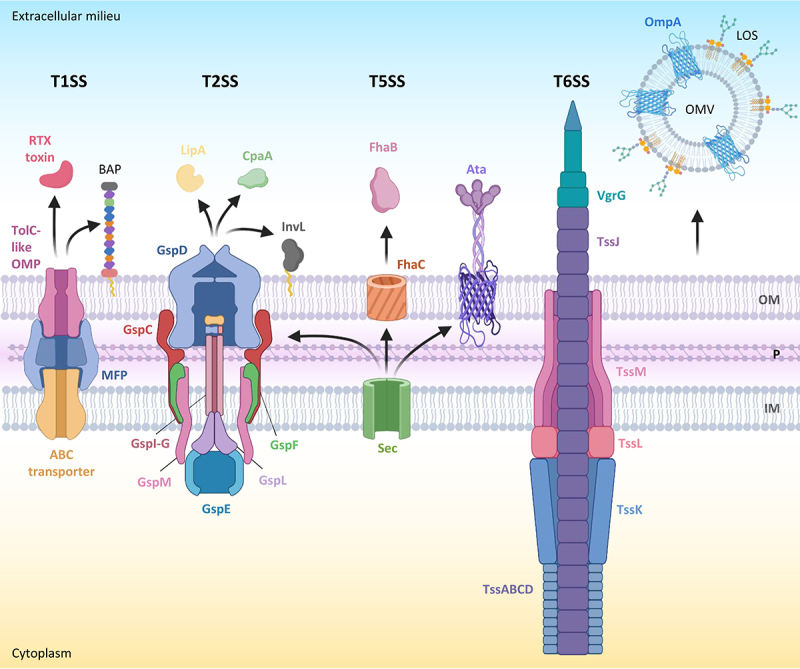
Secretion systems and released effector proteins associated with A. baumannii virulence. for each secretion system, the name of the main protein components is indicated. Outer membrane vesicles (OMVs) are also shown. LOS in the outer membrane (OM) is omitted. Other abbreviations: P, periplasm; IM, inner membrane. Proteins and protein subunits are not in scale. Figure created with Biorender.
Figure 3.
Figure 3.
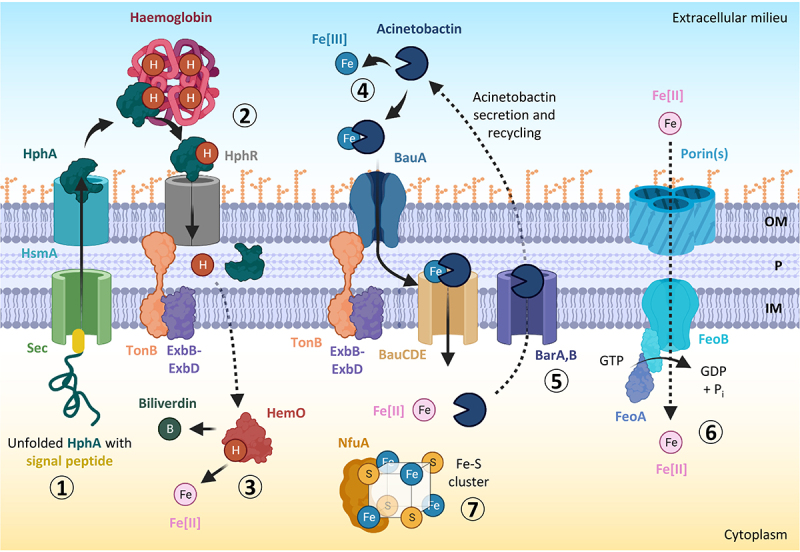
Iron acquisition, utilization, and storage mechanisms in A. baumannii. the haem scavenger HphA is translocated via the sec-dependent pathway and secreted outside the cell by the haemophilin secretion modulator HsmA (step 1). The haemophilin HphA delivers haem to its receptor, HphR, facilitating haem transport across the outer membrane by the concerted action of an inner membrane TonB complex (step 2). The enzyme HemO causes iron release from haem for use by the cell (step 3). The acinetobactin siderophore binds extracellular ferric iron (Fe[III]) with high affinity, and uses the BauA TonB-dependent outer membrane receptor and an inner membrane ATP-binding cassette (ABC) transporter composed of BauC, BauD, and BauE to deliver iron inside the cell (step 4). Acinetobactin can be recycled by the BarA/BarB siderophore secretion system (step 5). The GTP-dependent FeoAB system located in the cytoplasmic membrane is involved in the import of ferrous iron (Fe[II]) (step 6). NfuA is a cytoplasmic Fe-S cluster protein needed for intracellular iron storage and utilization (step 7). Abbreviations: OM, outer membrane; P, periplasm; IM, inner membrane. Figure created with Biorender.
Figure 4.
Figure 4.
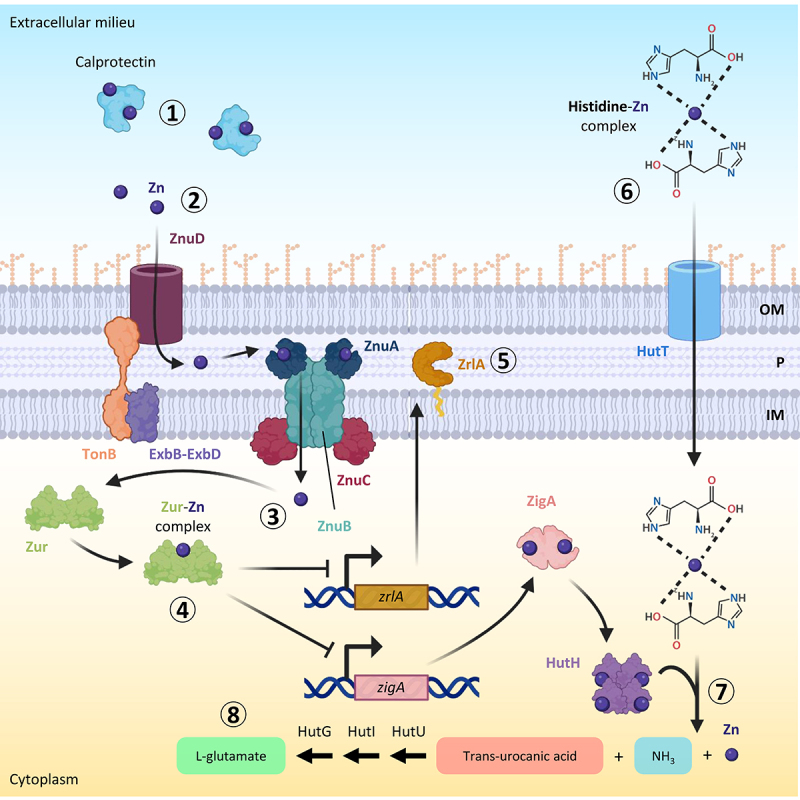
A. baumannii zinc uptake system and mechanism of in vivo zinc uptake. during infections, zinc is sequestered mainly by calprotectin (step 1). The A. baumannii TonB-dependent receptor ZnuD transports free zinc through the outer membrane (OM) (step 2). Once in the periplasm (P), zinc crosses the inner membrane (IM) and enters the cytoplasm through the ZnuABC system (step 3). Zur binds intracellular zinc and acts as a transcriptional repressor, modulating the expression of zinc-regulated genes, including zigA and zrlA (step 4). ZrlA is a putative peptidase involved in peptidoglycan remodelling and cell envelope integrity (step 5). The zinc-His complex can enter the cell through the HutT transporter (step 6). Once in the cytoplasm, this complex is cleaved into trans-urocanic acid, ammonia, and zinc by the Zn-dependent His ammonia-lyase HutH, activated by the metallochaperone ZigA with a still unknown mechanism (step 7). Trans-urocanic acid is eventually converted into L-glutamate by sequential reactions catalysed by HutU, HutI, and HutG (step 8). Figure created with Biorender.
Figure 5.
Figure 5.
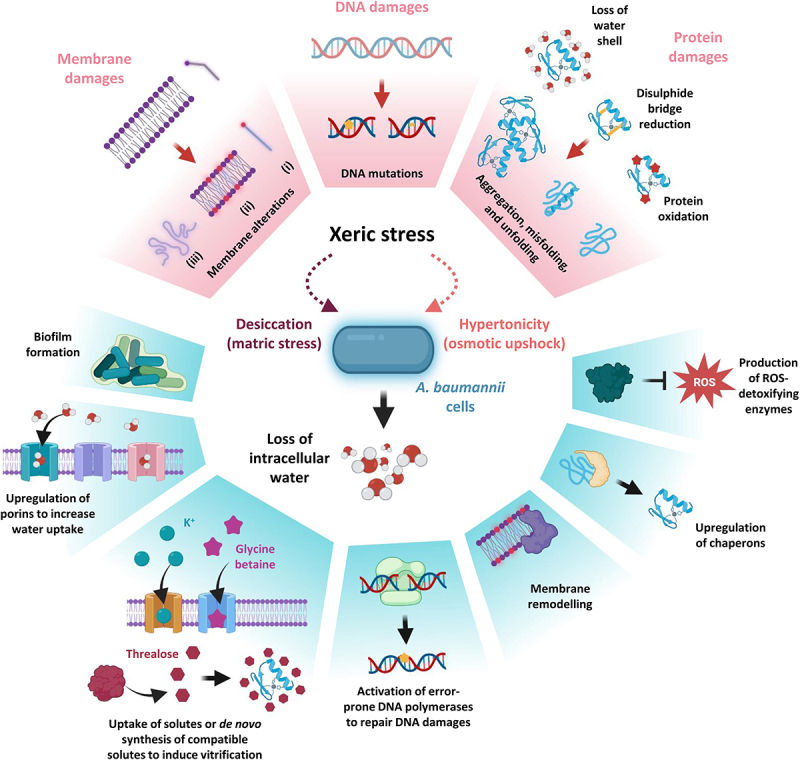
The effects of xeric stress on A. baumannii cells. The effects of xeric stress at the molecular level and A. baumannii responses are boxed in pink and cyan, respectively. During xeric stress, water loss causes lesions to membranes, DNA, and proteins (upper part of the figure). Among membrane damages, the saturation of aliphatic chains of phospholipids (i) results in the transition from a liquid crystalline to a gel phase (ii) causing membrane leakage and ruffling (iii). ROS increasing during dehydration causes DNA damage occurring through covalent modifications, single- and double-strand breaks, and cross-linking. ROS can induce the formation of disulphide bridges, Maillard reactions, and oxidation of proteins. Together with crowding and the removal of the hydration shell, damaged proteins can misfold, denature or lead to the formation of protein aggregates. The lower part of the figure shows the A. baumannii strategies to counteract the molecular damages caused by xeric stress (see text for details). Figure created with Biorender.
Figure 6.
Figure 6.
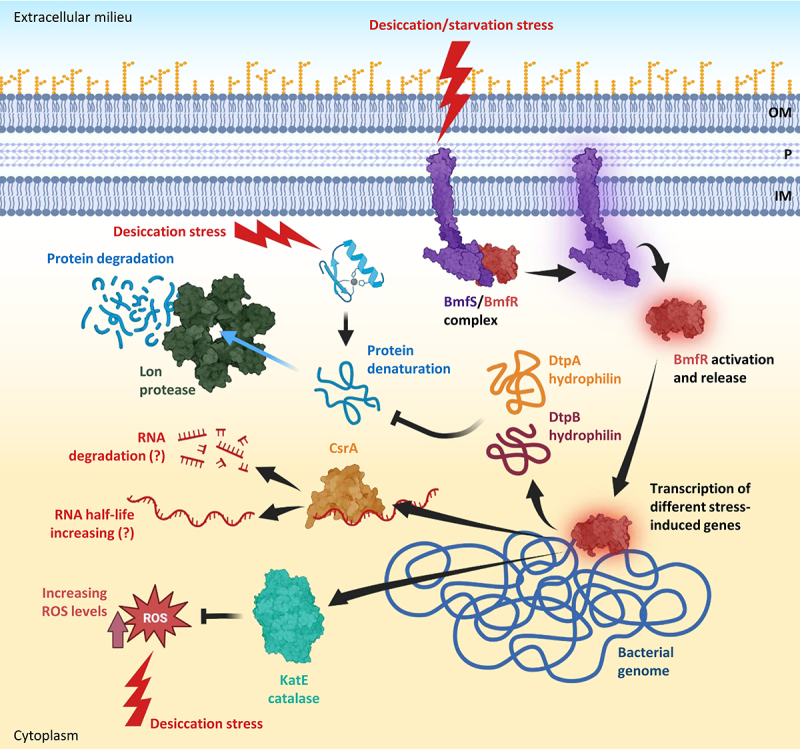
Molecular pathways induced by desiccation and starvation stresses in A. baumannii. desiccation and starvation stresses activate the two-component system BmfS/BmfR leading to the release of BmfR that acts as a transcriptional regulator. BmfR activates the expression of different genes, including those coding for the catalase KatE implicated in ROS detoxification, CsrA, an RNA-binding protein acting as a post-transcriptional regulator through modulation of the half-life of different mRnas, and the two hydrophilins DtpA and DtpB, acting as molecular chaperones that prevent protein denaturation. Denatured proteins that cannot be re-folded are degraded by the lon protease. Abbreviations: OM, outer membrane; P, periplasm; IM, inner membrane. Figure created with Biorender.

References

    1. Wong D, Nielsen TB, Bonomo RA, et al. Clinical and pathophysiological overview of Acinetobacter infections: a century of challenges. Clin Microbiol Rev. 2017;30(1):409–28. - PMC - PubMed
    1. Sarshar M, Behzadi P, Scribano D, et al. Acinetobacter baumannii: an ancient commensal with weapons of a pathogen. Pathogens. 2021;10(4):387. doi: 10.3390/pathogens10040387 - DOI - PMC - PubMed
    1. Whiteway C, Breine A, Philippe C, et al. Acinetobacter baumannii. Trends Microbiol. 2022;30(2):199–200. - PubMed
    1. Migliaccio A, Bray J, Intoccia M, et al. Phylogenomics of Acinetobacter species and analysis of antimicrobial resistance genes. Front Microbiol. 2023;14:1264030. doi: 10.3389/fmicb.2023.1264030 - DOI - PMC - PubMed
    1. AIDA Study Group, Dickstein Y, Lellouche J, Ben Dalak Amar M, et al. Treatment outcomes of colistin- and carbapenem-resistant Acinetobacter baumannii infections: an exploratory subgroup analysis of a randomized clinical trial. Clin Infect Dis. 2019;69(5):769–776. - PubMed

LinkOut - more resources